
Just wanted to touch base with everyone and apologize for not posting anything for the past week. I have not been idle, however.
Years ago I had what I thought was a great idea for a children's book. I have thought about it off and on ever since. Many times I thought to myself that I really should try to write this story. I have spent the last week doing just that. I know that a week isn't a very long time to write a book but, again, it is a children's book and not a novel. Also, like I said, I have been thinking about the story for years. Once I actually sat down at the keyboard it flowed pretty well. I wrote most of it in two days and spent the rest of the week tweaking it and editing for grammar, spelling, etc. I'm still not completely done but have gotten the story to a point where I think it is a pretty good first draft.
I have done more than just write it; however, I've actually sent the first draft to an illustrator. He thought my concept was a good one and has agreed to work with me on the project. I'm pretty excited by the whole thing.
Needless to say, the story does relate to the type of content I post on this site. I will update you all with more details as the project moves forward. In the meantime, there is more than enough going on out there to keep me busily writing for this site. I'll have something new posted within a day or two.
My best...
Tuesday, January 18, 2011

Wednesday, January 12, 2011
How Big Is The World Record Gar?
We Texans like to believe that everything is bigger and better here in the Lone Star State. While that is not always true, it does seem to be the case when the discussion turns to world-class alligator gar (Atractosteus spatula).
What got me thinking about big gar was a story I stumbled upon over at the "Fishing Fury" site. There is a short post about what was considered to be a potential new world record gar caught with a bow and arrow back in May of 2009. The post mentions that the big gar was caught by Johnny Morris, of Bass Pro Shops fame, with the help of the Garzilla guide service in a private lake near the Trinity River. The Garzilla Bowfishing Guide Service is listed as being physically located in Elkhart, Texas so I assume the big fish was taken somewhere in that general vicinity. According to both sites the fish went 8' 3" in length and weighed in at a whopping 230 lbs.
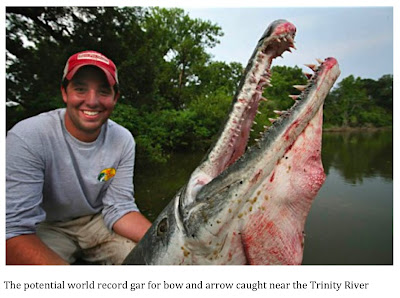
Alligator gar records are difficult and a bit confusing to research. Just give it a try and you'll see what I'm talking about. I found dozens of sites that listed the weight and/or measurements of THE world record alligator gar. There were nearly as many different lengths and weights listed as there were sites. It reminds me a bit of the way boxing has a half a dozen organizations that sanction champions in each weight class. I saw at least a half dozen listings for THE record fish. Some based the title on the length of the gar and some on the weight. I even found one site that listed the world record based on girth (that's a first). On top of all that confusion is the fact that there are different world records for fish caught on rod and reel, bow and arrow, and "other means", which basically means via trotline, jug line, or cane pole. You also have records for the largest gar caught by a senior citizen angler, the largest gar caught by a junior angler, and the largest gar caught in private waters. There certainly seems to have been a whole lot of "world record" alligator gar caught over the years. So, what's the deal? Was the alligator gar caught by Johnny Morris back in 2009 a new world record or not?

The one thing that nearly all of these "record" fish I came across had in common was that they were caught in Texas. That being the case, I decided to peruse the Texas Parks & Wildlife site to see what they had to say. The TP&W currently lists three fish as state records. The official record alligator gar taken on a rod and reel in Texas is a 279 lb. monster pulled from the Rio Grande River back in 1951 by Bill Valverde (no length was listed for this fish). The state record for an alligator gar taken with a bow and arrow is an 8' 0" long 290 lb. specimen taken in July of 2001 on the Trinity River by Marty McClellan. Finally, the recognized state record for an alligator gar taken by "other means" is an 8' 0" leviathan caught on a trotline back in January of 1953 by T.C. Pierce, Jr. that tipped the scales at 302 lbs. This beast was pulled from the Nueces River in South Texas. These were the officially recognized state records as of January 12, 2011.

It seems the gar taken by Johnny Morris is not recognized as the Texas state record much less the world record. Of course, the Texas Parks & Wildlife is recognizing state records based on weight not length. The Morris fish may well be recognized as the longest gar taken in Texas but, if so, the TP&W site does not mention it. I'm guessing this is why the original story escaped my notice. The fish might have been submitted for record consideration but came up short, or light, as the case may be.
So, which of these fish is recognized as the world record alligator gar? The answer may very well be none of them. In my previous research for other gar posts, I found a site that listed the world record alligator gar to be a fish taken from the Saint Francis River in Arkansas in the 1930s that weighed in at an astounding 350 lbs. Yet, even this monster might not be the real record. Take a look at the photo below. I have heard this fish was caught somewhere in Mississippi in the 1920's. I believe the photo to be genuine but don't know if the location or date of the catch listed is accurate.

To be honest, when it comes to which fish should truly be recognized as the world record alligator gar I am more confused than ever. What has become clear, however, is that Texas truly is the home of some of the largest freshwater fish in the world. So, if you are looking to haul in a world record alligator gar this is the place. Not only do we have the best fishery on the planet for these giants but there seems to be at least a half a dozen different ways for your gar to be recognized as THE world record.
How could you ask for more than that?
What got me thinking about big gar was a story I stumbled upon over at the "Fishing Fury" site. There is a short post about what was considered to be a potential new world record gar caught with a bow and arrow back in May of 2009. The post mentions that the big gar was caught by Johnny Morris, of Bass Pro Shops fame, with the help of the Garzilla guide service in a private lake near the Trinity River. The Garzilla Bowfishing Guide Service is listed as being physically located in Elkhart, Texas so I assume the big fish was taken somewhere in that general vicinity. According to both sites the fish went 8' 3" in length and weighed in at a whopping 230 lbs.

Alligator gar records are difficult and a bit confusing to research. Just give it a try and you'll see what I'm talking about. I found dozens of sites that listed the weight and/or measurements of THE world record alligator gar. There were nearly as many different lengths and weights listed as there were sites. It reminds me a bit of the way boxing has a half a dozen organizations that sanction champions in each weight class. I saw at least a half dozen listings for THE record fish. Some based the title on the length of the gar and some on the weight. I even found one site that listed the world record based on girth (that's a first). On top of all that confusion is the fact that there are different world records for fish caught on rod and reel, bow and arrow, and "other means", which basically means via trotline, jug line, or cane pole. You also have records for the largest gar caught by a senior citizen angler, the largest gar caught by a junior angler, and the largest gar caught in private waters. There certainly seems to have been a whole lot of "world record" alligator gar caught over the years. So, what's the deal? Was the alligator gar caught by Johnny Morris back in 2009 a new world record or not?

The one thing that nearly all of these "record" fish I came across had in common was that they were caught in Texas. That being the case, I decided to peruse the Texas Parks & Wildlife site to see what they had to say. The TP&W currently lists three fish as state records. The official record alligator gar taken on a rod and reel in Texas is a 279 lb. monster pulled from the Rio Grande River back in 1951 by Bill Valverde (no length was listed for this fish). The state record for an alligator gar taken with a bow and arrow is an 8' 0" long 290 lb. specimen taken in July of 2001 on the Trinity River by Marty McClellan. Finally, the recognized state record for an alligator gar taken by "other means" is an 8' 0" leviathan caught on a trotline back in January of 1953 by T.C. Pierce, Jr. that tipped the scales at 302 lbs. This beast was pulled from the Nueces River in South Texas. These were the officially recognized state records as of January 12, 2011.

It seems the gar taken by Johnny Morris is not recognized as the Texas state record much less the world record. Of course, the Texas Parks & Wildlife is recognizing state records based on weight not length. The Morris fish may well be recognized as the longest gar taken in Texas but, if so, the TP&W site does not mention it. I'm guessing this is why the original story escaped my notice. The fish might have been submitted for record consideration but came up short, or light, as the case may be.
So, which of these fish is recognized as the world record alligator gar? The answer may very well be none of them. In my previous research for other gar posts, I found a site that listed the world record alligator gar to be a fish taken from the Saint Francis River in Arkansas in the 1930s that weighed in at an astounding 350 lbs. Yet, even this monster might not be the real record. Take a look at the photo below. I have heard this fish was caught somewhere in Mississippi in the 1920's. I believe the photo to be genuine but don't know if the location or date of the catch listed is accurate.

To be honest, when it comes to which fish should truly be recognized as the world record alligator gar I am more confused than ever. What has become clear, however, is that Texas truly is the home of some of the largest freshwater fish in the world. So, if you are looking to haul in a world record alligator gar this is the place. Not only do we have the best fishery on the planet for these giants but there seems to be at least a half a dozen different ways for your gar to be recognized as THE world record.
How could you ask for more than that?
Monday, January 10, 2011
California Thylacine?: Addendum
Bill Warren, the gentleman who purchased what may be the pelt of the ostensibly extinct thylacine (Thylacinus cynocephalus) has sent a brief response to the article, written by TBRC Chairman Alton Higgins, entitled "California Thylacine?" and posted here on this site back on November 22, 2010.

You can access the article here or just hit the "guest blogger" label in the right margin to review the original post. In the article, Higgins posits that the pelt Mr. Warren has purchased is actually that of a zebra duiker (Cephalophus zebra), a small (9-20 kg) antelope that lives in the dense forests of West Africa. The zebra duiker is a spectacularly colored and marked animal and is listed as endangered. Alton did a very nice job of comparing the available photos of Mr. Warren's pelt to those of photos of zebra duikers as well as to known photos of thylacines.

Higgins, while not completely ruling out that the pelt is thylacine in origin, came to the conclusion that the skin is most likely that of the zebra duiker. He wasn't alone in reaching that conclusion. A gentleman identifying himself as a Col. Bailey from Tasmania wrote in and said, "You are so right. This is indeed the pelt of the Zebra duiker from Sierre Leone. The striking similarity to the thylacine pelt has previously lead many astray." This Col. Bailey claimed to have been involved in the analysis of the Emmerich photos, alleged to be of a thylacine, as well. To be fair, I have no idea if this gentleman is who he claims to be as this message was left as a comment to the original article. So take it for what it is.
A gentleman identifying himself as Bill Warren left the following comment today: "I am Bill Warren and I have written reports from various experts on the Tasmanian tiger and they agree my skin is a Tasmanian Tiger. The stripes on my skin are shorter than a duiker. My skin is much longer. My skin is soft when you run your hand against the grain." Again, to be consistent, I have no idea if this is in fact the real Bill Warren. I have reason to doubt it is not either so, again, take it for what it is. I replied, as you can see in the comments section below the original post, that I hope he is right and the pelt is that of a thylacine. I did ask if he had made the skin available for DNA testing and if any museums or universities had stepped up to help make this happen.

Mr. Warren, if you are reading this, I would like to say again that I, and I think I can safely speak for Alton Higgins as well, hope you did find the skin of a thylacine. It would be a spectacular find. The points you mention about the pelt being larger than a duiker, the stripes being shorter than those of a duiker, and the texture being different could all be valid but, obviously, you have the advantage as neither I, nor Mr. Higgins, have had the opportunity to inspect the pelt in person. Higgin's assessment of the pelt was made on comparison of photographs only. I would be glad to publish some or all of the written reports you possess from scientists who have examined the pelt. It could go a long way toward removing the doubts that persist out there.

You can access the article here or just hit the "guest blogger" label in the right margin to review the original post. In the article, Higgins posits that the pelt Mr. Warren has purchased is actually that of a zebra duiker (Cephalophus zebra), a small (9-20 kg) antelope that lives in the dense forests of West Africa. The zebra duiker is a spectacularly colored and marked animal and is listed as endangered. Alton did a very nice job of comparing the available photos of Mr. Warren's pelt to those of photos of zebra duikers as well as to known photos of thylacines.

Higgins, while not completely ruling out that the pelt is thylacine in origin, came to the conclusion that the skin is most likely that of the zebra duiker. He wasn't alone in reaching that conclusion. A gentleman identifying himself as a Col. Bailey from Tasmania wrote in and said, "You are so right. This is indeed the pelt of the Zebra duiker from Sierre Leone. The striking similarity to the thylacine pelt has previously lead many astray." This Col. Bailey claimed to have been involved in the analysis of the Emmerich photos, alleged to be of a thylacine, as well. To be fair, I have no idea if this gentleman is who he claims to be as this message was left as a comment to the original article. So take it for what it is.
A gentleman identifying himself as Bill Warren left the following comment today: "I am Bill Warren and I have written reports from various experts on the Tasmanian tiger and they agree my skin is a Tasmanian Tiger. The stripes on my skin are shorter than a duiker. My skin is much longer. My skin is soft when you run your hand against the grain." Again, to be consistent, I have no idea if this is in fact the real Bill Warren. I have reason to doubt it is not either so, again, take it for what it is. I replied, as you can see in the comments section below the original post, that I hope he is right and the pelt is that of a thylacine. I did ask if he had made the skin available for DNA testing and if any museums or universities had stepped up to help make this happen.

Mr. Warren, if you are reading this, I would like to say again that I, and I think I can safely speak for Alton Higgins as well, hope you did find the skin of a thylacine. It would be a spectacular find. The points you mention about the pelt being larger than a duiker, the stripes being shorter than those of a duiker, and the texture being different could all be valid but, obviously, you have the advantage as neither I, nor Mr. Higgins, have had the opportunity to inspect the pelt in person. Higgin's assessment of the pelt was made on comparison of photographs only. I would be glad to publish some or all of the written reports you possess from scientists who have examined the pelt. It could go a long way toward removing the doubts that persist out there.
Sunday, January 9, 2011
Chinese Wisdom
"What is the smartest animal? The one you cannot find."
- Chinese Proverb
I actually don't know if this is an old Chinese proverb or not. This quote was part of an email I received through the TBRC website. I thought there was much wisdom in it. I hope you agree.
My best...
- Chinese Proverb
I actually don't know if this is an old Chinese proverb or not. This quote was part of an email I received through the TBRC website. I thought there was much wisdom in it. I hope you agree.
My best...
Thursday, January 6, 2011
The Cougar of Sierra Blanca
The picture below was sent to me by a reader who, noting the unusually dark color of the cougar, wondered if it, and others like it, might not be responsible for black panther sightings in Texas and other areas of the country.

According to what I've read, this cougar was taken in far west Texas near Sierra Blanca. Sierra Blanca sits in the Trans-Pecos region of the Lone Star State in Hudspeth County (see graphic below). This is an area of the state which is recognized by the Texas Parks & Wildlife Department as having a breeding mountain lion population. That being the case, a mountain lion in the area is not out of place. The coloration of the lion, though, makes it a somewhat unusual specimen.

The animal in the photo is unusually dark for a cougar but far from the dark black color reported by witnesses who claim to have seen a black panther. Having said that, I can see where a dark cougar, like this one, could easily be misidentified as being black in color at night or low-light conditions.

I don't feel this cat satisfactorily explains black panther sightings across the state. Cougars as dark as this one are rare to be sure as this is only the second photo I've come across of one this dark; however, these cats go through phases when their coats are thicker or thinner depending on the time of year. No doubt, this affects coloration. Still, this cat is unusually dark. Since this coloration, seemingly, is seen only sporadically it can't be the basis for all black panther sightings; many of which that have occurred in broad daylight. In addition to that, this cat's coloration is still far lighter than the truly melanistic cats described by many witnesses.

The question that may need to be asked is this; if cougars can get as dark as the individual animal in the photo above could they get darker still? If so, then the black panthers of Texas might not be an impossibility after all.

According to what I've read, this cougar was taken in far west Texas near Sierra Blanca. Sierra Blanca sits in the Trans-Pecos region of the Lone Star State in Hudspeth County (see graphic below). This is an area of the state which is recognized by the Texas Parks & Wildlife Department as having a breeding mountain lion population. That being the case, a mountain lion in the area is not out of place. The coloration of the lion, though, makes it a somewhat unusual specimen.

The animal in the photo is unusually dark for a cougar but far from the dark black color reported by witnesses who claim to have seen a black panther. Having said that, I can see where a dark cougar, like this one, could easily be misidentified as being black in color at night or low-light conditions.

I don't feel this cat satisfactorily explains black panther sightings across the state. Cougars as dark as this one are rare to be sure as this is only the second photo I've come across of one this dark; however, these cats go through phases when their coats are thicker or thinner depending on the time of year. No doubt, this affects coloration. Still, this cat is unusually dark. Since this coloration, seemingly, is seen only sporadically it can't be the basis for all black panther sightings; many of which that have occurred in broad daylight. In addition to that, this cat's coloration is still far lighter than the truly melanistic cats described by many witnesses.

The question that may need to be asked is this; if cougars can get as dark as the individual animal in the photo above could they get darker still? If so, then the black panthers of Texas might not be an impossibility after all.
Wednesday, January 5, 2011
The Lake Nasworthy "Monster"
Ok, I admit that title is a bit sensational but early last month a news report out of San Angelo caught my eye. The report, written by Michael Price and published in the San Angelo Standard-Times details an incident involving the "Lake Nasworthy Monster." This "monster" has been described as a large reptile roughly six feet long cruising the depths, and occasionally the shallows, of Lake Nasworthy.
Lake Nasworthy is a small municipal lake located in San Angelo. The lake is named for John R. Nasworthy who sold the land the lake is located on to the city. The lake was built back in 1930 by the Texas Utilities Company to provide water for the city of San Angelo. The lake is small encompassing only 1,380 acres and is a mere 29 feet deep at its deepest point. It hardly seems a likely location for a monster. Even so, reports of a large animal in the lake have persisted for at least a decade.

Mr. Price, who is the Executive Director of the San Angelo Nature Center, stated in his piece, "Before my hobby of herpetoculture brought me to the Nature Center this decade, I had heard rumors of an enormous (always at least 6 feet long) reptile that would patrol the depths of Lake Nasworthy." He added, "This tall tale has been brought to my attention at the Nature Center a few times but never as seriously or as dangerously as this past week."

It seems two San Angelo police officers visited the Nature Center, which sits on the eastern shore of Lake Nasworthy, to see if all of their alligators were present and accounted for. A concerned citizen had reported that he had shot at a large creature in the lake and was worried about the safety of the people of San Angelo.
Mr. Price pretty much dismisses the possibility of an alligator, be it an out of place wild one or an escaped pet, outright. Instead, he theorizes the person who reported the sighting actually had seen a large flathead, or yellow, catfish (Pylodictis olivaris) or a longnose gar (Lepisosteus osseus). Both species can reach lengths of 4-5 feet and are present in Lake Nasworthy. Mr. Price also suggests the possibility the report is an outright hoax.

Who knows what, if anything, was actually seen in Lake Nasworthy on this particular occasion? The fact is, however, that reports of something big in the lake have persisted for a decade or so. This leads me to believe that something big does, or did, live in the lake. I'm not suggesting there is a "monster" in the lake by any means; however, I do think dismissing an alligator as a possibility might not be wise. It is true that San Angelo is outside recognized alligator habitat. So is Cross Plains, Texas but an alligator was killed there back in August of 2009. You can read that account here. The Cross Plains alligator had made a home in a stock tank on the property of one Dick Vestal. Vestal speculated that his reptilian squatter had been a pet that grew too large and dangerous for it's owner and had been released somewhere near his property. Whether the Cross Plains gator was wild or a released pet is irrelevant. The point is, wild or not, an alligator was making a home for itself in a stock tank in West Texas. Is a similar scenario impossible in San Angelo? I don't think so.

I'm not suggesting the citizens of San Angelo should be afraid to enter the waters of Lake Nasworthy. I do think simply dismissing the possibility of the "Lake Nasworthy Monster" being an out of place alligator could be a mistake. You just never know. Many stranger things have happened.

What swims in the waters of Lake Nasworthy? Probably nothing unusual or exotic; however, if you live in the area and frequent the lake it might not be a bad idea to keep a camera handy. After all, you just never know.
Lake Nasworthy is a small municipal lake located in San Angelo. The lake is named for John R. Nasworthy who sold the land the lake is located on to the city. The lake was built back in 1930 by the Texas Utilities Company to provide water for the city of San Angelo. The lake is small encompassing only 1,380 acres and is a mere 29 feet deep at its deepest point. It hardly seems a likely location for a monster. Even so, reports of a large animal in the lake have persisted for at least a decade.

Mr. Price, who is the Executive Director of the San Angelo Nature Center, stated in his piece, "Before my hobby of herpetoculture brought me to the Nature Center this decade, I had heard rumors of an enormous (always at least 6 feet long) reptile that would patrol the depths of Lake Nasworthy." He added, "This tall tale has been brought to my attention at the Nature Center a few times but never as seriously or as dangerously as this past week."

It seems two San Angelo police officers visited the Nature Center, which sits on the eastern shore of Lake Nasworthy, to see if all of their alligators were present and accounted for. A concerned citizen had reported that he had shot at a large creature in the lake and was worried about the safety of the people of San Angelo.
Mr. Price pretty much dismisses the possibility of an alligator, be it an out of place wild one or an escaped pet, outright. Instead, he theorizes the person who reported the sighting actually had seen a large flathead, or yellow, catfish (Pylodictis olivaris) or a longnose gar (Lepisosteus osseus). Both species can reach lengths of 4-5 feet and are present in Lake Nasworthy. Mr. Price also suggests the possibility the report is an outright hoax.

Who knows what, if anything, was actually seen in Lake Nasworthy on this particular occasion? The fact is, however, that reports of something big in the lake have persisted for a decade or so. This leads me to believe that something big does, or did, live in the lake. I'm not suggesting there is a "monster" in the lake by any means; however, I do think dismissing an alligator as a possibility might not be wise. It is true that San Angelo is outside recognized alligator habitat. So is Cross Plains, Texas but an alligator was killed there back in August of 2009. You can read that account here. The Cross Plains alligator had made a home in a stock tank on the property of one Dick Vestal. Vestal speculated that his reptilian squatter had been a pet that grew too large and dangerous for it's owner and had been released somewhere near his property. Whether the Cross Plains gator was wild or a released pet is irrelevant. The point is, wild or not, an alligator was making a home for itself in a stock tank in West Texas. Is a similar scenario impossible in San Angelo? I don't think so.

I'm not suggesting the citizens of San Angelo should be afraid to enter the waters of Lake Nasworthy. I do think simply dismissing the possibility of the "Lake Nasworthy Monster" being an out of place alligator could be a mistake. You just never know. Many stranger things have happened.

What swims in the waters of Lake Nasworthy? Probably nothing unusual or exotic; however, if you live in the area and frequent the lake it might not be a bad idea to keep a camera handy. After all, you just never know.
Monday, January 3, 2011
Back To Work
I hope that everyone had a restful and peaceful holiday. I pretty much stepped away from everything and just recharged. I kept my eye on things and have several topics I would like to address but nothing too earth shattering seemed to take place during my short hiatus.
I have been biding my time a bit and waiting for deer season to close. I want to get a few game cameras out into some areas of interest in East Texas. I am not a fan of being accidentally shot by some hunter so I have waited. Also, with increased human activity in some of these areas there is a greater chance of having one of the cameras vandalized or stolen. The season ended in most regions of the state yesterday so the plan is to get out to the areas I'm interested in shortly. I am going to specifically dedicate one camera to the pursuit of a big cat photo. I would love to show cougars are indeed making a comeback and, of course, getting a black panther photo would be the ultimate reward.
While hunting season puts a bit of a crimp in my camera trapping it does tend to bring more sighting reports into the TBRC. This is always interesting and I hope this trend continues this year.
Also, I have been sitting on a photo for a long time that I have almost worked my nerve up enough to share on this site. Don't get too excited. It is a classic blob squatch in most ways. It is far from definitive and whatever the photo shows is partially obscured by a tree. Unlike most such shots, however, it is in focus. What you can see is pretty clear. I am going to attempt to enlarge the photo a bit in order to get more clarity before I post it. Like I said, don't get too excited. It is not the shot we've all been waiting for. It is what it is but I figure there are people that might like to see it...and, yes, I took the photo myself.
Here's to hoping that 2011 yields some interesting photos and evidence supporting the existence of some of the mystery animals of Texas.
Onward...
I have been biding my time a bit and waiting for deer season to close. I want to get a few game cameras out into some areas of interest in East Texas. I am not a fan of being accidentally shot by some hunter so I have waited. Also, with increased human activity in some of these areas there is a greater chance of having one of the cameras vandalized or stolen. The season ended in most regions of the state yesterday so the plan is to get out to the areas I'm interested in shortly. I am going to specifically dedicate one camera to the pursuit of a big cat photo. I would love to show cougars are indeed making a comeback and, of course, getting a black panther photo would be the ultimate reward.
While hunting season puts a bit of a crimp in my camera trapping it does tend to bring more sighting reports into the TBRC. This is always interesting and I hope this trend continues this year.
Also, I have been sitting on a photo for a long time that I have almost worked my nerve up enough to share on this site. Don't get too excited. It is a classic blob squatch in most ways. It is far from definitive and whatever the photo shows is partially obscured by a tree. Unlike most such shots, however, it is in focus. What you can see is pretty clear. I am going to attempt to enlarge the photo a bit in order to get more clarity before I post it. Like I said, don't get too excited. It is not the shot we've all been waiting for. It is what it is but I figure there are people that might like to see it...and, yes, I took the photo myself.
Here's to hoping that 2011 yields some interesting photos and evidence supporting the existence of some of the mystery animals of Texas.
Onward...
Subscribe to:
Posts (Atom)


 Posts
Posts

