KWTX, a CBS affiliate in Central Texas is reporting that a Dallas area man has been hospitalized as the result of an attack by bees. The story is brief so I will post it in its entirety below.
Bee Attack Sends Central Texas Man To The Hospital
DALLAS (October 8, 2014) A man who was attacked by a swarm of bees while mowing near a self-storage facility in Hearne was flown to a hospital in Bryan.
The bees attacked the man late Tuesday morning, authorities said.
Firefighters were able to get the bees away by hosing the man down with soap and water.
Authorities diverted traffic away from the area for about an hour-and-a-half.
The self-storage facility and a nearby abandoned hotel were roped off until beekeepers were called in.
As a precaution, school officials kept students indoors for the rest of the day.
Obviously, the report is short on details and there is no mention of the condition of the victim. There is no word yet on whether the bees involved in the attack were of the Africanized variety, commonly referred to as killer bees, but it seems a safe bet.
The theme of someone out mowing and being attacked is a common one when it comes to bee attacks. On August 26, 2013, a Waco man was taken to a local hospital after being stung dozens of times by bees that he accidentally disturbed while mowing his lawn. The bees responsible for this attack were identified as normal honey bees initially, but other officials felt that designation was premature. To my knowledge, though some officials felt the bees were of the Africanized variety, the label was never changed.
In June of 2013, a Moody, Texas man was attacked and killed by a swarm of Africanized bees as he drove his tractor by an abandoned chicken coop on his property. Larry Goodwin was stung more than 1,000 times and died at the scene. His wife and daughter witnessed the attack and rushed to try and help. They were each stung more than 100 times but survived the onslaught.
In July of 2012, a swarm of killer bees attacked and killed two horses and seriously injured two adults near Pantego, Texas. According to the owner, her two horses were “so covered in bees that they shimmered,” before they were overcome and collapsed. The owner and her boyfriend were stung upwards of 200 times while trying to save the horses.
There are other incidents involving Africanized bees ranging from the Rio Grande Valley to north of the Red River but you get the idea.
As dangerous as Africanized bees can be, it is important for us not to overreact to their growing presence. Bee populations all over the world have dropped dramatically over the last two decades. Nobody seems quite sure why. Bees perform critical pollination, without which, agriculture would suffer terribly. As a result, we can’t go around and simply wipe out every beehive we come across. As always, use good sense and caution when out and about and realize that bees could be on or near your property. Pay attention and be aware of your surroundings. When a hive is located be sure to call in an expert to examine it. If it is a common honeybee hive it can likely be relocated and won’t need to be destroyed. If it is determined that the hive houses Africanized bees then it will be dealt with by the pros and, hopefully, nobody will get hurt.
Be careful out there.
Showing posts with label Bugs/Insects. Show all posts
Thursday, October 9, 2014
Thursday, August 29, 2013
Africanized "Killer" Bees A Growing Problem in Texas
I remember being very worried about only two things as a 10-12 year old boy. The first was the belief that we would all be switching over to the metric system and I would have to relearn all things related to measurement. The second thing that preyed upon my young mind was the impending and inevitable arrival of Africanized “killer” bees. Producer/director, and master of the disaster movie, Irwin Allen chronicled the coming bee apocalypse that would soon be upon us in the United States in the 1978 movie The Swarm. While tame by today’s standards, the movie made quite an impression on me. I paid close attention to any killer bee news stories on television or in the newspapers after seeing it. As time went on I realized that my fears had been unfounded. We were not converting to the metric system and the bees were not coming to kill us all. We were safe.
Maybe I was wrong.
While not nearly as dramatic as the huge swarming menace depicted by Irwin Allen in his film, and almost 40 years later than predicted, Africanized bees have arrived in Texas and they are causing problems. As a matter of fact, they are practically in my own back yard. The danger was highlighted by a couple of incidents here in Central Texas over the last couple of months.
On Monday, August 26, a Waco man was taken to a local hospital after being stung dozens of times by bees he accidentally disturbed while mowing his lawn. The man will recover and authorities dispatched a beekeeper that found the hive about 30 feet off the ground in a large tree. The beekeeper destroyed the nest. Authorities said the attackers were identified as regular honeybees and could not say why they reacted so violently. I’ve since heard rumors that this identification might have been premature but have not seen anything official.
While the identity of the attacking bees in the Waco attack may still be up in the air, there is no doubt as to what type of bees attacked and killed a Moody man back in June. Larry Goodwin was riding on his tractor when he came across a hive of Africanized bees in an old chicken coop. Their attack was swift and merciless. Goodwin was stung more than 1,000 times and died at the scene. His wife and daughter, who rushed to his aid, were each stung about 100 times each. Local beekeeper Allen Miller was called in to remove the hive and said he’s seen more Africanized bee hives in the past few weeks than he normally sees in a year.
In July of this past summer a swarm of killer bees attacked and killed two horses and severely injured two adults near Pantego, TX. According to the owner, her two horses were, “so covered in bees that they shimmered,” before they were overcome and collapsed. The owner and her boyfriend were stung upwards of 200 times when they tried to intervene and help the horses. Pantego is in Tarrant County near Arlington.
There are other, less recent, attacks, too. They range from the south Texas Rio Grande Valley to north Texas along the Red River. The killer bees are not getting the press that they used to; I guess the media squeezed every last bit of mileage from this topic years ago. Don’t let that fool you though as the Africanized bee is here to stay.
Killer bees are actually hybrids produced by the cross breeding of African honeybees and various Western honeybee species. It is thought that Africanized bees in the Western Hemisphere are the direct descendents of Tanganyikan queen bees that were accidentally released by a replacement beekeeper in Brazil back in 1957. The Africanized bees are much more aggressive and tend to drive out and overrun native bee species. The Africanized bees are now actually the dominant type of honeybee used for beekeeping in Central and South America. They are prolific in this regard* but this is often offset by the fact that collection of honey is made much more difficult by the super aggressive nature of these bees.
While it is all but impossible to visually tell the difference between a western honeybee and an Africanized bee, there are some very large differences between the two species. Africanized bees:
- Tend to swarm more frequently and fly farther than other types of bees.
- They are more likely to migrate seasonably in response to poor food supply.
- They are more likely to “abscond”- the entire colony leaves and relocates in response to stress.
- They are more defensive when in “resting swarm” than other honeybees.
- Live in ground cavities more often than other honeybees.
- Guard their hives more aggressively than other types of bees and have a larger “alarm zone” around the hive.
- Have more guard bees in their population compared to other species.
- Deploy in greater numbers for defense and pursues much longer than other species of bee.
Africanized bees have spread from Central America and into the American Southwest and South. By 2002, they had been found in California, Arizona, New Mexico, Texas, Louisiana, and Arkansas. Recent events seem to indicate the bees continue to spread. In 2010, a 73-year–old man was killed by Africanized bees while clearing brush on his property in southern Georgia. In 2012, beekeepers located a hive of killer bees in Monroe County, Tennessee. It has long been assumed that Africanized bees would likely become a hazard in southern states but not spread too far north because they can’t tolerate the cold winters. That is being questioned now as, much like another invasive, the Burmese python, the bees are proving to be more cold tolerant than anyone would have ever guessed.
As dangerous as Africanized bees can be, it is important for us not to overreact to their growing presence. Bee populations all over the world have dropped dramatically over the last two decades. Nobody seems quite sure why. Bees perform critical pollination, without which, agriculture would suffer terribly. As a result, we can’t go around and simply wipe out every beehive we come across. As always, use good sense and caution when out and about and realize that bees could be on or near your property. Pay attention and be aware of your surroundings. When a hive is located be sure to call in an expert to examine it. If it is a common honeybee hive it can likely be relocated and won’t need to be destroyed. If it is determined that the hive houses Africanized bees then it will be dealt with by the pros and, hopefully, nobody will get hurt.
It turns out that my childhood fear of killer bees was not completely unfounded after all. I just hope that the metric system doesn’t make a comeback, too.
*I've actually seen conflicting reports about how prolific Africanized bees are when it comes to making honey. Some sources I've come across state they don't make much wax or honey while others say the opposite. I would welcome being enlightened by someone with more knowledge on this subject.
Maybe I was wrong.
While not nearly as dramatic as the huge swarming menace depicted by Irwin Allen in his film, and almost 40 years later than predicted, Africanized bees have arrived in Texas and they are causing problems. As a matter of fact, they are practically in my own back yard. The danger was highlighted by a couple of incidents here in Central Texas over the last couple of months.
On Monday, August 26, a Waco man was taken to a local hospital after being stung dozens of times by bees he accidentally disturbed while mowing his lawn. The man will recover and authorities dispatched a beekeeper that found the hive about 30 feet off the ground in a large tree. The beekeeper destroyed the nest. Authorities said the attackers were identified as regular honeybees and could not say why they reacted so violently. I’ve since heard rumors that this identification might have been premature but have not seen anything official.
While the identity of the attacking bees in the Waco attack may still be up in the air, there is no doubt as to what type of bees attacked and killed a Moody man back in June. Larry Goodwin was riding on his tractor when he came across a hive of Africanized bees in an old chicken coop. Their attack was swift and merciless. Goodwin was stung more than 1,000 times and died at the scene. His wife and daughter, who rushed to his aid, were each stung about 100 times each. Local beekeeper Allen Miller was called in to remove the hive and said he’s seen more Africanized bee hives in the past few weeks than he normally sees in a year.
In July of this past summer a swarm of killer bees attacked and killed two horses and severely injured two adults near Pantego, TX. According to the owner, her two horses were, “so covered in bees that they shimmered,” before they were overcome and collapsed. The owner and her boyfriend were stung upwards of 200 times when they tried to intervene and help the horses. Pantego is in Tarrant County near Arlington.
There are other, less recent, attacks, too. They range from the south Texas Rio Grande Valley to north Texas along the Red River. The killer bees are not getting the press that they used to; I guess the media squeezed every last bit of mileage from this topic years ago. Don’t let that fool you though as the Africanized bee is here to stay.
Killer bees are actually hybrids produced by the cross breeding of African honeybees and various Western honeybee species. It is thought that Africanized bees in the Western Hemisphere are the direct descendents of Tanganyikan queen bees that were accidentally released by a replacement beekeeper in Brazil back in 1957. The Africanized bees are much more aggressive and tend to drive out and overrun native bee species. The Africanized bees are now actually the dominant type of honeybee used for beekeeping in Central and South America. They are prolific in this regard* but this is often offset by the fact that collection of honey is made much more difficult by the super aggressive nature of these bees.
While it is all but impossible to visually tell the difference between a western honeybee and an Africanized bee, there are some very large differences between the two species. Africanized bees:
- Tend to swarm more frequently and fly farther than other types of bees.
- They are more likely to migrate seasonably in response to poor food supply.
- They are more likely to “abscond”- the entire colony leaves and relocates in response to stress.
- They are more defensive when in “resting swarm” than other honeybees.
- Live in ground cavities more often than other honeybees.
- Guard their hives more aggressively than other types of bees and have a larger “alarm zone” around the hive.
- Have more guard bees in their population compared to other species.
- Deploy in greater numbers for defense and pursues much longer than other species of bee.
Africanized bees have spread from Central America and into the American Southwest and South. By 2002, they had been found in California, Arizona, New Mexico, Texas, Louisiana, and Arkansas. Recent events seem to indicate the bees continue to spread. In 2010, a 73-year–old man was killed by Africanized bees while clearing brush on his property in southern Georgia. In 2012, beekeepers located a hive of killer bees in Monroe County, Tennessee. It has long been assumed that Africanized bees would likely become a hazard in southern states but not spread too far north because they can’t tolerate the cold winters. That is being questioned now as, much like another invasive, the Burmese python, the bees are proving to be more cold tolerant than anyone would have ever guessed.
As dangerous as Africanized bees can be, it is important for us not to overreact to their growing presence. Bee populations all over the world have dropped dramatically over the last two decades. Nobody seems quite sure why. Bees perform critical pollination, without which, agriculture would suffer terribly. As a result, we can’t go around and simply wipe out every beehive we come across. As always, use good sense and caution when out and about and realize that bees could be on or near your property. Pay attention and be aware of your surroundings. When a hive is located be sure to call in an expert to examine it. If it is a common honeybee hive it can likely be relocated and won’t need to be destroyed. If it is determined that the hive houses Africanized bees then it will be dealt with by the pros and, hopefully, nobody will get hurt.
It turns out that my childhood fear of killer bees was not completely unfounded after all. I just hope that the metric system doesn’t make a comeback, too.
*I've actually seen conflicting reports about how prolific Africanized bees are when it comes to making honey. Some sources I've come across state they don't make much wax or honey while others say the opposite. I would welcome being enlightened by someone with more knowledge on this subject.
Monday, July 1, 2013
The Crazy Ant Invasion
A couple of years ago I was visiting with my younger brother about the growing problem of Africanized (killer) bees in my part of Central Texas (more on this topic soon). I recall clearly making the comment, “One day insects may just take over and rule the world.” My brother, a rather stoic individual, replied, “What makes you think they don’t already?”
I was reminded of this conversation by a couple of recent news articles regarding the growing problems being caused by invasive “crazy” ants. The tawny crazy ant (Nylanderia fulva) is native to Northern Argentina and Southern Brazil in South America. They’ve been, like many other invasive species, inadvertently transported to the southern U.S. by humans. The ants are tiny; only 1/8 of an inch in length, which allows them to get into nearly anything and everything and they are causing big problems.
Tawny crazy ants, named thusly due to their herky-jerky manner of locomotion, unlike most other ant species, do not excavate their own holes and tunnels. Because of this they are always looking to move in to existing cavities. Sometimes this means moving into the nests of other ant species. In some areas of Texas the crazies have driven out another invasive; fire ants. This might seem like a good trade as fire ants are largely responsible for a precarious drop in the population of ground nesting birds such as bobwhite quail. Fire ants also pack a powerful sting that nearly every living Texan has had to endure at one time or another. The fact is, however, that while fire ants are pests they pretty much keep to themselves unless disturbed and don’t cause the millions of dollars in damage that crazy ants do. Once they move in, tawny crazy ants will eventually outnumber native ants by a 100-1 ratio. The ecological issues brought about by such an out of whack ratio are probably pretty obvious as different species of ants are responsible for different tasks in nature. Complete domination by one species leaves a void, which means these tasks do not get done.
Crazy ants have now been identified in 21 Texas counties, 20 in Florida, and a handful of counties and/or parishes in Mississippi and Louisiana and they are leaving a trail of expensive destruction in their wake. As mentioned previously, tawny crazy ants do not excavate their own nests and are always on the lookout for a suitable cavity into which they can move. When native ant nests are unavailable, the crazy ants will move into air conditioner units, well pumps, sheds, storage buildings, farm equipment, vehicles, the walls and attics of homes and even cell phones. This has caused a huge problem for Texas industries and homeowners. When crazy ants enter areas that house electronic components their bodies sometimes create connections between electrical contacts which leads the circuits to short out and electrocute ants. When this occurs, the dying ant releases an alarm pheromone that is quickly sensed by the other ants. This alarm is a “we’re under attack” message and a call to come and fight. The brethren of the electrocuted ant come running in huge swarms and the process is repeated in a destructive cycle which leaves appliances broken and full of huge numbers of dead and/or angry ants. It has been estimated that crazy ants were responsible for $146.5 million in damage to electronic components last year alone.
So, why not just call the exterminator? As with many things, it just isn’t that simple. The ants have proven to be resistant to most insecticides and are not partial to any one type of bait. Exterminators have to use a variety of baits and liquid insecticides in order to even put a dent in the population of a crazy ant colony. Tom Rasberry, a Houston area exterminator credited with first identifying the tawny crazy ants in Texas, has had some success by using the insecticide Termidor (fipronil). The problem is that this insecticide is in the form of a poisonous gas and, if used incorrectly, can be deadly to bees, birds, aquatic animals, and other wildlife. It is so toxic that the FDA has restricted its use to “emergency situations” only. As you might guess, the definition of the word emergency varies widely depending on whose property is under siege.
It is likely that crazy ants are here to stay. Hopefully, officials and scientists can work together to figure out a way to control these pests. Control, I fear, is the best that we can hope for at this point. The genie is now out of the bottle. There is no putting it back.
Sources: USA Today, Live Science
I was reminded of this conversation by a couple of recent news articles regarding the growing problems being caused by invasive “crazy” ants. The tawny crazy ant (Nylanderia fulva) is native to Northern Argentina and Southern Brazil in South America. They’ve been, like many other invasive species, inadvertently transported to the southern U.S. by humans. The ants are tiny; only 1/8 of an inch in length, which allows them to get into nearly anything and everything and they are causing big problems.
Tawny crazy ants, named thusly due to their herky-jerky manner of locomotion, unlike most other ant species, do not excavate their own holes and tunnels. Because of this they are always looking to move in to existing cavities. Sometimes this means moving into the nests of other ant species. In some areas of Texas the crazies have driven out another invasive; fire ants. This might seem like a good trade as fire ants are largely responsible for a precarious drop in the population of ground nesting birds such as bobwhite quail. Fire ants also pack a powerful sting that nearly every living Texan has had to endure at one time or another. The fact is, however, that while fire ants are pests they pretty much keep to themselves unless disturbed and don’t cause the millions of dollars in damage that crazy ants do. Once they move in, tawny crazy ants will eventually outnumber native ants by a 100-1 ratio. The ecological issues brought about by such an out of whack ratio are probably pretty obvious as different species of ants are responsible for different tasks in nature. Complete domination by one species leaves a void, which means these tasks do not get done.
Crazy ants have now been identified in 21 Texas counties, 20 in Florida, and a handful of counties and/or parishes in Mississippi and Louisiana and they are leaving a trail of expensive destruction in their wake. As mentioned previously, tawny crazy ants do not excavate their own nests and are always on the lookout for a suitable cavity into which they can move. When native ant nests are unavailable, the crazy ants will move into air conditioner units, well pumps, sheds, storage buildings, farm equipment, vehicles, the walls and attics of homes and even cell phones. This has caused a huge problem for Texas industries and homeowners. When crazy ants enter areas that house electronic components their bodies sometimes create connections between electrical contacts which leads the circuits to short out and electrocute ants. When this occurs, the dying ant releases an alarm pheromone that is quickly sensed by the other ants. This alarm is a “we’re under attack” message and a call to come and fight. The brethren of the electrocuted ant come running in huge swarms and the process is repeated in a destructive cycle which leaves appliances broken and full of huge numbers of dead and/or angry ants. It has been estimated that crazy ants were responsible for $146.5 million in damage to electronic components last year alone.
So, why not just call the exterminator? As with many things, it just isn’t that simple. The ants have proven to be resistant to most insecticides and are not partial to any one type of bait. Exterminators have to use a variety of baits and liquid insecticides in order to even put a dent in the population of a crazy ant colony. Tom Rasberry, a Houston area exterminator credited with first identifying the tawny crazy ants in Texas, has had some success by using the insecticide Termidor (fipronil). The problem is that this insecticide is in the form of a poisonous gas and, if used incorrectly, can be deadly to bees, birds, aquatic animals, and other wildlife. It is so toxic that the FDA has restricted its use to “emergency situations” only. As you might guess, the definition of the word emergency varies widely depending on whose property is under siege.
It is likely that crazy ants are here to stay. Hopefully, officials and scientists can work together to figure out a way to control these pests. Control, I fear, is the best that we can hope for at this point. The genie is now out of the bottle. There is no putting it back.
Sources: USA Today, Live Science
Sunday, January 20, 2013
Giant Insect Spotted in Texas Hill Country
As you might imagine, I get all manner of emails. To say these messages cover a wide range of topics would be an understatement. Earlier this month, I received an email from a reader that touched on something I’ve never discussed on the site before. This reader recounted his encounter of a giant and unusual insect of some sort in the Texas Hill Country. Following is the reader’s email to me:
“Hello, I hope this e-mail finds you well. I'm a XXXX resident, and a follower of your blog for the past two years or so. During that time I’ve thought of contacting you once or twice to get some input on something that happened about six years ago while I was living in Fredericksburg, out in the hill country. I don't know why, but today is the day I'm finally writing that e-mail. I’m sure you're besieged with stuff like this on a weekly basis, so I'll try to keep it brief.
Back in Fredericksburg, i was working the night shift at a pizza hut on Main Street (or 290, as it's known to the rest of the state) and was out in the back area behind the restaurant smoking a cigarette. Earlier that evening one of the waitresses had come in from break a little shaken up saying that she'd seen some kind of large insect while taking out the trash - being a lifelong Texas native in a relatively rural part of the state, I didn't think much of it - after all, we've got some big bugs here in Texas. Sure enough though, about halfway through my cigarette, I caught sight of something I, to this day, cannot explain. Hanging out on the wall of the building just under a security light was a gigantic insect of some sort.
It was very awkward in shape, something I've attributed in hindsight to the possibility that it might have actually been two insects mating - but even dividing the size of what I saw in half, each one of these things would have to be at least 6 inches - and that's probably a conservative estimate. It had exposed wings which were folded back, the backs of the wings were a molted brown and black pattern much like a moths, but had a very pronounced membrainage like a cicada. It's body was hidden under the wings, but the glimpse I caught of it as it took flight was slender - like a lacewing - but huge. The most prominent feature, and the one that keeps me coming back to the memory time and time again, was a pair of pretty sizable pincher like mandibles - very reminiscent of the kind you see on large tropical beetles. Of course, Fredericksburg, being as small and uneventful as it is, my first response was to grab everyone I could from inside and show them. Shortly afterwards, amid a chorus of 'gross' and 'eww' the whatever-it-was flew off.
No, it's not a very exciting story at all but it's one that's stuck with me over the years. Me and my roommates at the time, both of whom were also there to see it, tried a few times to identify it via the internet but never came up with anything that looked similar. I know it's probably a shot in the dark, but I was wondering if you'd ever come across reports of similar sightings from the Fredericksburg area, or anywhere else for that matter - or if you might know of a species that fits the description. I watch a lot of David Attenburough, but I'm admittedly no entomologist or wildlife expert, so this could be a pretty common species. I just figured that if there was anyone to ask it'd be you. “
I very much appreciated this reader’s faith in me but I’m no entomologist either, I’m afraid. So, what to do? I was intrigued by the description of this large insect as it sounded nothing like anything I was familiar with but didn’t really know where to start. I have all manner of books on mammalian and reptilian species but nothing on insects. I decided that, before I started blindly searching through Google for Texas insects, I would pick the brain of some of my friends and contacts who know a whole lot more about just about everything than I do. They did not let me down.
It was suggested that the insect in question might have been a dobsonfly. There are over 200 species of Dobsonfly and they are found all over the world. Both male and females can reach lengths in excess of five inches. The wingspans of these large insects are often twice the length of their bodies and are lined with intersecting veins. These insects also have very long segmented antennae, which make them appear even larger.
Of all the unique features, it is the sharp mandibles these insects possess that seem to catch the attention of any who spot them and rightfully so. The mandibles of the male are quite menacing looking and can be in excess of one inch in length. While large and scary looking, these mandibles are quite harmless to humans. Males can’t generate much leverage with them and use them only to clasp onto females when mating. These mandibles do add to the frighteningly prehistoric appearance of the creature to be sure. While the male dobsonfly can’t deliver much of a bite, the female, which retains the short and powerful mandibles of their larval stage, certainly can. The female dobsonfly would be more than capable of delivering a painful bite to a human. Both sexes will put on an intimidation display when threatened. They will raise their heads and spread their jaws in a menacing fashion. This display is mostly a bluff. Their last real line of defense is an irritating and foul-smelling liquid they spray from their anal region.
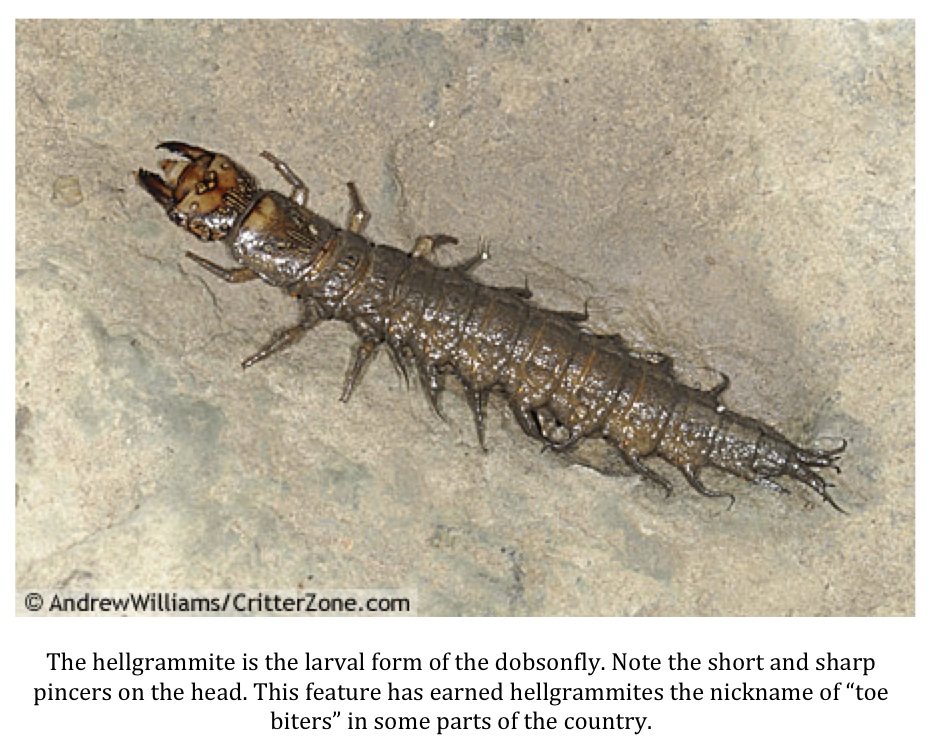
If you’ve never heard of a dobsonfly you aren’t alone. You may be more familiar with what they are called during their larval stage: hellgrammites. Hellgrammites live in rivers, lakes, and creeks. They prefer to linger under rocks and feed on the larvae of other insects. Both males and females possess short and sharp pincers at this stage. Hellgrammites typically reach lengths of two to three inches and remain in this stage of development for 2-3 years before crawling up onto shore to pupate. Typically, the hellgrammite will remain in its cocoon over the winter months and emerge as a fully formed dobsonfly in the spring.
Adult dobsonflies don’t usually venture far from the body of water from whence they emerged. The species is mainly nocturnal and is attracted to bright lights (The reader mentions the insect was positioned under a security light. I would be curious to know if there was a creek or stream in the immediate vicinity as well). Once out of its cocoon, the dobsonfly has only seven days to mate and deposit its eggs near a water source before dying. The fact that they spend most of their lives under water in the larval stage as hellgrammites, don’t venture too far from water sources (which often feature heavily wooded shorelines), and live only seven days once they reach adulthood prevent them from being well-known to most people.
I can’t say for sure the reader who emailed in saw a dobsonfly. I sent a reply email to the reader with a photo of this insect attached but have not yet heard anything back. I do feel the dobsonfly is a good candidate for what this reader witnessed in the Hill Country.
While I am familiar with hellgrammites, I have never seen an adult dobsonfly. After looking into the matter a bit, I can see why running into one would be a bit startling. They are truly intimidating, prehistoric-looking creatures. I was stunned to know insects of this size and appearance make Texas their home.
It is good to know there are still surprises out there in the Lone Star State... even for an old dog like me.
“Hello, I hope this e-mail finds you well. I'm a XXXX resident, and a follower of your blog for the past two years or so. During that time I’ve thought of contacting you once or twice to get some input on something that happened about six years ago while I was living in Fredericksburg, out in the hill country. I don't know why, but today is the day I'm finally writing that e-mail. I’m sure you're besieged with stuff like this on a weekly basis, so I'll try to keep it brief.
Back in Fredericksburg, i was working the night shift at a pizza hut on Main Street (or 290, as it's known to the rest of the state) and was out in the back area behind the restaurant smoking a cigarette. Earlier that evening one of the waitresses had come in from break a little shaken up saying that she'd seen some kind of large insect while taking out the trash - being a lifelong Texas native in a relatively rural part of the state, I didn't think much of it - after all, we've got some big bugs here in Texas. Sure enough though, about halfway through my cigarette, I caught sight of something I, to this day, cannot explain. Hanging out on the wall of the building just under a security light was a gigantic insect of some sort.
It was very awkward in shape, something I've attributed in hindsight to the possibility that it might have actually been two insects mating - but even dividing the size of what I saw in half, each one of these things would have to be at least 6 inches - and that's probably a conservative estimate. It had exposed wings which were folded back, the backs of the wings were a molted brown and black pattern much like a moths, but had a very pronounced membrainage like a cicada. It's body was hidden under the wings, but the glimpse I caught of it as it took flight was slender - like a lacewing - but huge. The most prominent feature, and the one that keeps me coming back to the memory time and time again, was a pair of pretty sizable pincher like mandibles - very reminiscent of the kind you see on large tropical beetles. Of course, Fredericksburg, being as small and uneventful as it is, my first response was to grab everyone I could from inside and show them. Shortly afterwards, amid a chorus of 'gross' and 'eww' the whatever-it-was flew off.
No, it's not a very exciting story at all but it's one that's stuck with me over the years. Me and my roommates at the time, both of whom were also there to see it, tried a few times to identify it via the internet but never came up with anything that looked similar. I know it's probably a shot in the dark, but I was wondering if you'd ever come across reports of similar sightings from the Fredericksburg area, or anywhere else for that matter - or if you might know of a species that fits the description. I watch a lot of David Attenburough, but I'm admittedly no entomologist or wildlife expert, so this could be a pretty common species. I just figured that if there was anyone to ask it'd be you. “
I very much appreciated this reader’s faith in me but I’m no entomologist either, I’m afraid. So, what to do? I was intrigued by the description of this large insect as it sounded nothing like anything I was familiar with but didn’t really know where to start. I have all manner of books on mammalian and reptilian species but nothing on insects. I decided that, before I started blindly searching through Google for Texas insects, I would pick the brain of some of my friends and contacts who know a whole lot more about just about everything than I do. They did not let me down.
It was suggested that the insect in question might have been a dobsonfly. There are over 200 species of Dobsonfly and they are found all over the world. Both male and females can reach lengths in excess of five inches. The wingspans of these large insects are often twice the length of their bodies and are lined with intersecting veins. These insects also have very long segmented antennae, which make them appear even larger.
Of all the unique features, it is the sharp mandibles these insects possess that seem to catch the attention of any who spot them and rightfully so. The mandibles of the male are quite menacing looking and can be in excess of one inch in length. While large and scary looking, these mandibles are quite harmless to humans. Males can’t generate much leverage with them and use them only to clasp onto females when mating. These mandibles do add to the frighteningly prehistoric appearance of the creature to be sure. While the male dobsonfly can’t deliver much of a bite, the female, which retains the short and powerful mandibles of their larval stage, certainly can. The female dobsonfly would be more than capable of delivering a painful bite to a human. Both sexes will put on an intimidation display when threatened. They will raise their heads and spread their jaws in a menacing fashion. This display is mostly a bluff. Their last real line of defense is an irritating and foul-smelling liquid they spray from their anal region.
If you’ve never heard of a dobsonfly you aren’t alone. You may be more familiar with what they are called during their larval stage: hellgrammites. Hellgrammites live in rivers, lakes, and creeks. They prefer to linger under rocks and feed on the larvae of other insects. Both males and females possess short and sharp pincers at this stage. Hellgrammites typically reach lengths of two to three inches and remain in this stage of development for 2-3 years before crawling up onto shore to pupate. Typically, the hellgrammite will remain in its cocoon over the winter months and emerge as a fully formed dobsonfly in the spring.
Adult dobsonflies don’t usually venture far from the body of water from whence they emerged. The species is mainly nocturnal and is attracted to bright lights (The reader mentions the insect was positioned under a security light. I would be curious to know if there was a creek or stream in the immediate vicinity as well). Once out of its cocoon, the dobsonfly has only seven days to mate and deposit its eggs near a water source before dying. The fact that they spend most of their lives under water in the larval stage as hellgrammites, don’t venture too far from water sources (which often feature heavily wooded shorelines), and live only seven days once they reach adulthood prevent them from being well-known to most people.
I can’t say for sure the reader who emailed in saw a dobsonfly. I sent a reply email to the reader with a photo of this insect attached but have not yet heard anything back. I do feel the dobsonfly is a good candidate for what this reader witnessed in the Hill Country.
While I am familiar with hellgrammites, I have never seen an adult dobsonfly. After looking into the matter a bit, I can see why running into one would be a bit startling. They are truly intimidating, prehistoric-looking creatures. I was stunned to know insects of this size and appearance make Texas their home.
It is good to know there are still surprises out there in the Lone Star State... even for an old dog like me.
Subscribe to:
Comments (Atom)