Showing posts with label Coyotes/Wolves. Show all posts

Thursday, July 21, 2022

The Lobo Girl of the Devil's River

Even a man who is pure of heart

And says his prayers by night,

May become a wolf when the wolfbane blooms 

And the Autumn moon is bright.


The werewolf legend is likely as old as mankind itself. Tales of shape-shifting shamans, skinwalkers, and unfortunate souls who were either cursed or survived an attack by one of these beasts (only to become a monster themselves) appear in nearly every culture to have ever existed on this planet. I am sure that those versed in the science of psychology could share many theories on why this may be so. I, however, tend to believe that there is something more to such stories. Something significant – and very real to those who experienced it – must have taken place at some point; otherwise, the lore of the werewolf would not have survived for these many generations.


What sort of event could lead to the belief that a human being could be transformed into a wolf when the moon is full? Perhaps the legend has its roots in the tales of feral children found in the forests and jungles of the world long after they were presumed dead. Some of these stories are purely fictional, of course. The wolf-suckled twins Romulus and Remus who, according to legend, founded Rome, are one such example. Rudyard Kipling’s The Jungle Book, which details the rescue of the “man cub” Mowgli by a she-wolf who nursed him and raised him as her own, is another. These tales are all well and good, but is there any proof that such a thing has ever really happened? Surprisingly, the answer is yes.
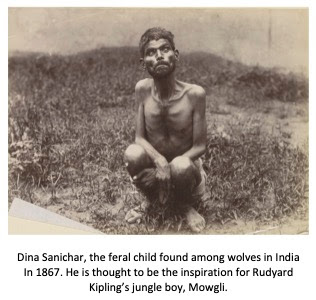


Throughout history, the discovery of feral children has been extremely rare, but it has happened. The previously mentioned Mowgli was inspired by the strange tale of Dina Sanichar who was raised by wolves in India’s Uttar Pradesh jungle. Found by hunters in a wolf’s den in 1867, Sanichar (named by missionaries who later took him in) walked on all fours, would only accept raw meat as food, gnawed on bones to sharpen his teeth, and could not communicate verbally other than producing decidedly wolf-like grunts, barks, and howls. Eventually, Sanichar did learn to walk upright and dress himself; however, he never did learn language and died at the age of 35. Another real-life example of this phenomenon is “Peter the Wild Boy” who was discovered in the forests of Germany in 1725. Believed to have been abandoned by his parents, the boy was estimated to be 11 years old when found. He was unable to speak and loathed wearing clothes. Within a year of his rescue, Peter was shipped off to London where he became the “human pet” of King George I. The wild boy bounded about the King’s court on all fours, which the courtiers of Kensington Palace initially found quite entertaining. It was widely believed that the boy had been raised by wolves or bears due to his behavior. Eventually, the King tired of Peter and shipped him off to a farm in Herfordshire where he was forced to wear a collar that read: “Peter the Wild Man of Hanover. Whoever will bring him to Mr. Fenn at Berhamsted shall be paid for their trouble.” Peter died in 1785 and was buried in the cemetery of St. Mary’s at Northchurch. There are numerous other examples of feral children that were suspected to have been raised by animals that could be cited here, but I trust the point has been made. What many do not realize is that this very scenario may have once played out in the deserts of west Texas.


A nearly forgotten historical fact is that a group of English people once established a small settlement called Delores on the banks of the Devil’s River (part of the Rio Grande drainage basin) in southwest Texas. The community was short-lived as most of the settlers were killed by Comanches. One white couple (who had a rather colorful history of their own), who lived on the extreme edges of the settlement, survived and carried on. One day in 1835, the settler husband frantically rode up to a homestead owned by Mexican goat ranchers and asked for help as his wife was having a baby and was in great distress. According to legend, a storm was brewing and the Mexican couple wanted to wait it out before mounting up and going to the aid of the mother to be. The settler insisted they leave immediately as his wife’s need was great. The Mexican couple relented and they started toward the settler’s home on the Devil’s River. The party had hardly started out when the settler was struck by lightning and killed. This event gave the rancheros pause and they decided to wait until morning to make the trek. While understandable, the decision of the Mexican couple proved disastrous for the female settler. Her lifeless body was found beneath an open brush arbor the next morning. There were clear signs the woman had died during childbirth, yet no child could be found. The couple hastily searched for the infant but found only lobo tracks in the vicinity. The couple assumed that wolves had come upon the scene and devoured the infant. Why the lobos had left the body of the mother unmolested was puzzling to the pair, but they proceeded with burying the unfortunate woman and then made their way home.


Ten years later, in 1845, a boy living at San Felipe Springs (now called Del Rio) reported that he had witnessed a pack of wolves attacking a herd of goats. With them, he claimed, was a long-haired creature that resembled a naked girl. The boy was chastised greatly, but the story – as good tales are apt to do – spread throughout the region. Roughly a year later, a Mexican woman at San Felipe declared she had watched two big lobos and a naked girl ravenously devouring a freshly killed goat. The woman claimed to have gotten very close to this odd trio before they took notice of her and bolted. The naked girl, at first, ran on all fours but eventually rose up and ran on two feet. The woman reported she was positive as to what she had seen and that the child was definitely keeping company with the two wolves.


Again, the story spread like wildfire, but this time the memory of the unfortunate settler woman who had died during childbirth, but whose baby was never found, was recalled. Could the feral “lobo girl” be the missing child, now 10 years old? Other stories related by local Native Americans – previously dismissed as superstitious drivel by the Anglo settlers - were also recalled. The Indians had claimed more than once to have located barefoot human tracks and handprints on the sandy areas along the river. The human spoor was always found among wolf tracks. Could it be? Was such a thing even possible? It was decided by the settlers that they had to find the wolf or lobo girl and rescue her. The posse managed to pick up the wolf pack’s trail quickly and cornered the girl in a small canyon. With the feral girl was a big lobo that fled when the child wedged herself into a crevice in the canyon wall. The girl at first cowered in fear before her tormentors, but then her countenance grew fierce. She spat, hissed, and growled at the men as they approached and bit and clawed them once they took a hold of her. Once captured, the girl began to produce a “pitiful, frightful, unearthly sound…resembling both the scream of a woman and the howl of a lobo, but being neither.” Distracted by these terrifying sounds, the vaqueros nearly failed to spy a huge he-wolf, likely the pack alpha, creeping up on the group. Fortunately for the posse, one man turned in time to see the wolf as it was preparing to spring and shot it dead with his pistol. At this, the lobo girl fainted.


The men bound the girl securely and stepped back to examine her more closely. According to the men, she was “excessively hairy, but breasts of beautiful curvature and other features showed that she was a normally formed human female. Her hands and arms were muscled in an extraordinary manner but were not ill proportioned.” The party rode to the nearest ranch where the girl was untied and placed in an isolated room for the night. The men attempted to communicate with her, offered her food, coverings for her body, and water but she reacted only with distrust and fear. The terrified girl backed herself into the farthest corner of the room where she cowered pitifully. The men decided, for the time being at least, to leave the poor creature alone. The door was closed and locked and the men nailed a thick board across the room’s only window. Things remained quiet…until darkness fell.


Once the sun set, the wolf girl began to emit screaming howls that were terrible to hear. Soon, her cries were answered by the long deep howls of wolves in the distance. The men’s eyes widened and fear began to creep into their souls as the cries of the lobos – seemingly approaching the ranch house from all sides - grew louder and more menacing. It wasn’t long before they were all howling in unison, “a bass-throated chorus of ferocity” the likes of which the rough and tumble vaqueros had never before heard. To the men, it seemed all of the lobos of the western world were gathering outside of the house. These rancheros, all of whom had lived their entire lives in the region, had never heard anything like it, “either from such a number of wolves now assembling or in the sullen, doom-like quality of the long, deep howling.” Back and forth the calls went. One of the men later recalled, “They (the wolves) would go silent as if waiting from some answer, and the wild girl in the dark room there would answer back with her unearthly, howling scream, a voice neither of woman nor of beast.”


After a while, exactly how long no one could say for sure, the pack made for the corrals and pens, attacking goats, cows, and horses. The screams of the livestock broke the spell the terrified men were under and they sprang into action in an effort to save the animals. Ordinarily, the rancheros did not fear wolves; however, on this night, the men stayed tightly packed together as they sought to run the predators off by shooting and shouting into the darkness. Eventually, the wolves retreated. When the men returned to the ranch house, they discovered that someone, or something, had managed to wrench the plank nailed across the window of the room where the lobo girl had been incarcerated loose. She was gone, presumably reunited with her pack. Not a single howl was heard for the rest of the night and, somewhat curiously, wolf sightings in the general area became exceptionally rare over the following years.


Six years would pass before the wolf girl was seen one final time. The year was 1852; gold had been discovered in California and travel westward had greatly increased necessitating the need for a wagon trail or road that was better watered than the Chihuahua Trail currently used by travelers heading to and/or through El Paso. A group of scouts seeking such a route came upon the lobo girl at a spot on the Rio Grande where it takes a sharp bend far above the mouth of the Devil’s River. At close range, the men caught sight of the hair-covered, naked young woman (some versions of the tale say she was holding or nursing two young wolf pups). Once she caught sight of the men, she sprang away in a flash, “dashing into the breaks at a rate no horse could follow.” The slack-jawed men sat stunned upon their mounts, knowing they had just glimpsed none other than the lobo girl of the Devil’s River.


As far as I can tell, the lobo girl was never seen again…at least not by white or Mexican settlers who would have left some record of the account. It is rumored that some of the handful of Apaches left in the region caught sight of her from time to time, but it cannot be confirmed. As years passed, the memory of the lobo girl faded. What happened to her will likely never be known. Some would later claim the entire story had been fabricated as it was simply not possible; however, the vaqueros, rancheros, and scouts who did see her never recanted their stories and stuck to their guns until the day they died.


Texas does have werewolf legends of the more classic shapeshifting type: The Beast of Bear Creek, The Converse Werewolf, and the Cajun Rougarou all come to mind. To me, however, the tale of the lobo girl of the Devil’s River may be the strangest and most unsettling of them all. If scenarios where feral children raised by animals in other parts of the world have proven to be true, why could it not also have happened in the arid deserts and scrubland of frontier west Texas? Was she a true werewolf? No. To the rancheros that encountered the lobo girl and her fiercely protective pack, however, it mattered little. She was wolf enough to them.


West Texas remains sparsely populated to this very day. It is a wild and lonesome country where nature still reigns supreme. It is a region where all manner of strange goings on continue to be reported; a place where it is easier to believe in such things as the lobo girl of the Devil’s River than it might be in other locales. Should you ever find yourself there, alone on the night of a full moon, you might still hear the howl of a wayward wolf or coyote and recall the legend of the lobo girl. On such a night, even though you do not believe in such things, another stanza of the famous werewolf poem might come to mind:


To hear her cry in the dead of night

And strain to see the terrible sight,

Is to know the meaning of dreadful fright.


Sleep well.


Sources: 


Dobie, J. F., & Boatright, M. C. (1966). Straight Texas. Southern Methodist University Press.

Sawyer, B. J. (2017, November 22). The Devils River is an Off-Grid Paradise for Adventurers. Wide Open Country. Retrieved July 21, 2022, from https://www.wideopencountry.com/devils-river-off-grid-rugged-texas-paradise/ 

Lee, A. (2021, August 12). Dina Sanichar – a wild Indian feral child who was raised by wolves. Mysteriesrunsolved. Retrieved July 21, 2022, from https://mysteriesrunsolved.com/2020/04/dina-sanichar-real-mowgli.html 

Lane, M. (2011, August 8). Who was peter the wild boy? BBC News. Retrieved July 21, 2022, from https://www.bbc.com/news/magazine-14215171 

Zimmerman, J. (2014, March 24). Wolf Boys and girls. Jean Zimmerman. Retrieved July 21, 2022, from https://jeanzimmerman.com/bio/savage-girl/wolf-boys-and-girls/ 


Wednesday, October 30, 2019

Gray Wolf Killed in East Texas

 A wolf has been killed in East Texas. 

That is not a misprint or a mistake. A gray wolf was shot and killed this past week in a heavily wooded region of East Texas. I will not be revealing the location – please don’t ask – for a variety of reasons. I will say that the man who took the wolf is a close friend of mine and I can absolutely vouch for the authenticity of the story and the photographs included in this post. 

The details are as follows: The property owners where the wolf was taken were decorating for a party they would be hosting the next day. The family noticed the animal skulking about on the edge of the wood line and reported it to my friend. He told me the family members described it as being “as large as a shepherd.” These are people who live in the woods and they know a coyote when they see one. They were quite sure this was no coyote. My friend searched the area, but found no sign of it.


The next day, the animal was seen again – this time by a delivery person who had come to the property. According to the delivery man, the animal fled when it was seen. Another search revealed nothing.

Sunday evening, my friend heard one of his dogs yapping at something in a pasture that was occupied by livestock. Upon investigation, my friend saw a huge, gray, dog-like animal interacting with his pointer. The interaction did not seem aggressive, but knowing coyotes will often act playful in order to lure a domestic dog away from its yard in order to attack it, my friend decided to take no chances. He felt that a huge wolf-like animal near his livestock, dogs, and family was a recipe for disaster and took the shot.


The animal weighed in at 120 lbs. Certainly, this was no coyote. On top of that, it did not look like a coyote; it looked like a wolf. My friend called the local Game Warden who arrived and took possession of the animal. My friend was notified today that the animal has been positively identified as a gray wolf by the Texas Parks & Wildlife Department.

Gray wolves (Canis lupus) once roamed over the western two-thirds of Texas but has long been considered extirpated there. While red wolves once occupied East Texas, gray wolves were always rare there. It has long been believed that the last two gray wolves in Texas were killed in 1970. One was shot on the Cathedral Mountain Ranch, south of Alpine in Brewster County on December 5 and the other was trapped on the Joe Neal Brown Ranch, located near the point where Brewster, Pecos, and Terrell Counties meet. While there have sporadic wolf reports from all over the state since 1970, almost all of them turned out to be coyotes. As for the few sightings that seem intriguing, the more likely candidate was always the red wolf. These facts are what makes this incident so fascinating.

The Texas Parks & Wildlife biologists are almost certain that this animal – though absolutely a gray wolf – was someone’s pet. Whether this unfortunate canid escaped an enclosure or was released will never be known.

I’m sure the biologists are correct and that this was not a truly wild wolf. Wolves are pack animals, not solitary wanderers. Certainly, a pack of wolves – even a small one – would be noticed by authorities and the locals. Still, the next time I am out in the woods and hear the coyotes start to howl and carry on, I will pause and listen a little more closely. My hope is that I will hear an answer to their calls that goes on longer and is a bit deeper, something that might indicate the presence of a wild canid larger than a coyote.

A guy can hope… 

Wednesday, August 21, 2019

Sasquatch FAQ Series: Do Wood Apes Avoid Game Cameras?

With thousands of game cameras out there, if bigfoot is real, why are there no pictures?

The question above is one I have heard countless times over the years. Make no mistake, it is a fair question and I have no problem with anyone who asks it. On the surface, the fact that no clear and conclusive photos have been captured via game camera would seem to indicate that the wood ape does not exist. The real answer as to why game cameras have failed to get the “money shot,” however, may not be quite so simple. As seems to be the case with almost everything related to the sasquatch enigma, the truth may be more nuanced and layered than one might expect.

In 2003, a team from the University of Nebraska published a paper titled Wariness of Coyotes to Camera Traps Relative to Social Status and Territory Boundaries. The paper detailed an aversion that Alpha coyotes seemed to have regarding game cameras. The study took place in the Dye Creek Preserve in the foothills of the Cascade Mountains of California which was closed to the public. The authors thought the coyote population in this area would make good subjects for their study due to their extremely limited exposure to humans. “Coyotes on the preserve were not hunted and generally represented an unexploited population,” the authors wrote. The results of their study were fascinating.


The study found that the dominant coyotes, the Alphas, were never photographed inside their territories during the three years the game cameras were in place. Not one time. The authors concluded that this was not due to the animals having left the area as Betas and transient coyotes, thirty-eight in all, were successfully photographed by the cameras and Alphas were observed via more traditional means in their territories. Instead, the authors felt the lack of photos of the Alphas had to do with an increased level of awareness and caution on the part of the dominant pack members. “Alphas are probably the only coyotes that are truly territorial in terms of defending and fully exploiting their space,” the authors said. The Alphas regularly traversed their entire territories and “actively tracked human activity within their territories and presumably gained information about camera stations as they were being set up.” The final conclusion was the Alphas “were cautious of camera stations because of their association with humans and not simply because they were novel.”

The conclusion that Alpha coyotes avoided game cameras because they associated them with humans is one that has real ramifications for those attempting to gain photographic evidence of the wood ape by the use of such devices. The NAWAC conducted a large-scale camera-trapping project dubbed Operation Forest Vigil from 2006 – 2011. Despite hundreds of man hours and thousands of dollars spent on the effort, no definitive photos of the target species were captured. The thinking was that apes might avoid the cameras for a few days or weeks after their initial deployment, but get used to them over time. The lack of results and the findings of the University of Nebraska biologists caused the group to reconsider that opinion and the project. If the apes were avoiding the cameras due to associating them with humans and not because they were something new and out of place – like the Alpha coyotes in the University of Nebraska study – then the group was very likely wasting its time and money. 

Coyotes are one thing, apes are another. How can we be sure that apes are as wary of cameras as Alpha coyotes? A recent study conducted by the Max Planck Institute of Evolutionary Anthropology shed some light on that question. According to a paper published in March of 2019, an international team of researchers placed cameras in ape-populated forests in Africa in an effort to learn how wild apes would react to these unfamiliar objects. Responses varied by species, and even among individuals within the same species, but one thing was consistent throughout: the apes definitely noticed the cameras.

“Our goal was to see how chimpanzees, bonobos, and gorillas react to unfamiliar objects in the wild since novel object experiments are often used in comparative psychology research, and we wanted to know if there were any differences among the three great apes,” said primatologist Ammi Kalan. “We were specifically surprised by the differences in reactions we observed between the chimps and bonobos. Since they are sister species and share a lot of the same genetic makeup, we expected them to act similarly to the camera, but this wasn’t the case.” The chimps, though they noticed the cameras, seemed uninterested, for the most part. The bonobos, on the other hand, were stressed by the devices. “The bonobos appeared to be much more troubled by the camera traps; they were hesitant to approach and would actively keep their distance from them,” said Kalan.


The experiment pointed out the necessity of researchers to consider how animals will respond to unfamiliar monitoring equipment – I would include audio recording devices under this umbrella, too –in their natural habitats. The variation in behavior from species to species towards unfamiliar objects placed in their environment “might be problematic when trying to collect accurate monitoring data,” said Kalan. In other words, there may be no such thing as truly passive observation. The mere presence of a camera or a recorder may alter the behavior of the target species.

Many researchers, me among them, have long held the belief that wood apes avoid camera traps. Do not misunderstand, I do not think an ape knows what a camera does and makes a conscious effort to avoid having its picture taken. That is foolishness. I do, however, think it is possible – likely even – that these wood apes associate cameras with humans. If they understand, even on an extremely rudimentary level, that humans are generally bad news, and if they are more bonobo-like than chimpanzee-like in their sensitivity to foreign objects in there environment, then they are likely going to go to great pains to avoid anything to do with them; that would include camera traps.

Despite this belief, I am still a proponent of the use of game cameras. I feel short of a hunter taking a specimen or a road-kill type of scenario, cameras remain our best chance of documenting the species. I also feel that despite the challenges, a large-scale camera project sponsored by a well-funded group with sufficient resources just might be able to capture the evidence desired. What must be understood is that just hanging a camera on a stake or a tree is not going to be good enough when the quarry is something as intelligent as a great ape. New and novel techniques will need to be utilized to have any chance of success. Another reason I remain a proponent of game cameras is that these creatures are not infallible. They do make the occasional mistake. Researchers can do the wrong thing, be too loud, fail to camouflage their cameras, etc. day after day for years. That is okay; there is always tomorrow. The wood ape has to be perfect every day in order to permanently avoid detection. That is simply not possible, not even for an animal as furtive and elusive as the sasquatch. One mistake. That is all it will take for the discovery of the millennium to be made. The question really is not whether or not the wood ape will make a mistake; one will. The question is will there be anyone or a monitoring device present to capitalize on said mistake?

If you are the type to get into discussions over cryptozoological-related matters – and you likely are considering you are reading this – file the findings of the University of Nebraska biologists and the researchers of the Max Planck Institute away for future conversations. The question of why no photos have been captured by game cameras is bound to come up eventually. Along with the most common response – and quite a valid one, in my opinion – stating that most game cameras are pointed at deer feeders that are not too deep into the woods, bring up the possibility, backed by scientific studies, that some animals simply avoid cameras due to their association with humans. You will come across as well-read, reasonable, and intelligent.

You will also be right.


Sources:

“Wild African Ape Reactions to Novel Camera Traps.” ScienceDaily, ScienceDaily, 14 Mar. 2019, www.sciencedaily.com/releases/2019/03/190314111015.htm.

Sequin, E.S, et al. “Wariness of Coyotes to Camera Traps Relative to Social Status and Territory Boundaries.” Digital Commons @ University of Nebraska-Lincoln, USDA National Wildlife Research Center - Staff Publications, Mar. 2003, digitalcommons.unl.edu/cgi/viewcontent.cgi?referer=http://woodape.org/index.php/about-bigfoot/articles/190-cryptidcaution&httpsredir=1&article=1227&context=icwdm_usdanwrc.

Higgins, Alton, and Daryl Colder. “Cryptid Caution Concerning Cameras?” Cryptid Caution Concerning Cameras?, woodape.org/index.php/about-bigfoot/articles/190-cryptidcaution.

Monday, February 29, 2016

Fact or Fiction? The Government is Releasing Large Predators in Texas

Periodically, I receive an email that addresses a topic that I think is worthy of discussion on the blog. I received an email back on February 3rd that I feel falls into this category. It involves a story I have heard many times over the years. I have attached the email in question below.

So I stumbled across your webpage earlier this evening while obsessively googling mountain lions. I live in Pilot Point, TX, super small town in the far northeast corner of Denton County. The town is along the northeast side of Lake Ray Roberts. I've lived in this town my whole life, and have heard many stories of Mountain lions, but one story has seriously intrigued me and I need your help. It was brought up to me again tonight, which led me to google and then to you.

It's a very known fact around here that we have mountain lions (this is what we refer to them as), but if you ask any wildlife and parks people or game wardens they say that we don't and it isn't true. So, the story goes back in the early to mid 90’s this guy in southern Oklahoma was catching wild hogs, feeding them and releasing them into northern Texas. No clue why. That part isn't included in the tale. As a result, the population of wild hogs grew to insane numbers and they put a bounty on them. Something like 15-20 dollars for a pair of ears. After they realized this wasn't working, it is said, that "they", I've also heard "a guy" released 6 mountain lions (3 males and 3 females) in far north central Texas to "try to control the hogs". But of course, the wildlife and parks people and "those government people" didn't want the public to be aware of this, as not to frighten them. And that's why they deny any accounts of mountain lions.

I don't want to throw out this possibility, because I’ve heard of this tale for years now and from multiple people, and I also don't understand why mountain lions existing here is so denied, when it is so known that they are here among the public. But yes it sounds insane and I cannot find any valid information on this.

Please tell me if you think the old town folk around here are just crazy.

Thank you,
Kodi.


Kodi relays a rumor that has become something of an urban legend here in Texas. The whispers that the Texas Parks and Wildlife Department, the Federal Government or some other entity has released large predators in the state have been around for a while now. The story varies slightly each time I hear it (this is the first time I have heard an Okie blamed for our feral hog problems in Texas, lol). Sometimes it is wolves that were allegedly released, other times cougars. I have even heard some claim that jaguars were the predators released. The reasons for the alleged release of these predators are usually thought to be an attempt to control the feral hog population or a simple reintroduction of native species that once called the Lone Star State home. The reason for the secrecy most often given is that the public would likely not handle the idea of potentially dangerous predators being released in their woods and river bottoms very well.


The strangest twist on this rumor I have heard comes from a gentleman I know in Montgomery County, Texas who swears that a friend of a friend received a visit from two “government employees” after he had lost several cows to an unknown predator. According to my acquaintance, these government men paid the rancher roughly twice the market value for his lost livestock in cash but told him to keep quiet about the incident so as “not to alarm others in the area.” I asked my acquaintance if he would relay a message to this rancher through his friend and ask if he would be willing to speak to me, even if it had to be off the record. Needless to say, I have never heard anything back.

As far as I can tell, there is no truth to the rumors that wildlife officials are releasing, or contracting anyone else to release, large predators in Texas. I think the myth has gained steam due to the explosion of the feral hog population in the state. Certainly, this hog problem is real and nothing the state has tried to do to curb the population growth has worked. On the surface, the idea of reestablishing native predators to help with the problem seems plausible, as the state/feds would be killing two birds with one stone. Native species, all but extirpated in the state, would once again be living free in Texas and would be helping to eliminate the hog problem. The problem is there is simply no evidence suggesting such a program does, or ever did, exist. All the stories seem to originate from a “friend of a friend” or some other second, third or fourth hand source. I have never been able to track down anyone who claimed they had directly interacted or spoken with any government personnel about the release of predators or reparations for lost livestock. In addition, the story has spread to other parts of the country. Following is a post I located on the Lake-Link Hunting Forum. The post sounds pretty familiar.

A friend of mine lives in Southern Marquette county and his wife recently saw a cougar while out on a walk...the cougar was in plain sight and was casually walking in the yard of rural neighbors.... upon reviewing this my friend discovered a few things....that a local farmer had recently reported seeing two cougars within 5 miles of this cougar....then a week ago he ran into a firefighter friend wh0 told him and even more interesting story....basically a person that he knew was going out near some property he has up near Westfield and came across several DNR vehicles in his field...when he approached they told him he had to leave the area immediately even though it was his property...two of the trucks had large cages in the back and one contained a cougar...he left the area went down the road and waited and when those trucks drove past there was no cougar....I know this story is third if not fourth hand so I do not know how much is true but I know the people who have seen the other cougars in the field and I believe them...how they got there who knows...wanderers or released.....but does the DNR have the right to release such animals without public input...I know they have released Wolves in Portage county to help control the deer herd...obviously if they are releasing cougars that could be their only reason....but this animal is totally different than a wolf...while it does not multiply as rapidly as wolves it will stalk a human in the field or a child in a yard....I just thing it should have some public input...what da ya think?

Like most urban legends, there is just enough real information wrapped up in the tale to make it at least somewhat believable. Mix in a healthy dose of distrust for the government, which is not uncommon in our country these days, and you have the makings of a great conspiracy theory, an almost gift wrapped and ready made urban legend.

In the end, I think an urban legend is all we have here.

Friday, February 13, 2015

Ellis County Camera Project: The Texas Zoo

This past weekend, I was able to get up to Ellis County and check on my game cameras. The property on which the cameras are placed is a very rich environment where all manner of wildlife is thriving. The property sits on the banks of Waxahachie Creek and is a combination of hardwood forest and pasture land. The property owners have had a couple of encounters with large cats, which is what led me to the property originally. I have had cameras on site on and off for the better part of two years now. I have captured all manner of wildlife in photos here. The property is almost like a zoo featuring animals native to Texas. I think this will be made clear with the photos featured in this post.

Before I get to the photos, however, I want to let it be known that I am holding one photo back for the time being. Do not get too excited as I do not have a photo of a wood ape or a black panther. The animal in question is, no doubt, a cat but the identity of this feline is something that is being debated. I had pretty much settled on the species of this animal when I received a phone call yesterday from a friend of mine who had visited a big cat rescue facility on business. I had shared the photo of this cat with him, along with others with backgrounds in wildlife biology, and he showed it to the staff of this facility. What they told him was surprising. I am hoping to get in touch with the staff of this facility personally to get their full opinion on what sort of cat might be roaming this section of Waxahachie Creek. Once I do, I will post the information and the photo.

In the meantime, enjoy the photos below.


Monday, December 8, 2014

Field Report: Ellis County, TX

Yesterday, I managed to make a long overdue trip up to my study site in Ellis County, Texas. I have had cameras on the property off and on for about two years now. The property owner originally contacted me after multiple family members had seen large cats on the property (one tawny-colored mountain lion and one large long-tailed black cat) and several of the horses on the property came up with injuries that resembled deep claw marks and puncture wounds on their haunches and necks. To date, I have captured one intriguing video of an animal I cannot identify but nothing else unusual. I have tons of photos of feral hogs, raccoons, opossums, coyotes and a few of bobcats. Interestingly, I have not one single shot of a white-tailed deer.

My arsenal of game cameras has become quite depleted over the last few years. Some have worn out and stopped working properly. Some have been destroyed in high water events. Still other cameras have been stolen. For the last few months I have had only one camera on the property, a Cuddeback Ambush model. I was several weeks past due on checking this camera and anxious to look at what it might have captured. Also, I recently had two older Reconyx cameras (an RC55 and an RC60) repaired and upgraded and was ready to get them back out into the field. All that being the case, I set out for Ellis County excited at the prospect of having better coverage of the property once the reconditioned Reconyx cameras were deployed.


Upon arrival, the first order of business was getting the two reconditioned cameras set out. I found two locations that I am very excited about. Both cameras will be overlooking spots where well-worn game trails intersect. The trails run very close to a major creek in a heavily wooded section of the property. There are ample food sources and several dens, belonging to several different species, were found while scouting the potential camera locations. I anticipate getting some nice photos of whatever roams around those woods. Once the two Reconyx cameras were placed, secured with camouflaged steel cables and padlocks and activated, we moved to the location of the Cuddeback Ambush camera in order to download what photos and/or video it might have captured over the last two months.

I was disappointed in the number of events the camera was able to capture. The spot over which the camera watched, apparently, is not the busy animal thoroughfare I thought it was when I placed it. Even so, I got some nice shots of a couple of very large feral hogs and some coyotes. One of the hog shots is interesting as it shows this very large pig leaping into the air. I am not sure why it was doing so as there is no debris in that spot that could not be negotiated simply by stepping over. Maybe it was feeling its oats that night. In any case, it is a fun photo. A couple of the coyote shots interested me as the animal(s) photographed is travelling with its tail straight out behind it in a horizontal position . This is a characteristic of wolves, not coyotes, which usually travel with their tails down below the level of their backs. Do not misunderstand me, as I am not claiming the canid photographed is a red wolf. I do feel, however, that it could be a sign that the coyotes in this particular area have some red wolf lineage to them.


By far the most interesting item captured by the Cuddeback is a short video showing an animal of some kind in a tree. The animal is a rusty color and, though mostly obscured by foliage and branches, clearly negotiating a tree branch in the upper right hand portion of the video. There appears to be the flip of a tail, or some other appendage, toward the end of the video. The tail, if that is what it is, appears too thick and puffy to be that of a cat, in my opinion. The animal is close to the same color as the coyotes photographed. Could a coyote be up in this tree? Not impossible, I suppose, but not the likeliest of explanations either. I feel a red fox is a possibility. I know foxes have a limited ability to climb trees and they are native to the area. Admittedly, I have never captured a photo of a fox (red or gray) on the property and the animal in the video seems a bit large to be a fox (you’ll have to take my word on this as I am familiar with the tree in which this animal is moving). It is a bit of a head scratcher but enjoyable to ponder. Maybe the culprit will return now that the leaves have dropped and it would be easier to identify. The video is below. Again, keep your eyes on the upper right hand quadrant of the video.


Overall, it was a very good trip. The property owners and I have become good friends and it is always nice to visit with them. Time outdoors is always a good thing as well and does more to recharge me than just about anything else. The only negative I took away was the quality of some of the video shot by the Cuddeback Ambush camera. The video of the last few events captured was of very poor quality. So much so that it was hard to tell what you were looking at on the screen. I am hoping this is a result of the batteries having been very low (I was more than a month overdue in changing them) and not some flaw in this almost brand new camera. Time will tell, I suppose.


Tuesday, November 11, 2014

Could Red Wolves Still Roam Texas?

The red wolf (Canis rufus) once roamed a large part of the southeastern part of North America. The range of the red wolf once stretched from the Atlantic and Gulf Coasts northward into Indiana and the Ohio River Valley. This long-legged canid also inhabited areas stretching from central Pennsylvania to Missouri and central Texas. The red wolf was an apex predator that could successfully make a living in forests, swamps or prairies. Now, however, it is all but gone. Most scientists feel the species went extinct in the wild in the early 1980’s. The last red wolves known to have lived in Texas were documented by John Paradiso. He noted that seven specimens taken from Chambers County near Anahuac between 1963 and 1964 and one specimen taken from Kennedy County near Armstrong in 1961 were full-blooded red wolves. Subsequent specimens taken from the eastern portion of the Lone Star State have all been found to be large coyotes.


Debate has raged among biologists as to whether the red wolf went extinct in the traditional sense. What I mean by that is that many believe, as their numbers dwindled, red wolves interbred with coyotes (Canis latrans). This continued long enough that full-blooded wolves disappeared, leaving only a sort of coyote/wolf mutt here in Texas. It has been documented that many, if not most, coyotes in Texas carry at least some red wolf genetics. This confirms that this interbreeding took place and took place often. Some scientists feel that the red wolf was nothing but a hybrid in the first place, albeit a fertile one that was able to reproduce; the offspring of coyotes and gray wolves. The taxonomy of the red wolf is a topic for another post and I do not want to get bogged down in that right now. The important thing to note here is that due to a combination of hunting, aggressive predator control practices, habitat destruction and increasingly extensive hybridization with coyotes, the red wolf has disappeared forever from Texas.

Or has it?

Reports continue to filter in from rural Texas of wolves stalking the woods, creeks, swamps and prairies. These witnesses will stress to you that they are wolves and not coyotes. A lot of these folks will tell you that they have popped many a coyote while protecting their stock and know the difference between what they have taken in the past and a wolf. Wildlife biologists disagree and say these predators have been extirpated. After all, they say, if they were still here there would be photos of them. Case closed.

Or is it?

There are some pretty interesting photos out there that seem to indicate that the red wolf might not be completely gone after all. I will explore three different sets of photos in this post. One set, in my opinion, is likely a coy dog, the identity of the canid in one photo is debatable and, finally, one set of photos seems to clearly show a red wolf-like animal.


I recently obtained a couple of photos, that came from a gentleman living near Meridian, of a dead canid that he feels is a red wolf. As you can see in the photo below, the animal has some wolf-like characteristics. In my opinion, however, this is likely some sort of shepherd mix or possibly a coy dog (coyote/domestic hybrid). The animal does have pointed ears but they appear narrower than what I would expect to see in a red wolf. The muzzle is larger than that of a coyote but more rounded in appearance than I would expect in a red wolf. Certainly, the Meridian specimen appears thick in the neck and through the chest like a wolf but the coloring is more like that of a German shepherd. I admit that the eyes of the specimen have the narrow appearance that would be expected in a wolf but it must be kept in mind that could be because we are looking at a dead animal. The animal appears quite large, and I have been assured that the Meridian specimen stretched from the hunter’s shoulders to the ground when held up by the back legs but have no hard evidence to back that up. There is nothing in the photos I received that shows scale. That being the case, the best I can say is that the photos are inconclusive and should not be used as evidence that red wolves still roam the Lone Star State.


A few years ago, a NAWAC game camera captured a photo of a canid that was the subject of much discussion among group members. The animal in question appeared to be larger than a typical coyote and had many of the hallmarks of a red wolf or, at the very least, a red wolf hybrid. The coloring on the NAWAC specimen is certainly dead on as compared to most typically colored red wolves. Too, the ears are large and the snout is of the correct shape. The animal is thick in the chest and, as the comparison photo shows, is almost interchangeable in size and coloration with that of a red wolf. There are arguments against this being a red wolf, too. The coloration is a good match but the problem is that many coyotes exhibit almost identical coats. The ears are large but are more rounded than I would expect to see on a true wolf. I think the comparison photo illustrates this point quite well. In addition, the eyes of the NAWAC specimen look more rounded and coyote-like than the more narrow eyes usually associated with a full-blooded wolf. One of our members, who has an extensive background in all things wildlife-related, showed the photo to three wildlife biologists. Two of these scientists felt that, at the very least, this animal had red wolf genetics in him and was likely a hybrid. The third, towing the company line, said it was a coyote. When asked how he could be so sure, the biologist responded, “because there are no red wolves in Texas,” (I’ll leave that statement alone for the time being). Scale is also a problem here. It is impossible to say just how large the canid in the NAWAC photo actually is as there is nothing in the picture to provide obvious scale. It appears tall and long-legged but the photo is far from definitive. Measurements could have been taken of the tree behind the specimen but, as it was another cryptid we were attempting to photograph at the time, this was not done. My personal opinion on this animal is that it clearly has some red wolf in it. Whether it is a true hybrid (the first generation offspring of a coyote-red wolf coupling) or a descendent of a hybrid (more likely) I cannot say.


The third set of photos I want to take a look at were graciously provided by Chester Moore, Jr. and are featured on his Kingdom Zoo website (www.thekingdomzoo.com). The photos were captured via game camera by Mr. Moore’s research partner, Terri Werner, in 2012. The two pictures featured here are stills from two separate videos taken at the same location. I think most would agree that the animal seen in these photos is anything but a common coyote. The coloration, thick body, long legs and large ears immediately caused me to think “wolf.”


Mr. Moore also has a very interesting video of a red wolf-like canid on his website that is worth the time to view. The video subject is not built like a coyote; it is taller and longer-legged. While the video is black and white, the stark white of the subject’s chin, neck and chest is obvious. This pattern is exactly what one would expect to see when viewing a red wolf. Obviously, I cannot definitively say that the canids captured on video by Moore and Werner are full-blooded red wolves. What I can say is that whatever their genetic make-up might turn out to be, these canids are likely the closest thing to true red wolves I have seen in the wild and, if nothing else, their existence should prove the need for all of us to keep an open mind when it comes to entertaining the idea that these magnificent animals might once again roam parts of the Lone Star State…

… if they ever left at all.

*A special thanks to Chester Moore, Jr. for allowing me to use the photos above in this post. Please check out Mr. Moore’s Kingdom Zoo website and consider supporting his Children’s Kingdom Ministry.

Monday, October 13, 2014

Ellis County Camera Maintenance Trip

I made a trip out to check on one of my game cameras yesterday. The camera is located on private property in Ellis County, Texas where some odd goings on have been reported. The property owners have spotted two large cats, one tawny-colored and one black, on their land and have had several of their horses suffer injuries that they suspect were caused by run ins with a predator of some kind. The family has also found scat that looks suspiciously like that of a black bear and heard some odd clicking, moaning and growling from wooded areas adjacent to their home. Possibly the strangest thing to have gone on at this location is the disappearance of peaches from trees on the property. In two of the last three years, last year being the exception as a terrible drought prevented the trees from blooming, the trees have been quite prodigious. In fact, the trees have produced at such a rate that the property owners could not keep up. Peaches littered the ground and the branches were heavy with them. Each of these good years, the property owners returned from work one day to find the peaches gone. Not only were the peaches on the ground gone but the trees were completely stripped of fruit as well. For all of these reasons, the spot is an area of interest to me.


I was anxious to check the camera, as it is a brand new Cuddeback Ambush IR model on its maiden voyage. I have owned several older Cuddeback models in the past and they have been workhorses for me, providing years of service. They would likely still be working for me except I deployed them in a dry creek bed in Central Texas a while back and they fell victim to a flash flood event. The creek bed was a virtual wildlife highway and I got hundreds of great photos from the spot but a rain event in August of last year, pretty unusual in these parts, took them out. I’ve been attempting to rebuild my camera arsenal ever since but progress has been slow. In any event, I was anxious to see how the new Cuddeback performed.

I was a bit disappointed in the lack of events recorded by the camera. I got only a handful of shots/video of feral hogs and a coyote. The quality of the images was fine, however, and left me encouraged for the future. I downloaded the images on my laptop, refreshed the batteries and redeployed the camera in the same spot thinking that six weeks was not a fair enough sample size to determine whether it was going to be productive. After redeploying the camera, the property owner and I stared making our way back toward the house so we could take a look at what kind of images we had. That is when things got interesting.


We had walked approximately 150 yards back to the north of the camera location when I stopped to examine a game trail cutting back to the west. While I was looking for sign, I heard what sounded like a very large animal crashing through the brush back close to the location of the camera. I turned to look but saw nothing. The property owner had lingered behind me as I checked the trail and did report seeing something. She reported seeing something large and gray fly or drop out of a tree back in the spot from where we had just been moments before. She could not give many details as it happened quite fast but said the object was substantial. We immediately returned to the spot but could find nothing on the ground in the spot or surrounding area matching the description of what she says she saw. She was adamant that she saw something gray and big come from the tree or out of the tree line and land on the ground. She did not see any sort of movement after the event that would indicate an animal of some kind came out of the tree and then moved away. It should be noted at this time, however, that the grass is quite high in the spot and something low to the ground likely could escape detection quite easily by hugging the ground. I really do not know what else to say about the incident. It occurred exactly as recounted. As I said, I did not see the object but clearly heard something large. Other than that, I cannot really speak to what it might have been. After looking around for another 30-45 minutes, we made our way back to the house.


As I mentioned previously, I did not capture very many images on this set. While this was disappointing, I was pleased with the image quality of the photos and the video that was captured. Even though nothing unusual was photographed or captured on video, I have included the images here for your inspection.

I will continue to monitor the situation in Ellis County. I have two Reconyx cameras currently in the shop and hope to have them back by the time I refresh the Cuddeback in 4-6 weeks.

Wednesday, February 26, 2014

Revisiting the Melanistic Jaguar Theory

All of you who have read this blog for any length of time at all know that the subject of large, black, long-tailed cats, or “black panthers,” is something in which I am particularly interested. This subject has become the number one most popular topic on this site. More people contact me about black cat sightings, by far, than sightings or anecdotes about any other animal (known or cryptid).


I have always felt that there must be a biological entity behind these “black panther” sightings. There are just too many incidents and too many credible witnesses to believe otherwise, in my opinion. If I am right and there is a real animal out there responsible for these sightings, what could it be? I’ve put forth several possibilities over the years: jaguarundi, jaguar, unusually dark-colored cougars, for example. Perhaps a combination of these three animals plus the occasional case of mistaken identity could explain the phenomenon? I’ve also entertained the idea, briefly, that maybe cougars in the wild do occasionally exhibit melanism as well as the possibility of an entirely undocumented large, dark-colored cat might exist in Texas and the deep South; however, the culprit most often suspected of being responsible for “black panther” sightings by those who think there is something to all of this is, without a doubt, the jaguar.


In the past, I’ve been very hesitant to jump on the jaguar (Panthera onca) bandwagon and anoint this big cat as the number one suspect in the hundreds of black cat sightings. Jags fit the bill as far as the size most often reported by “black panther” witnesses. People often describe “Labrador-sized,” or larger, cats with long tails. The jaguar is the largest cat in the New World and ranges in weight from 125-250 lbs. under normal conditions with some males reaching weights in excess of 300 lbs. (very rare). Color morphism does occur in the species with melanistic specimens appearing almost totally black in color. While much more rare than their normal rosette-coated brethren, melanistic jaguars make up approximately 6% of the total jaguar population. That being the case, why have I been hesitant to grasp the theory that “black panthers” may very well be remnant, or Northward wandering, jaguars?


The answer is simple. While 6% of the jaguar population is not an insignificant number of individuals, it still leaves 94% of the population with the normal spotted coats. IF the black panthers of Texas are melanistic jaguars then why is nobody seeing or reporting the much more commonly colored cats? If these are jags people are seeing, the spotted individuals have to be here too. If that is the case, then they would be easier to spot than those of the melanistic variety. Right?

Maybe not.


Spotted coats are a tremendous form of camouflage. It is the very reason so many wild cats are marked in this way. They are predators and need to be hard to see. Leopards, jaguars, bobcats, ocelots, margays, servals, cheetahs, young lions and young cougars all have spotted coats for part of, if not all, their lives. The spots allow these animals to blend into almost any form of cover as they break up the silhouette of the cat beautifully. I have come to the conclusion that maybe the large black cats being reported in the South are melanistic jaguars and they are being seen, while their spotted brethren are not, because their black coloration is not as effective a form of camouflage.


Allow me to demonstrate. Spread through out this post, is a series of photographs. In each photo there is a normally marked leopard or jaguar. These photos have all been circulating for some time now as a sort of “Where’s Waldo” game of find the cat. I’d seen them but not given them a lot of thought. Lately though, I’ve revisited them while considering them as something to study instead of just a hide-and-seek type of game. As you will see, or maybe not, the spotted coats of these cats make them all but impossible to detect while a solid black cat might stand out more. Imagine trying to spot one of these cats that is hunkered down in tall grass or a wooded area from a moving car or even as you walk through the woods. If it remains still, you aren’t going to see it.


As a matter of fact, just standing or sitting perfectly still in and of itself can keep an animal well hidden. We, as humans, seem to depend on movement to a large extent in order to spot things. Add the fact that we, as a species, have become less and less in tune to nature and become unobservant, at best, and totally oblivious, at worst, and not many of these animals are going to be seen, not even those that are not thought of as having perfect camouflage. The photo below illustrates this point. See how long it takes you to see the wolf in the photo. Some will see the wolf quicker than others but there is no denying that he would be very easy to miss despite not sporting a spotted coat.


IF the “black panthers” of Texas are jaguars, then the much more common spotted cats are here, too. They are just going to be almost impossible to detect unless they cross a road directly in front of a vehicle. Jaguars were native to Texas and much of the deep South at one time. Maybe they are making a bit of a comeback, much as cougars appear to be doing, across much of their old range.

What a great story it would be if it turned out to be so.

Thursday, February 13, 2014

Black Panthers: Photographic Evidence At Last?

This post will be much heavier on photos than writing. That is good news as a picture truly is worth a thousand words. That being said, let’s go.

Two different readers have sent me photos of large cats over the last couple of weeks. Both sets of photos come from South Texas and both are interesting in their own way. I’ll take them one at a time.

The first two photos come from Uvalde County. The photos clearly show what appears to be a large, long-tailed cat of some kind. It is unusual in that the markings of the cat appear to be a cross between what you would expect to see on a bobcat and what you see on a common domestic/feral cat. The photo where the cat is in motion is the most interesting as it makes the cat look lean and extremely muscular. The photo where the cat is walking slowly gives a slightly different impression. It appears very, very thick, almost beefy. The head is very bobcat-like but the long tail eliminates the bob as a possibility.


My response to the reader who sent me these photos was as follows:

The cat seems very large but there is nothing in the picture of known size to provide scale. At first glance, it seems as if the cat would be as long as the rutted road is wide, however, it could be a trick of perspective as the road is at an angle to your camera.

The coloring of the cat is very much like that of a common barn or house cat. The feet seem small for a truly big cat. It does seem very thick though.

What complicates matters even more is that I get a different impression from each of the two photos. The picture where the cat is moving slowly gives me the impression of a big feral cat. The impression I get of the cat where it is jumping/running is quite different. In that photo it appears much more lean and less "fluffy" looking.

The thing to do would be to get back to the site and photograph yourself or someone/ something else of a known size in that spot. Make sure the camera is in the same location. You could also measure the height of that small piece of brush the cat is walking by. If that is only a foot or so high then we know the cat is small. If it is 3 feet tall then we have something else all together.

Please let me know if you decide to go back and take some photos for scale.


The next set of photos also originates from South Texas. To me, they are more intriguing than the first set. The series of shots clearly show a cat of some kind that is a very dark charcoal gray to black in color. According to the reader who sent the photos to me, the pictures were taken from a pretty good distance using a telephoto lens. When the photos were shown to Texas Parks & Wildlife personnel, he was told he had pictures of either a bear or a coyote. There is one photo in the series where I can sort of see how someone might think “bear”… if I squint really hard. To say bear OR coyote is almost laughable to me as the two species do not resemble each other in the least.


In my opinion, these are clearly pictures of a cat. That is really about all I can say. Are these photos proof of the existence of the ever-elusive “black panther?” Alas, no. Even the reader who sent the photos knows this to be the case as he said, “those are the absolute best photos I've seen from anyone who sighted a black cat, and still they're not definitive!” His willingness to admit this makes me doubt very much that we are looking at some sort of hoax.


My response to the gentleman who sent the photos was as follows:

The shots are very intriguing. The problem is there is nothing in them to indicate scale. That being the case, it is hard to say how close the photographer was to the animal or how big it might have been. I can tell you it is NOT a coyote or a bear. It is a cat. Just don't know how large.


If you are beginning to think that all these photos seem to have the same issue (scale) then you are correct. It is just impossible to say how big this cat really was by looking at the photos. Critics will point out that the photographer could have been very close to the animal and it is nothing more than a normal domestic-sized cat. While I believe the story of the reader who sent these pictures, I can’t prove that such a critic is wrong. It cuts to the heart of the fact that a photograph alone will likely never suffice as definitive proof that the black panthers of Texas are a reality. They do, however, provide another anecdotal piece to this puzzle. Slowly but surely, we seem to be gaining ground on these elusive “ghost cats.”


*Please continue to forward me any reports and/or photographs of strange, odd or out of place animals. Feel free to make short comments to the post or, if you want to provide more detail or send a photo, use the Texascryptidhunter@yahoo.com email address.