Showing posts with label Wood apes. Show all posts

Monday, July 10, 2023

Was the Tshul'gul' of Cherokee Legend a Sasquatch?


Long time readers of this blog know that I am an avid amateur folklorist. I can, and often do, spend hours perusing the myths and folklore sections of various libraries near my home in the hopes of finding an undiscovered gem that might somehow connect ancient lore to my cryptozoology interests. Logic dictates that if cryptid creatures like the sasquatch or black panthers really do exist, then the people of long ago should have encountered them. If so, then there should be some sort of record of these encounters. One issue with this line of thinking, however, is that very few of the Native American tribes that inhabited North America in pre-Columbian times had a written language. That doesn’t mean there is no historical record, though, as the stories, myths, legends, and experiences of each tribe were passed from generation to generation via the spoken word. Among the folktales told by these first Americans are stories of encounters with large, hair-covered giants. The fact that these tales have survived by way of oral tradition should in no way lessen their significance as part of the historical record regarding this topic. Today, we will explore a tale from Cherokee folklore.


The Cherokee Nation of Oklahoma is the largest of three Cherokee branches/tribes recognized by the U.S. government. The members of the Oklahoma-based tribe are descendants of the Old Cherokee Nation who “voluntarily” relocated or who were forced to march west to Indian Territory on the Trail of Tears, due to increased pressure from American settlers in the East. The Oklahoma Cherokees now reside on a vast reservation that spans all (or parts of) fourteen counties. The tribe’s territory includes much of the mountainous eastern border of Oklahoma, a region rich in historical bigfoot sightings and lore. If the sasquatch is, or was, a real animal, then the Cherokee Tribe of Oklahoma should have known about it. The following excerpts from a Cherokee folktale support the idea that these Native Americans were, indeed, familiar with these creatures in the distant past.


Tsunihl’gul’ or Tshul’gul’ was the subject of many Cherokee tales. Cherokee elders described Tshul’gul’ in various ways and related many stories of encounters with this being to folklorists Jack and Anna Kilpatrick. A tribesman named Asudi shared, “He was very wicked…People didn’t want to live near where he was. The older people used to say he would lean on something and that he was very tall. He used to fall over upon people and mash them. Tshul’gul’ did a great many things and was always to be feared.” Asudi went on to share a story told to him by his father, who had learned it from his mother. In the interest of brevity, I will not reprint the entire story here. Instead, I will share excerpts that describe behaviors/characteristics of Tshul’gul’ that alleged sasquatch witnesses in modern times have reported as well. My thoughts on the behaviors/characteristics described will appear in red.


“It was in the Old Cherokee country where these Tshul’gul’ lived. They were very tall men.”


TCH Comment: Nearly all alleged sasquatch witnesses in modern times have described the creature as man-like in appearance and very tall.


“There was a couple there who had daughters of marriageable age. These daughters had heard many times about these tall, huge Tshul’gul’. These daughters were very desirous of seeing for themselves because they had heard fantastic tales of these tall, huge men. They had heard that these men could pull up large trees with their bare hands alone. That’s what they had heard, and that’s what these young women desired to see.”


TCH Comment: Again, the great size of these beings is stressed. Too, their great strength is mentioned. Many alleged sasquatch witnesses report seeing a creature perform a feat of strength that no normal man would be capable of. For example, people have testified to seeing wood apes breaking trees, twisting off thick branches from trees, killing feral hogs with their bare hands, and hurling large boulders.


“At sunset they would hear a whooping in the west. In the Old Cherokee country there is a great mountain that begins in the east and does not end until it gets to the west. When he (Tshul’gul’) whooped in the west, he whooped four times in traversing that mountain. His whooping ceased when he reached the end of the mountain in the east. At sunset the next evening he began whooping at the east end of the mountain. He whooped as he traversed the mountain and ceased as he reached the west end.”


TCH Comment: “Whoops” and “whooping” have become synonymous with the sasquatch. I, myself, have heard whoops at close range multiple times in a mountainous area in eastern Oklahoma. On a few of these occasions, the original whoop was answered by another “whooper” secreted in a different location. Countless others have reported hearing these vocalizations as well. Some of these whooping vocalizations have been recorded. Several such recordings made by the NAWAC are available to the public here. To my knowledge, no other animal native to Oklahoma or Arkansas is capable of making this distinctive “whoop” sound.


“When they got to the top of the mountain, everything was quiet. Then they heard him whoop right behind them, just out of sight, and they heard another noise, sounding ‘Daaast’!’ The noise was as if he was breaking sticks. Then they saw the limbs of trees shaking.”


TCH Comment: Many sasquatch researchers and alleged witnesses have reported incidents where they walked in very close proximity to one of these animals without knowing it. The people involved often say something along the lines of, “I’d have never known it was there if it hadn’t…” Behaviors described at that point include growling, grunting, huffing, whooping, the breaking of limbs or sticks, the throwing of a rock or a tree branch, or the violent shaking of trees and other vegetation. It should be noted here that all of these behaviors are textbook examples of intimidation tactics employed by the known great apes.


“Then they saw the tall man – swaying. While he was swaying, he was knocking over the smaller trees, and that’s what they were hearing. There was a large area where Tshul’gul’ had flattened the trees…The man that they saw there was whooping.”


TCH Comment: Again, classic intimidation tactics that continue to be reported today are described in this passage. Something else of interest is the observation of the creature swaying. Many alleged witnesses have reported this behavior. Descriptions of an upright animal that shifted its weight from one foot to the other in an agitated or nervous manner, or that peeked from behind one side of a tree and then the other, are easily found in today’s literature. Finally, the report of “flattened” areas could correlate to a nesting area or possible territorial marking. While such features have been located in modern times, the purpose behind them remains the subject of speculation.


“Then the young women came up and took a look at his face. They saw that he had slanting eyes, and they fled and said, ‘He has slanting eyes!”


TCH Comment: While many today might not be comfortable with the term “slanted eyes,” I think it is a key detail that should not be ignored because of perceived political incorrectness. On multiple occasions, historical and modern witnesses have used similar terms to describe the facial features of the sasquatch. I have heard or read accounts where witnesses said the face looked “Asian,” “like a person with Down’s Syndrome,” or “like a mongoloid” due to the appearance of the creature’s eyes. Let’s not throw the baby out with the bath water because we are not comfortable with these descriptions. The fact is, similar characteristics continue to be described today, albeit in gentler and more politically correct terms.


“In those days, Tshun’gul’ were fond of women and would visit them. But when he went to a neighbor’s house, if it were still light, he always turned his back away from the people who lived there. The young women would circle him and try to see his face but he would always turn in another direction…Early in the evening the Tshun’gul’ arrived. When they gave him a chair by the fire, he sat down and turned away from the fire.”


TCH Comment: Accounts of the “glowing” or highly reflective nature of the eyes of the sasquatch are well known. In my opinion, that could be the grain of truth hidden in the middle of the account above. Many researchers have documented the eyeshine that these creatures exhibit. Too, many are of the belief that the wood apes themselves are aware that their eyes shine and can give their location away. NAWAC investigators have reported catching the eyeshine of an ape in a flashlight only to have the animal duck its head or turn away from the light source. This could, of course, simply be due to the fact that having a bright light shone in one’s eyes is annoying, but when paired when the observations of others who have claimed to have seen these animals actually cover up their eyes with their own hands when spotlighted, it is an intriguing bit of anecdotal evidence that the wood ape is aware that its eyes strongly reflect light. Perhaps the Cherokee were attempting to explain the behavior of a sasquatch turning away from a light – in this case a fire – in this passage.


“…God permitted them all to live among people like us (of normal size); but they were always taking all the women and wives away from ordinary-sized men until smaller men were without women…So God declared that this was not the place for Tshun’gul’. God decided to send them all to the west, to the end of the world, and that’s where they live now. Someday they may return, and we will see them, they say.”


TCH Comment: Tales of sasquatches kidnapping women and children can be found in the folklore of Native American tribes across North America. Some tribes felt the behavior stemmed from the desire of a lonely sasquatch to acquire a mate and companion (wife). Others felt the abductions were more sinister in nature and felt the kidnappings were the work of cannibals. Whichever explanation you prefer, the belief that these creatures occasionally abduct women and children goes back centuries. I find the part of the story where the Tshun’gul’ were banished to “the west, to the end of the world” by God interesting. While it is true that bigfoot sightings continue to take place in and near Cherokee country – and other places across the continent – the unrivaled “Holy Land” of the sasquatch is the Pacific Northwest. Could the Pacific Northwest be “the end of the world” referred to in the folktale? It is interesting to ponder.


You can read the entire Cherokee folktale that I have cited above in the book, Friends of Thunder: Folktales of the Oklahoma Cherokees, if you would like to fill in some of the gaps in the story. Remember, I focused only on the passages that seemed to directly correlate to behaviors and characteristics of the sasquatch that are still being reported today. Having done that, I believe the correlation between the actions and characteristics of the Tshun’gul’ and those of today’s bigfoot are undeniable. I have no doubt in my mind that the Cherokees of days long past were describing the same animal so many seek today: the sasquatch.


More soon.


Sources:


Kilpatrick, J. F., & Kilpatrick, A. G. (Eds.). (1964). Tales of Monsters. In Friends of Thunder: Folktales of the Oklahoma Cherokees (pp. 64–69). essay, Southern Methodist University Press.


Bureau, U. C. (2023, July 3). Census.gov. https://www.census.gov/ 


ArcGIS web application. (n.d.). https://vmgis4.cherokee.org/portal/apps/webappviewer/index.html?id=d890e55c04c04c31a658301f9d020521 


Staff, N. (2023, February 22). Cherokee Nation announces 450,000th citizen registration. www.fox23.com. https://www.fox23.com/news/cherokee-nation-announces-450-000th-citizen-registration/article_f18e96da-b258-11ed-9733-972cafa8db3b.html 


Cleary, C. P. (2023, May 15). The rediscovery of Indian country in eastern Oklahoma. Oklahoma Bar Association. https://www.okbar.org/barjournal/may-2023/the-rediscovery-of-indian-country-in-eastern-oklahoma/#_ednref47 

Thursday, February 2, 2023

The Kindly Phantom of Wilson Creek

As most of you know, I am a native Texan. To be more specific, I am from East Texas. The reason I make this distinction is due to the difference in terrain and geography from east to west.  The East is home to the Piney Woods and the legendary - and jungle-like - Big Thicket. Copious amounts of rain falls on this part of the state, birthing numerous rivers and countless creeks.  The dark woods and deep thickets offer cover and food for many animal species. This is also the region of the state from whence most of the sightings of large, hairy, ape-like creatures originate. The tale that follows concerns at least one such creature and is one I was not familiar with until recently. Some of the details reported will be familiar to followers and researchers of the sasquatch phenomenon; however, other accounts are unlike anything I have ever come across. Do the various stories over the years describe different beings/creatures or are all the accounts related? I suppose that is for you to decide, dear reader. Now, on with the story.


“It looked like a monster,” a 1934 article from the May 20th Sunday edition of the Beaumont Enterprise begins. “It’s (sic) body…seemed to be covered with long black hair. Some described the Thing as bearing every earmark of a great ape.” The creature in question was squatty and powerfully built. He (we make an assumption on gender here) wore no clothing and never uttered a word. More often than not, the phantom – as he came to be known – appeared to locals at the height of raging storms and/or when said folks were in some sort of trouble and in dire need of help.


This particular “haint” wandered the woods and along the banks of creeks in Tyler County, Texas in the 1840s and 1850s. While the settlers of this region had many encounters with the benevolent beast – for that is how he was thought of by the locals – it is the stories of brothers John and Robert Rotan which I will focus on here. The following tales were related to reporter Dean Tevis by Young John Rotan for the previously referenced 1934 article. The stories were told to him by both his uncle, Old John, and father, Robert Rotan.


 Old John left the community of Peach Tree one night to visit the nearby Burch settlement, which sat about a mile from the spot where the town of Chester exists today. The exact nature of the trip is not stated, but it was most likely a business trip (Old John dealt in cattle). Whether John Rotan closed his deal is not disclosed; what is known is that a terrible storm set in on the area as he was making his way home. The night was pitch black and rain was falling in buckets. Old John had to depend on the vision of his horse to keep to the trail, as he could see little to nothing in the deluge. It was not long before he rode up on a creek called Wilson Branch. The usually benign stream was running fast and deep due to the heavy rains. His horse – an unusually trustworthy animal, according to John – hesitated and balked at crossing the torrent. Old John tried everything to get his mount to proceed. He coaxed, prodded, and spurred the beast but to no avail. The horse would not budge. Suddenly, an event occurred that caused Old John to question whether it had really been the raging waters that his horse had shied away from. “Seemingly from the creek itself, then well out of its banks, grew an unnatural figure.” His horse reared in fright, pawing at the air in the direction of the advancing shadow, forcing John to hold on for dear life. “It wasn’t very tall,” he is quoted as saying. “But it was thick set, ape-like, and seemed hairy. It seemed to wear no clothes. In a way, you may have said it was rather shapeless.”


John was chilled to the bone by the sight of the apparition but made no move to retrieve the loaded pistols he carried in his saddlebags. Whether John froze in fear, or, as he later claimed, concluded that it would not have been to his advantage to fire a bullet into the Thing, can only be speculated upon now. What is known is that while Old John pondered on what action to take, the phantom walked up to a position even with his saddle horn. Miraculously, the frightened horse quieted and stood stock still as the creature reached out and touched the animal’s neck. Wide-eyed, Old John Rotan watched as “The wild figure put its hand on the horse for an instant, and then, without adoo (sic) took hold of the bridle” and began leading the steed down the slope and across the angry creek branch safely. “It was all over in a few seconds,” John said, “then the figure disappeared into the darkness it came from…”. Old John never saw the phantom again but often speculated on what his fate might have been had the creature never appeared. The tale of the kindly phantom of Wilson Creek might have faded into oblivion soon after, had not dozens of other settlers seen and had experiences with what most feel was the same being. One such notable account was given by Old John Rotan’s own brother, Robert.


Robert Rotan’s story took place in the springtime as he awaited the arrival of his first-born, a season that brings violent thunderstorms to much of the Lone Star State. As many can attest, babies care little for what atmospheric conditions are present at the time of their arrival on this mortal plane, nor do they seem concerned whether or not medical help is available. Such were the circumstances the night of little Sally Rotan’s birth.  Mother and father had hoped and prayed that the child’s arrival would come after the raging storm outside had broken, but it soon became obvious that would not be the case. Help was needed and it was needed fast. Robert saddled up and tore off through the storm towards the homestead of a local woman known to locals as “Grandma Pullen.” Ms. Pullen was often called upon by the residents of Tyler County to assist in the birthing process. Robert needed to fetch her fast, as his wife was in distress. The problem was that Ms. Pullen lived 8-10 miles away in an area that was in the thick woods and nearly impenetrable under the best of circumstances. Robert was attempting to find the Pullen cabin on a moonless and stormy night.


Situated between Robert Rotan’s home and that of Grandma Pullen was Caney Creek. According to theEnterprise article, “Caney is famed for its tangled wilderness. Its banks, and the country on both sides of them for a good distance, are thick in palmettos, tear blankets, and saw vines, bearing mean sharp briars which cling tenaciously to the clothing, and rip the hide of a horse sent through them. By daylight a horseman could ride round the worst of the patches which overgrew the narrow roadways, but at night he was almost helpless against them. It was often said that a man could hide all his life in this country and never be found…”. This is what Robert Rotan was up against as he fought the elements in an effort to locate the Pullen cabin.


Robert successfully, though painfully, negotiated the tear-blanket vines and made it to the bank of Caney Creek. Once there, he found the creek dangerously high and fast-moving, due to the raging storm. While searching for a safe spot to cross the creek, Robert and his mount became hopelessly lost. Being nighttime – a dark, stormy, and moonless night at that – there were no landmarks visible to guide him, and after riding in circles for what seemed like an eternity, Robert stopped his horse and hunkered down, hoping that the weather would soon break and he would be able to find his way out of the thicket. 


Exactly how long Robert and his horse had been motionless in the deep thicket is not known. All that is known is that Robert, after having been still for a while, saw a figure rise up mere yards in front of his mount, “seemingly from the ground.” The apparition did not hesitate, but stepped forward and took the reins of the horse and proceeded to lead him through the bottoms, across the creek, and up into the hills, where Robert was able to again locate the trail. Robert, who had had ample time to observe the creature, described a being “covered with black hair,” and having a “somewhat short, stubby body, and looked like…an ape.” The phantom said nothing, nor did it ever even look at Robert, and melted back into the gloom of the forest once its mission had been accomplished. 


Robert Rotan did make it to Grandma Pullen’s cabin that night and she was, indeed, able to help deliver baby Sally. Years later, Robert’s son, Young John, would say, “As you can believe, my father was desperate that night. Perhaps it was a dream he had. Perhaps it was something else. As far as I’m concerned, I’m of the opinion that what he saw was the same figure my Uncle John saw that night he crossed Wilson Branch.”


There are other stories from the Peach Tree Village area that are more typical (if that term can ever be used) descriptions of sasquatch encounters. Settlers during this same time period were hounded by a mischievous “pebble thrower.” One homestead in particular, dubbed the Hallmark Home, was the favorite target of the hurler and was showered with rocks, pebbles, gravel, and other forest debris on a regular basis for 75 years. Often, the pebble thrower was accompanied by what the pioneers called the “wild woman of Caney Creek.” The wild woman was never seen, but her “wild, untamed screams were heard in the tangled bottoms of the creek on many occasions over a period of half a century.” Were the pebble thrower, the wild woman of Caney Creek, and the kindly phantom of Wilson Creek all different entities, or was the same being responsible for all of the strange occurrences in Tyler County during the late 19th century? Young John Rotan, son of Robert and nephew of Old John, pondered the same question. “I often wonder if the kindly phantom was kin to the wild woman, if she was a ghost, too, and whether they both were related to the strange pebble thrower of the Hallmark House. Sometimes I think they’re different, and then sometimes I think, well, maybe they’re one and the same thing – just acting different at different times and for different purposes.”


I admit that the actions of the kindly phantom described in these old stories are unlike anything I have ever heard regarding sasquatch behavior. Whether the events took place exactly as described, I obviously cannot say. What I do know is that in a world where wood apes are often seen as creatures to fear and are subtly blamed for the disappearances of what seems like every missing hiker or hunter across the nation, it was nice to come across a story where the sasquatch-like figure was seen in a positive light and not feared by the locals (though the pioneers of Tyler County did fear the pebble thrower and wild woman of Caney Creek). 


I will wrap this post up with the words of Young John Rotan who said, “You know there are some things in this world, now as well as back there, that neither you nor I, or anyone else, can explain. And just because we can’t explain them, why, that’s no reason to say they didn’t happen. I don’t look at things like that, do you?”


Well, do you? 


P.S. – I would like to send a special “thank you” to Susan Shine Kilcrease and her crack research staff at the Ice House Museum in Silsbee, Texas for finding and forwarding the Beaumont Enterprise article sourced for this post. 


Source:

Tevis, Dean. “The Kindly Phantom of Wilson Creek.” Beaumont Enterprise, 25 May 1934, pp. 10–10. 

Sunday, January 9, 2022

Sasquatch Classics: Daniel Boone and the Yahoo

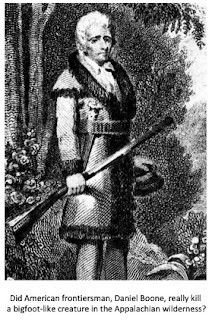
Daniel Boone was born on November 2, 1734 near the present-day town of Reading, Pennsylvania. The sixth of eleven children born to Squire Boone and the former Sarah Morgan, he would go on to earn great fame as a hunter, soldier, politician, statesman, woodsman, and guide. To this day, his is a household name that inspires images of trailblazing adventure and life on a frontier now long gone. Volumes have been written on this legendary figure’s life and of late, I have read through several tomes about this American legend. While doing so, one incident related by the great man himself kept popping up that seems to have been given short-shrift by each his biographers: Boone’s claim that he once shot and killed a ten-foot tall, hair-covered beast, called a “yeahoa” or “yahoo,” in the region that would one day become Kentucky or West Virginia.


     It is easy to see why a biographer of Boone would not know what to think about such a claim. The man did not suffer fools gladly, nor did he tolerate being thought of as one. This is obvious to anyone who reads about how Boone handled being dragged through a humiliating court-martial in 1778. Though he was found not guilty - and was even given a promotion in rank after the court heard his testimony about the matter in question – the frontiersman remained bitter about the entire affair and rarely spoke of it. The grudge against his accusers is one Boone held until the day he died. Yes, Boone was very conscious of his reputation and public image. That being the case, it seems odd he would make a claim as bizarre as having killed a monster.

     Some biographers go into more detail than others about the alleged incident; however, all seem to agree on the basic details of how the story came to light. Late in his life, Boone was holding court with a group of distinguished citizens at a dinner held in his honor at an inn in Missouri. At the conclusion of the meal, a question-and-answer session of sorts seems to have taken place. It was at this time that one of the men in attendance asked for a story. It is unclear if the gentleman asked for the particular yarn he ended up hearing or if Boone decided on the tale to be told. Either way, the story Boone shared was one of having come upon and shooting a ten-foot tall, hair-covered “yahoo” in the Appalachian wilderness many years before. The old frontiersman did not get too deep into the tale before one of the men listening laughed out loud and declared the story “impossible.” Accounts indicate that Boone was deeply offended and refused to continue despite the requests of the others in attendance. The awkwardness of the situation led to the premature end of the get-together and people began making their exits. After most of the others had left, the innkeeper’s son petitioned Boone to finish. 

“I would not have opened my lips had that man remained,” said Boone. 

“Well, we are alone now,” the boy replied. 

The frontiersman is said to have smiled wryly before saying, “You shall have it…” and finishing the story for the lad and the few holdouts who quietly made their way back into the room once it was obvious the story-telling had recommenced.


     While Boone never received much in the way of formal schooling – and his spelling was notoriously “creative” – he read well. His early favorites were history books. It is also said Boone took a strong liking to Robinson Crusoe. Later, two books dominated the frontiersman’s reading time: the Bible and Gulliver’s Travels. Written by Irish writer and clergyman, Jonathan Swift, Gulliver’s Travels became an instant hit upon publication in 1726. Most likely think they are familiar with the plot of Gulliver’s Travels in which the main character finds himself shipwrecked on the shores of an island nation called Lilliput and is taken prisoner by a horde of the island’s tiny inhabitants. It is true this is the most well-known part of Swift’s masterpiece; however, the tale of Lemuel Gulliver’s trials and tribulations among the Lilliputians is just part of the overall work. It is actually the story of Gulliver’s fourth voyage that concerns us in regards to the tale told by Daniel Boone.

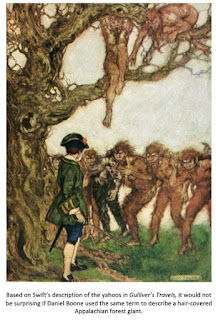
     In Part 4 of the book, titled “A Voyage to the Country of the Houyhnhnms,” Gulliver – who has tired of his life as a surgeon – returns to the sea as captain of a merchant vessel. After several crew members die, Gulliver hires replacements out of Barbados and the Leeward Islands. Unfortunately, the new hires turn out to be buccaneers and soon mutiny. The pirates strand Gulliver on the first piece of land they come across and sail away in his ship. It is now that the story becomes relevant to the Boone tale as the fictional Gulliver soon encounters some terrifying creatures:


“At last I beheld several animals in a field, and one or two and deformed, which a little discomposed me, so that I lay down behind a thicket to observe them better…their heads and breasts were covered with thick hair, some frizzled and others lank; they had beards like goats, and a long ridge of hair down their backs…they often stood on their hind feet…”


Another passage reads:


“My horror and astonishment are not to be described, when I observed in this abominable animal, a perfect human figure: the face of it indeed was flat and broad, the nose depressed, the lips large, and the mouth wide…the forefeet (arms) of the Yahoo differed from my hands in nothing else but the length of the nails, the coarseness and browness (sic) of the palms, and the hairiness of the backs. There was the same resemblance between our feet, with the same differences…the same in every part of our bodies except as to the hairiness and colour (sic)…I never saw any sensitive being so detestable on all accounts; and the more I came near them the more hateful they grew…”


Daniel Boone was intimately familiar with the yahoos described in Gulliver’s Travels. If he had ever come into contact with a huge, hair-covered, human-like beast in his years of traversing the American wilderness, calling the beast a yahoo – based on the description of the creatures written by Swift – seems natural enough. To this day, the names Yeahoh and Yahoo are used to describe sasquatch-like creatures said to roam the mountains and forests of Appalachia.

Critics say Boone’s tale of shooting a bigfoot-like creature is just a campfire story meant to entertain his rapt followers who hung on his every word. Boone biographer, Robert Morgan, would seem to concur and wrote, “He (Boone) was also known to tell tales about encountering great hairy monsters like the yahoos in Gulliver’s Travels. Most likely it never happened.” It is hard to blame Morgan for having doubts about such a fantastic claim, but he dismisses the tale without any elaboration. While the story might be hard to take at face value, Morgan himself writes about the integrity of Boone and how much he valued his reputation. It would seem proper for the author to explain why the famous woodsman would veer from his character and fabricate a story about having killed a monster, especially when it seems all scholars agree regarding how offended the frontiersman became when his story was challenged.


Boone is said to have related the tale of the yahoo on multiple occasions, most often during the last year of his life. Some have speculated that he might have been losing his faculties during his 85th and final year on this earth. Others correctly point out that the “deathbed confession” is a real phenomenon. People confess all manner of things when they realize the end of life is near. Such confessions are thought to help alleviate feelings of guilt or regret the dying person may have been harboring during their lifetime. Too, the “deathbed declaration” - when a dying person shares some secret knowledge - is not an unusual occurrence. Usually, these declarations have to do with feelings the dying individual has for another person; however, sometimes knowledge is shared which the person has been holding onto for years, decades even. Such dying declarations have sometimes been used in court as evidence; indeed, at times, the final words of a dying man/woman are given more credence in such a scenario, as common sense would seem to indicate that they no longer have anything to lose or gain by sharing what they know.

It is true Boone told the story of the yahoo multiple times over his final year(s), but not on his literal deathbed. Still, Boone’s health was beginning to wane and any man once he reached the age of 85 would realize that there was precious little time ahead of him. Too, men of a certain age often get to a point where they could not care less about what others think of them and no longer concern themselves with how they might be ridiculed. Could the knowledge that his time on earth was short have motivated Boone to relate his incredible tale while he still could? Was it important for him to share the story – one he had kept to himself for years – before leaving this mortal plane? Perhaps.

It is highly doubtful that the truth about whether or not Daniel Boone shot and killed a sasquatch-like creature will ever be known. What is inarguable is that Boone spent more time in the American wilderness than just about any white man who has ever lived. That being the case, if the sasquatch is a real creature, who would have been more likely to eventually come across one than Daniel Boone?


Sources:

Faragher, John Mack. Daniel Boone: The Life and Legend of an American Pioneer. The Easton Press, 1995. 

Morgan, Robert. Boone a Biography. Recorded Books, 2008. 

Mart, T. S. The Legend of Bigfoot: Leaving His Mark on the World. Indiana University Press, 2020. 

Swift, Jonathan, and David Womersley. Gulliver's Travels. Cambridge Univ. Press, 2012. 

“Daniel Boones' Sasquatch.” Daniel Boones' Sasquatch Story, enigmose.com/daniel-boone-sasquatch.html. 

Peacock, Lee. “Did Pioneer Daniel Boone Really Kill a Bigfoot-like Creature Prior to 1820?” Did Pioneer Daniel Boone Really Kill a Bigfoot-like Creature Prior to 1820?, 1 Jan. 1970, leepeacock2010.blogspot.com/2017/05/did-pioneer-daniel-boone-really-kill.html. 


Monday, January 11, 2021

The Missionary, the Former Slave, and the Sasquatch

What do an eighteenth-century Jesuit missionary and a former slave from the state of Arkansas have in common? I hate to disappoint any of you that thought this might be the opening line to a bad joke, it is actually a legitimate question. Read on for the answer.


In my mind, some of the strongest sources of anecdotal evidence regarding the existence of the sasquatch are those that pre-date the coining of the term bigfoot in an article about a catskinner named Jerry Crew - who found massive human-like tracks around his road-building equipment in California’s Six Rivers National Forest in August of 1958 - and the explosion of the Patterson-Gimlin footage on the world stage in October of 1967. Sightings reported before these two seminal events cannot be dismissed as the work of hoaxers seeking to hop on the bigfoot bandwagon. The sasquatch was all but unknown to the Europeans who began flooding the North and South American continents in the 1500s…and to the slaves that they brought with them. Their accounts of bipedal, hair-covered creatures simply cannot be dismissed out of hand.    


I would like to discuss here two such historical sightings. The incidents are not well-known, but they may well be extremely important when attempting to trace just how far back sightings of wood apes might go. The similarity between these two accounts cannot be denied and both lend credibility to the opinion of those who believe the animal commonly referred to as bigfoot was being seen well before the 1950s by people of different cultural backgrounds living many miles apart.


The first incident comes directly from the writings of a Jesuit missionary who worked among the people of the province of Sonora, Mexico – a region that stretched up from northwest Mexico to the Sierra Madre from Cjeme (now Ciudad Obregon), near the California coast, to Tuscon - in the eighteenth-century. Father Ignaz Pfefferkorn (b. 1725), a German Jesuit lived and worked among the Pima Indians from 1756 to 1767. Details of his work and life among these people can be found in his Descripcion de la Provincia de Sonora. The diaries, journals, and logs of missionaries have long been highly valued by anthropologists and historians. Pfefferkorn’s work was no different and he is considered by academics to have been an extremely reliable and credible observer. His writings continue to be cited by historians to this day. Among Pfefferkorn’s writings were descriptions of the local wildlife. Among the descriptions of what would be considered common animals, the good father wrote about the different bears (differentiated by their color) found in the region. He wrote:


“Of the Sonora bears some have black hair, others dark gray, and the smallest number are a reddish color. These last are the most cruel and harmful, according to the statements of herdsmen.”


Only two species of bear are known to have ever lived in the Province of Sonora during the eighteenth-century. The black bear (Ursus americanus) and the grizzly (Ursus arctos horribilis) both made Sonora part of their home range during the time in question. While black bears can be black, blonde, or reddish, it is likely the cinnamon-colored bears that were “the most cruel and harmful” were grizzlies. While these grizzlies were likely the animals most often responsible for the killing of livestock in the region, some of the other activities attributed to them may well have been the work of something else.


Pfefferkorn, while documenting bear activity related to him by the indigenous tribesmen, in some cases may have actually been recording accounts of bigfoot interaction with humans. If so, his accounts are some of the earliest ever written down in North America. One intriguing passage is below:


“Bears are a special menace to stock raising, for they eat many a calf, and, if no smaller prey falls into their clutches, they will attack even horses, cows, and oxen. They delight especially in eating maize as long as it is still tender and soft. Woe to the field if a hungry bear breaks into it at night. He eats as much as he can and makes off with as much as he can grasp and carry in his mighty arms. In so doing he ruins even more of the field by breaking it down and treading upon it. The inhabitants assert that a bear defends himself by throwing stones when one attempts to chase him away and that a stone hurled from his paws comes with much greater force than one thrown from the hand of the strongest man.”


I do not think I have to tell anyone that a bear cannot throw stones; nor is it capable of walking bipedally in order to carry off large amounts of corn in its “mighty arms.” Pfefferkorn was familiar with bears. He had traveled across the region for many years and had seen many bruins. Pfefferkorn even witnessed a grizzly kill his Indian guide on one trip across Sonora (the guide had attempted to kill the bear, succeeded only in wounding it, and paid the ultimate price when the animal turned on its tormentor). This being the case, it is strange that Pfefferkorn would attribute rock-throwing and the ability to carry large amounts of corn away while walking on two legs to grizzlies. I think it is entirely possible that the stone-hurling, corn-stealing, bipedal “bears” of Sonora might have actually been wood apes.


A strikingly similar account comes from another historical source: a former Arkansas slave. Doc Quinn was one of the oldest living residents of Miller County, Arkansas (yes, the same Miller County that would become known as the home of the Fouke Monster of The Legend of Boggy Creek fame) when he was interviewed by Cecil Copeland at his home in Texarkana in the 1930s. Doc recalled when he was first brought to the plantation of one Colonel Ogburn – between Index and Fulton on the Red River - that there was a section of the property dominated by an immense canebrake. This canebrake was a favorite retreat of bears and other wild animals. It was all but impossible to go in after problem bears that would steal out of the thicket at night and take livestock, so the plantation owner had the slaves round up the hogs and animals and place them in pens at the end of the day. Several slaves were charged with standing guard at night over the domesticated animals. The efforts of the slaves helped somewhat, but bears were still seen often and some of their actions “were almost human.” The following is a passage taken from the book Bearing Witness: Memories of Arkansas Slavery Narratives from the 1930s WPA Collection in which Doc Quinn describes to Cecil Copeland the odd behavior of a “bear” he came across in a cornfield one day:


“The bear picked off an ear of corn and put it in his bended arm. He repeated this action until he had an armful, and then waddled over to the fence. Standing by the fence, he carefully threw the corn on the other side, ear by ear. The bear then climbed the fence, much in the same manner of a human being, retrieved the corn, and went on his way.”


Sounds familiar, does it not? The simple truth is that bears cannot stroll around in a bipedal fashion while plucking ears of corn from stalks in the field with one front paw and place them into the crook of their other front “arm.” The description of how Quinn witnessed this animal climb a fence “in the same manner of a human being” is fascinating. The entire incident simply does not describe bear behavior in any form or fashion.


Quinn provides another interesting anecdote in the same interview. I thought long and hard about including it here, not because it is not interesting (it is), but because Doc Quinn’s words are transcribed in such a way that his dialect is evident. Some hot-button words, including the n-word, are used. After wrestling with it for a while, I decided to include the account here with only one minor edit (I decided not to type the n-word out. I fear in today’s climate, I would be accused of approving of it or some such thing). Again, I would remind readers these are not my words. These are the words spoken by former Arkansas slave, Doc Quinn and transcribed by his interviewer, Cecil Copeland. The text comes straight from the book previously mentioned. Try to focus on the story Doc Quinn is telling and not the language and terminology he uses. The account is as follows: 


“Late one ebenin’, me an’ anudder (edit) named Jerry wuz comin’ home frum fishin’. Roundin’ a bend in de trail, whut do we meet almos’ face to face? – A great big ol’ bar! Bein’ young, and blessed wid swif’ feet, I makes fo’ de nearest tree, and hastily scrambles to safety. Not so wid mah fat frien’. Peerin’ outen thru de branches ob de tree, I sees de bar makin’ fo’ Jerry, an’ I says to mahself: ‘ Jerry, yo’ sins has sho’ kotched up wid yo’ dis time.’ But Jerry, allus bein’ a mean (edit), mus’ hab had de debbil by he side. Pullin’ outen his Bowie knife, dat (edit) jumps to one side as de bar kum chargin’ pas’, and’ stab it in de side, near de shoulder. As de bar started toinin’ roun’ to make annuder lunge at de (edit) he notice de blood spurtin’ frum de shoulder. An’ whut do yo’ think happen’? Dat ole bar forgets all about Jerry. Hastily scramblin’ aroun’, he begins to pick up leaves, an trash an’ clamps dem on de wound, tryin’ to keep frum bleedin’ to deaf. Yo’ ax did de bar die? Well, suh, I didn’ wait to see de result. Jerry, he done lef’ dem parts, an’ not wantin’ to stay up in dat tree alnight by mahself, I scrambles down an’ run fo’ mile home in double quick time!”


I ask you, what kind of bear notices it is bleeding, stops in the middle of an altercation, begins gathering leaves, and then packs its own wound? I will tell you the answer. None. No bear behaves in this manner. If Doc Quinn is not spinning a yarn to his interviewer, the creature his fishing partner, Jerry, tangled with was certainly no bear. Was it an aggressive sasquatch? Certainly, the location was right as the aggressive nature of the Fouke Monster would be well documented some years later. There is a real shortage of viable alternatives if the creature in question was not a bear.


The parallels between these two accounts – accounts separated by more than a century and approximately 1,400 miles – are uncanny. Bears cannot and do not gather up corn in their “arms” and walk away with it in a bipedal fashion. Yet, a Jesuit missionary and a former Arkansas slave describe observing this same behavior. Doc Quinn’s account of how his fishing partner, Jerry, tangled with an animal that packed its own wound after being stabbed lends credence to the theory that something other than a bear was roaming about Miller County, Arkansas in his youth. Is it possible that these two men from very different worlds - Father Ignaz Pfefferkorn and former slave Doc Quinn - described the same type of animal? An animal they had no name for? An animal that just might have been a wood ape?


Food for thought.


*Special thanks to NAWAC Chairman Emeritus, Alton Higgins, who authored the article, “A Sonoran Sasquatch,” that I drew heavily from for this post.


Sources:


Brown, D. E. (1996). The Grizzly in the Southwest: Documentary of an Extinction. Norman, OK: University of Oklahoma Press.

Pfefferkorn, I., Treutlein, T. E., & Pfefferkorn, I. (1949). Sonora A Description of the Province. Albuquerque: University of New Mexico Press.

Higgins, A. (2010, November 19). A Sonoran Sasquatch? Retrieved January 11, 2021, from https://www.woodape.org/index.php/sonoransasquatch/

Lankford, G. E. (Ed.). (2006). Bearing Witness Memories of Arkansas Slavery. Fayetteville: University of Arkansas Press. 


Tuesday, January 5, 2021

Frequently Asked Questions Answered

As promised, I am going to attempt to breathe some new life into the blog in 2021 so here we go. I receive a LOT of correspondence and get many questions about a variety of topics. I enjoy getting those emails and messages but I do end up answering a lot of the same questions over and over. That being the case, I thought I would make my first post of the year one in which I addressed the most frequently asked questions I get. Some of the questions are personal in nature while others are more cryptid specific.


Question: How did you become interested in cryptozoology?


Answer: I have been interested since I was a young boy. In the early 1970s, my grandmother took my brothers and me to a movie. I do not recall what the movie was that day, but I do vividly remember seeing the Patterson-Gimlin footage in a short feature before it started. I was mesmerized. It just looked real to me. I was hooked from that point forward. Television shows like In Search of… and The Six-Million Dollar Man along with movies like The Legend of Boggy Creek only solidified my interests.


Question: How many people are part of your organization?


Answer: If referring to the Texas Cryptid Hunter site, it is just me. I have had some great folks volunteer to visit sighting locations and send me photos from time to time, but there is no membership or staff.


Question: How long have you been investigating bigfoot and other cryptids?


Answer: I have been actively engaged in field work since 2005.


Question: Are you the same Mike Mayes who is Chairman of the NAWAC?


Answer: Yes.


Question: Have you ever seen a sasquatch or another type of cryptid?


Answer: Yes. I had a sighting of what I believe was a sasquatch in the Sam Houston National Forest in May of 2005. Since, I have three times caught glimpses of animals I strongly believe were wood apes in the Ouachita Mountains of southeast Oklahoma, including one just weeks ago. I have also seen one of the hairless canines news outlets have taken to calling “chupacabras” and many Texans refer to as “blue dogs.”


Question: What do you say to skeptics who deny the existence of the sasquatch or wood ape?


Answer: I find I do not worry too much about what skeptics think. I believe anyone who takes the time to seriously – and that is the key word – look into the bigfoot phenomenon with an open mind will, at the very least, come away feeling that a closer look at the topic is warranted. I fully admit that the evidence is not yet strong enough to conclusively prove these creatures exist (more on that later), but believe a properly funded entity (National Geographic Society, major university, etc.) could obtain concrete evidence if willing to commit the proper resources and time.


Question: Many scientists deny the existence of bigfoot because they have spent many years in the field and have never seen one. How is it that they have never had a sighting?


Answer: How did the okapi stay hidden so long? The truth is that practically no one is looking for the sasquatch. Even field biologists spend most of their time in labs or at universities. The actual amount of time in the field for most is usually pretty limited and they tend to be funded by grants that dictate the specific research they are to be conducting. There is no time or money for “bigfoot hunting.” I would add the majority of witnesses state something along the lines of "I've hunted for X years and never seen anything like that" or "I've lived here my whole life and have never seen anything unusual." These animals are extremely furtive and these sorts of statements are the norm rather than the exception. Most people who spend time in the woods won't see them.


Question: With all the trail and surveillance cameras out there, why are there no photos of wood apes?


Answer: Most trail cameras are placed by hunters watching feeders and/or food plots. Even these cameras are rarely left up year round. There are often regulations that limit how long cameras are allowed to be left up on public land. Too, these cameras are rarely deep into the wilderness where I believe these animals spend most of their time. A hunter typically places his cameras no more than 100-300 yards off a road or an ATV trail. As for surveillance cameras, there are not many of them out in the middle of the forest. Having said that, there are at least a few extremely compelling images and videos that have been captured. The fact that they have garnered so little attention from the scientific community proves that no photo or video will ever be enough to get this species officially documented.


Question: Why have we not found the body/bones of a sasquatch?


Answer: Nature simply does not allow a body to last very long. In a true wilderness, environmental factors like temperature, humidity, insects, scavengers, and acidic soils work to “clean up” a body very quickly. Think about how often the body of a bear or mountain lion – two species that are almost certainly more prolific than wood apes – that died of natural causes are found in the woods. The answer, of course, is almost never. Consider, too, that many animals often seek the most remote and inaccessible location possible when they are sick or injured (think about a sick dog that hides under the porch of a house). Should an animal die in one of these locations, the chances of a human hiker or hunter finding it are pretty small. I do feel it is possible bones have been found and were misidentified and left behind due to their not being thought of as anything special. Outside of a skull or pelvis, most bones are not easily identifiable to laymen.


Question: Do you believe it is necessary to collect a specimen in order to prove the species exists?


Answer: Yes, I do. It may be unsavory to many – and I understand that – but science requires a body. It really is that simple. A compelling photograph or an anomalous DNA sample might get the attention of some in the scientific community, but for the species to be officially recognized, it will take a specimen. That is just the way science works.


Question: If bigfoot is an endangered species, won’t collecting a specimen increase the odds of of it going extinct?


Answer: No, I do not believe that. The collection of one individual should have no effect on the entire population of animals. The key here is to think in terms of a population as opposed to thinking of an individual. Collecting one – and one is all I would approve of - in order to save the population is worthwhile. The government will never set aside preserves or sanctuaries or legally protect the wood ape until it moves from the realm of myth and cable television into the pantheon of known and documented creatures. If the collection of one specimen is enough to send the species spiraling into the abyss of extinction, the animal is functionally extinct already.


Question: Why don’t you just try to tranquilize a specimen and capture it instead?


Answer: The short answer is that such an undertaking is immensely complicated, expensive, and dangerous. Tranquilizing an animal – especially one as large as most wood apes are reputed to be – is an extremely dicey undertaking. I think it would be all but impossible. For more on this topic, listen to the latest episode of the NAWAC’s official podcast, The Apes Among Us, titled “Exploring Alternative Paths to Discovery.”


As you can see, most of the questions I get are in regard to the bigfoot phenomenon. The sasquatch remains the undisputed “king of the cryptids” when it comes to public interest. For more answers to the most commonly asked wood ape questions, see my Sasquatch FAQ Series.


Check back soon as I have several other posts in the works including new black panther reports, historical bigfoot sightings, and an update on the NAWAC’s “Hadrian’s Wall” camera project.