Showing posts with label Texas Cryptids. Show all posts

Tuesday, July 18, 2023

Historical Black Panther Sighting, a Lesson Learned, and a Photo


As I mentioned in a post a few weeks ago, I will be making an effort to get caught up on several black panther sightings that were sent in to me over the last year or so. I was neck deep in trying to finish my book, Valley of the Apes: The Search for Sasquatch in Area X, and struggled to find the time to update all of you on these sightings. I am making the effort to correct that now. Following are a few sighting reports and one photo that I found interesting.


Reported November 20, 2022

My name is Greg XXXXXX and I live in Lexington Tx. Around 1987 I was leaving the Alcoa aluminum plant through the contractor construction gate approximately 5:00 pm. Can’t remember the exact date. I started driving north on Hwy 1786 towards Hwy 79 beside the Alcoa hot lake as it was called where the water from the power plant was released into. Right in front of me approximately 100 feet was a large black panther crossing the road. I got a real good look at him. He was as big as a full-grown mountain lion but appeared to a little thinner in build. I have seen a large mountain lion from my tree stand before while hunting near Milano so I can make the comparison accurately. I would have to guess the panther weighed between 130 and 150 lbs.


TCH Comment: This is a very believable and matter-of-fact report. The witness saw the cat clearly at close range and is familiar with what a mountain lion looks like. There are no signs of hyperbole in the report and I have ruled out mistaken identity. I believe this witness saw what he claims to have seen. 


The location of the sighting is rural and there are sufficient resources for a big cat to survive in the area. If one takes the time to zoom in on the sighting location, it becomes obvious water resources are plentiful. This is something that would be absolutely critical for any predator trying to survive in Central Texas. I find the report credible and will be adding it to my Black Panther Sightings Distribution Map.


Reported 6/22/22


"I saw a dead black panther on the right shoulder of the westbound lanes of I44E approximately 5 miles east of the Stroud sign on the Turner turnpike about 6:50pm Sunday, 6/5/2022. 


A cat is so obvious it cannot be mistaken. I saw the large paws, long legs, square head. It was in a dead pose, legs toward the street and back towards the grass, head facing west. I considered pulling off the road, essentially to gawk, but decided the safety considerations weren't worth the reasons. Had I known then that people don't believe big cat sightings, I would have pulled over. My 10-year-old son saw it too. My step daughter was in the car and she didn't see it, she was looking at her phone. 


With so many pick-up trucks in Oklahoma, I wonder if someone took it home, or if wildlife management can document it. I wonder if the toll pass cameras record what is in people's truck beds? 


I haven't followed up with wildlife management, but I am curious if there are others to corroborate.” 


Kathleen XXXXXX

Edmond, Oklahoma


TCH Comment: I will not be placing this sighting on my distribution map, but it isn’t because I do not believe the witness; rather, it is because she was traveling along the highway at a substantial rate of speed (likely 70-80 mph based on my experience on the Turnpike in question). While her description matches up well with historical reports of black panthers, the chance of misidentification while moving at such a clip is simply too great for me to feel totally confident.


The lesson here is to pull that vehicle over and pick that carcass up. If you aren’t comfortable with that, take lots of photos.


Reported: 6/2/22


Hi, my name is Caleb I live in south east Missouri. I just listened to an Expanded Perspectives episode about the black cats in Texas, or something like that, and I just wanted to share my story with you because I’ve had a very close encounter with a panther, a buddy of mine - his dad actually - killed a panther due to it messing with livestock. He actually had the head and pelt for a while. I’ve had other encounters with them while hunting and such but that was the closest that I’ve ever been to one. During the podcast you stated some people say that they have leopard-like spots on them. I can say that I do remember the spots on the pelt of this particular pelt. Let me know if you have any questions. I will try to answer them the best I can. 


Thanks for reading." 


TCH Comments: This is another account that I will not be mapping. I have heard multiple accounts of people killing a panther and keeping the pelt. Yet, there are absolutely no photos. Without a picture, this is just hearsay and I don’t feel good about placing the incident on my map. The witness claims other encounters but does not share any details regarding them. This doesn’t mean the witness is being untruthful, just that I don’t have enough details to feel good about adding it to my map.


I will wrap up this post with a photo sent to me from Mr. Brandon Darr. Brandon felt that the photo illustrated the different shading/coloration individual cougars can exhibit nicely and I agree with him. The only information on the photo itself is that it was allegedly “taken in Northern Mexico.” Since I’m posting it here only to show how different cougars can vary in the shade of their coats, it isn’t really relevant where it was taken.


The cats on the left and in the middle are clearly much darker in coloration that the cat on the right. I would guess the cat on the right is displaying the normal tawny-colored coat we are all used to seeing. The two on the left are much darker, especially on their dorsal surfaces. They are not, however, chocolate-colored or black. We can be sure of this by looking at the contrast in darkness between their backs/the ends of their tails and the rest of their bodies. If they were all black or dark brown, their bodies would be much more uniform in color, like the lighter-colored cougar on the right. Seeing darker-colored cougars in low light conditions could very well explain some black panther sightings.


If you would like to dig deeper into the black panther phenomenon, you might consider picking up a copy of my book, Shadow Cats: The Black Panthers of North America. In it, you get a thorough overview of the phenomenon, my thoughts on what these animals might be, interviews with big cat experts, and more. You can pick up a copy at the link above or, if you would like a signed copy, you can contact me at Texascryptidhunter@yahoo.com. 

Tuesday, June 27, 2023

Catching Up: Black Panther Reports


For the last few years, I have been deeply involved in several writing projects. Hopefully, you are familiar with the result of at least one of those projects (Valley of the Apes: The Search for Sasquatch in Area X). The process of writing that book was a true labor of love and seeing it published and well received was immensely gratifying. It did, along with other lower profile projects, take a LOT of time. When combined with my regular job of teaching middle school history, my responsibilities as the Chairman of the Board of Directors of the North American Wood Ape Conservancy (NAWAC), and the general stress that comes from life itself, there simply wasn’t much time left over to keep up with the blog (or much of anything else).


I have taken steps to simplify my life and create more time to do the things I really enjoy, like writing this blog. The results have been tangible as I have published three posts this month alone (this will be the fourth). I won’t have quite as much time once school starts in the fall but hope to average two posts per month going forward. I still have a lot to say and there are still an awful lot of strange stories to tell. In that vein, let’s move on to the real topic of this post: black panthers.


Disclaimer: according to mainstream science, there is no such animal as a “black panther.” The panthers of the movies and television are either melanistic leopards or jaguars. Wildlife authorities do not believe either of these species currently inhabit Texas, the American South, or any other region of the United States or Canada (the exceptions being the states of Arizona and New Mexico, in which a few transient male jaguars have been documented). Still, the reports of large, black, long-tailed cats have continued. Documenting and charting the location of the most credible reports is part of my ongoing effort to answer one simple question: what are the black panthers of North America?


The following is a report that I have had in my files for a while. Now that I have some time, I am going to attempt to catch all of you up on the backlog of reports that have come in to me. This account is a long one, so it will be the only report featured in this post. I have edited the report a bit for length in order to make it a better fit for this blog.  Wherever you see an elipse (…) some extra material was omitted for the sake of brevity. I do not believe my having done so changes the critical details of the report. The words you do see are those of the gentleman who forwarded the account to me.


Reported January 27, 2022


“Hello, Mr. Mayes.


“I recently visited the North American Bigfoot Center/Museum in Boring, Oregon. While there, I had the opportunity to purchase a number of books, one of which was your Shadow Cats. I specifically bought this book due to its topic on black panthers in North America…


“…I felt compelled to tell you an accurate and true sighting of a black panther in Idaho. The sighting was at a very close range. The witnesses were my mom and dad. I’ve heard the story a number of times and the facts never change, nor would I expect them to as both of my parents are of the highest ethical standards…


“…The sighting took place in west central Idaho around 2012. The closest town would be Cascade, located of highway 55. My dad retired as a captain with the Payette, Idaho Fire Department and my mom was a long-time real estate agent and later worked in the nursing field… When my parents retired, they spent a great deal of time in a side-by-side ATV taking trips deep into the Idaho back country…One trip…they accessed a road off of highway 55 and headed east on a dirt road…Mom and Dad were in no rush, just sightseeing, having a nice lunch, and enjoying the day…They were traveling west back toward highway 55 when Dad’s attention was drawn to the right side of the road where a black cat was lying…This cat then stood and walked across the road in front of their ATV and slunk into the heavy timber…both of them were essentially speechless…My dad recalled saying that was a black panther and that someone’s pet had to have escaped its enclosure…My dad was well-versed in mountain lions and, in fact, we’ve both had the good fortune to see them in the wild. Both of my parents were positive and adamant that this was not a color phase or a hybrid of a mountain lion but a real black panther. 


“After several minutes…they were able to re-start down the road. A short distance later, they came upon a couple of…ranch hands. My dad explained to them what they had seen and asked the men if they had any knowledge of panther activity on or around their spread. Dad said the older man’s body language changed and he seemed concerned, leading my mom and dad to think this guy had seen the panther himself or had experienced some livestock loss…prior to my parents leaving, one of the men radioed to the homestead to make sure the women were aware of the sighting and to make sure all of the children were accounted for…


“…I can testify under any oath…that this story is true and correct, a class-A legitimate sighting….my parents did not know there was a following on the topic or that there were even any books written about it. If you are ever inclined to go into this area or even chat up my mom, please feel free to reach out…


L.A. Dove”


TCH Comment: While the report lacks much in the way of detail regarding the appearance of the cat itself (approximate weight, length, etc.) the circumstances would seem to rule out a case of misidentification. Both witnesses were adamant that they saw a black panther and not a dark mountain lion. The fact that the male witness had seen cougars in the wild before, lends credibility to his claim that this was no mountain lion. I must say, the behavior attributed to the ranch hands is interesting. If true - and I have no reason to believe it isn’t – one stiffened up and clammed up while the other quickly radioed home to give the family there a heads up regarding the sighting. It is speculation of course, but these seem to be the behaviors of two men who are familiar with the animal that was described. I guess we’ll never know for sure.


As I mentioned above, due to the length of this submission, I am going to feature it alone on this post. Others will soon follow.


One other thing, I am going to start adding compelling sighting reports from other states on my Black Panther Distribution Map. I think I have accomplished my original goal of trying to pinpoint the most likely places to encounter these cryptid cats in the Lone Star State. Now, I am hoping to identify other patterns on a larger scale by including all of North America. I will be going back through my records and adding some reports that reached me from outside of Texas.


If you are interested and would like to know more about the black panther mystery, check out my book, Shadow Cats: The Black Panthers of North America. Click the book link in the right margin or here for more information.

Thursday, February 2, 2023

The Kindly Phantom of Wilson Creek

As most of you know, I am a native Texan. To be more specific, I am from East Texas. The reason I make this distinction is due to the difference in terrain and geography from east to west.  The East is home to the Piney Woods and the legendary - and jungle-like - Big Thicket. Copious amounts of rain falls on this part of the state, birthing numerous rivers and countless creeks.  The dark woods and deep thickets offer cover and food for many animal species. This is also the region of the state from whence most of the sightings of large, hairy, ape-like creatures originate. The tale that follows concerns at least one such creature and is one I was not familiar with until recently. Some of the details reported will be familiar to followers and researchers of the sasquatch phenomenon; however, other accounts are unlike anything I have ever come across. Do the various stories over the years describe different beings/creatures or are all the accounts related? I suppose that is for you to decide, dear reader. Now, on with the story.


“It looked like a monster,” a 1934 article from the May 20th Sunday edition of the Beaumont Enterprise begins. “It’s (sic) body…seemed to be covered with long black hair. Some described the Thing as bearing every earmark of a great ape.” The creature in question was squatty and powerfully built. He (we make an assumption on gender here) wore no clothing and never uttered a word. More often than not, the phantom – as he came to be known – appeared to locals at the height of raging storms and/or when said folks were in some sort of trouble and in dire need of help.


This particular “haint” wandered the woods and along the banks of creeks in Tyler County, Texas in the 1840s and 1850s. While the settlers of this region had many encounters with the benevolent beast – for that is how he was thought of by the locals – it is the stories of brothers John and Robert Rotan which I will focus on here. The following tales were related to reporter Dean Tevis by Young John Rotan for the previously referenced 1934 article. The stories were told to him by both his uncle, Old John, and father, Robert Rotan.


 Old John left the community of Peach Tree one night to visit the nearby Burch settlement, which sat about a mile from the spot where the town of Chester exists today. The exact nature of the trip is not stated, but it was most likely a business trip (Old John dealt in cattle). Whether John Rotan closed his deal is not disclosed; what is known is that a terrible storm set in on the area as he was making his way home. The night was pitch black and rain was falling in buckets. Old John had to depend on the vision of his horse to keep to the trail, as he could see little to nothing in the deluge. It was not long before he rode up on a creek called Wilson Branch. The usually benign stream was running fast and deep due to the heavy rains. His horse – an unusually trustworthy animal, according to John – hesitated and balked at crossing the torrent. Old John tried everything to get his mount to proceed. He coaxed, prodded, and spurred the beast but to no avail. The horse would not budge. Suddenly, an event occurred that caused Old John to question whether it had really been the raging waters that his horse had shied away from. “Seemingly from the creek itself, then well out of its banks, grew an unnatural figure.” His horse reared in fright, pawing at the air in the direction of the advancing shadow, forcing John to hold on for dear life. “It wasn’t very tall,” he is quoted as saying. “But it was thick set, ape-like, and seemed hairy. It seemed to wear no clothes. In a way, you may have said it was rather shapeless.”


John was chilled to the bone by the sight of the apparition but made no move to retrieve the loaded pistols he carried in his saddlebags. Whether John froze in fear, or, as he later claimed, concluded that it would not have been to his advantage to fire a bullet into the Thing, can only be speculated upon now. What is known is that while Old John pondered on what action to take, the phantom walked up to a position even with his saddle horn. Miraculously, the frightened horse quieted and stood stock still as the creature reached out and touched the animal’s neck. Wide-eyed, Old John Rotan watched as “The wild figure put its hand on the horse for an instant, and then, without adoo (sic) took hold of the bridle” and began leading the steed down the slope and across the angry creek branch safely. “It was all over in a few seconds,” John said, “then the figure disappeared into the darkness it came from…”. Old John never saw the phantom again but often speculated on what his fate might have been had the creature never appeared. The tale of the kindly phantom of Wilson Creek might have faded into oblivion soon after, had not dozens of other settlers seen and had experiences with what most feel was the same being. One such notable account was given by Old John Rotan’s own brother, Robert.


Robert Rotan’s story took place in the springtime as he awaited the arrival of his first-born, a season that brings violent thunderstorms to much of the Lone Star State. As many can attest, babies care little for what atmospheric conditions are present at the time of their arrival on this mortal plane, nor do they seem concerned whether or not medical help is available. Such were the circumstances the night of little Sally Rotan’s birth.  Mother and father had hoped and prayed that the child’s arrival would come after the raging storm outside had broken, but it soon became obvious that would not be the case. Help was needed and it was needed fast. Robert saddled up and tore off through the storm towards the homestead of a local woman known to locals as “Grandma Pullen.” Ms. Pullen was often called upon by the residents of Tyler County to assist in the birthing process. Robert needed to fetch her fast, as his wife was in distress. The problem was that Ms. Pullen lived 8-10 miles away in an area that was in the thick woods and nearly impenetrable under the best of circumstances. Robert was attempting to find the Pullen cabin on a moonless and stormy night.


Situated between Robert Rotan’s home and that of Grandma Pullen was Caney Creek. According to theEnterprise article, “Caney is famed for its tangled wilderness. Its banks, and the country on both sides of them for a good distance, are thick in palmettos, tear blankets, and saw vines, bearing mean sharp briars which cling tenaciously to the clothing, and rip the hide of a horse sent through them. By daylight a horseman could ride round the worst of the patches which overgrew the narrow roadways, but at night he was almost helpless against them. It was often said that a man could hide all his life in this country and never be found…”. This is what Robert Rotan was up against as he fought the elements in an effort to locate the Pullen cabin.


Robert successfully, though painfully, negotiated the tear-blanket vines and made it to the bank of Caney Creek. Once there, he found the creek dangerously high and fast-moving, due to the raging storm. While searching for a safe spot to cross the creek, Robert and his mount became hopelessly lost. Being nighttime – a dark, stormy, and moonless night at that – there were no landmarks visible to guide him, and after riding in circles for what seemed like an eternity, Robert stopped his horse and hunkered down, hoping that the weather would soon break and he would be able to find his way out of the thicket. 


Exactly how long Robert and his horse had been motionless in the deep thicket is not known. All that is known is that Robert, after having been still for a while, saw a figure rise up mere yards in front of his mount, “seemingly from the ground.” The apparition did not hesitate, but stepped forward and took the reins of the horse and proceeded to lead him through the bottoms, across the creek, and up into the hills, where Robert was able to again locate the trail. Robert, who had had ample time to observe the creature, described a being “covered with black hair,” and having a “somewhat short, stubby body, and looked like…an ape.” The phantom said nothing, nor did it ever even look at Robert, and melted back into the gloom of the forest once its mission had been accomplished. 


Robert Rotan did make it to Grandma Pullen’s cabin that night and she was, indeed, able to help deliver baby Sally. Years later, Robert’s son, Young John, would say, “As you can believe, my father was desperate that night. Perhaps it was a dream he had. Perhaps it was something else. As far as I’m concerned, I’m of the opinion that what he saw was the same figure my Uncle John saw that night he crossed Wilson Branch.”


There are other stories from the Peach Tree Village area that are more typical (if that term can ever be used) descriptions of sasquatch encounters. Settlers during this same time period were hounded by a mischievous “pebble thrower.” One homestead in particular, dubbed the Hallmark Home, was the favorite target of the hurler and was showered with rocks, pebbles, gravel, and other forest debris on a regular basis for 75 years. Often, the pebble thrower was accompanied by what the pioneers called the “wild woman of Caney Creek.” The wild woman was never seen, but her “wild, untamed screams were heard in the tangled bottoms of the creek on many occasions over a period of half a century.” Were the pebble thrower, the wild woman of Caney Creek, and the kindly phantom of Wilson Creek all different entities, or was the same being responsible for all of the strange occurrences in Tyler County during the late 19th century? Young John Rotan, son of Robert and nephew of Old John, pondered the same question. “I often wonder if the kindly phantom was kin to the wild woman, if she was a ghost, too, and whether they both were related to the strange pebble thrower of the Hallmark House. Sometimes I think they’re different, and then sometimes I think, well, maybe they’re one and the same thing – just acting different at different times and for different purposes.”


I admit that the actions of the kindly phantom described in these old stories are unlike anything I have ever heard regarding sasquatch behavior. Whether the events took place exactly as described, I obviously cannot say. What I do know is that in a world where wood apes are often seen as creatures to fear and are subtly blamed for the disappearances of what seems like every missing hiker or hunter across the nation, it was nice to come across a story where the sasquatch-like figure was seen in a positive light and not feared by the locals (though the pioneers of Tyler County did fear the pebble thrower and wild woman of Caney Creek). 


I will wrap this post up with the words of Young John Rotan who said, “You know there are some things in this world, now as well as back there, that neither you nor I, or anyone else, can explain. And just because we can’t explain them, why, that’s no reason to say they didn’t happen. I don’t look at things like that, do you?”


Well, do you? 


P.S. – I would like to send a special “thank you” to Susan Shine Kilcrease and her crack research staff at the Ice House Museum in Silsbee, Texas for finding and forwarding the Beaumont Enterprise article sourced for this post. 


Source:

Tevis, Dean. “The Kindly Phantom of Wilson Creek.” Beaumont Enterprise, 25 May 1934, pp. 10–10. 

Tuesday, November 22, 2022

The Ghost Horse of the Llano Estacado

          There were no horses in North America until the Spanish began their conquest of the New World in the 1500s. While it is true that the progeny of escaped English, French, and Dutch settlers in the northeast ran wild in the eastern region of the continent for a time, the wild mustangs of the western half of the continent are the horses that continue to hold sway in the imagination of most people. These horses were the direct descendants of the Arab and Andalusian stock used by the conquistadores who plundered the Aztecs and searched for the seven golden cities of Cibola on the plains of middle America and across the deserts of the southwest. These horses were legendary for their fiery temperament and resistance to domestication. No other creature on the continent represented freedom the way the wild mustangs of the American southwest did. This is the story of one very special horse, even by wild mustang standards, that some say continues to run free to this very day.


            The great horse, white man and Indian agreed, was special. The stallion was given many names: the White Steed of the Prairies, the Pacing White Stallion, the Ghost Horse of the Plains, the White Shadow, the Winged Steed, and Wind Drinker. The horse was described as being of a white or pale cream in color with a snow-white mane and tail. Too, the mustang was much larger than the normal wild horse of the plains and his harem of mares was twice the size of a normal steed. The speed of the Ghost Horse was the stuff of legends. “He seemed to glide rather than work his legs,” one cowboy who attempted to lasso the steed once said. “He did not seem to be trying to get away, just leading us on.” The fame of this magnificent creature spread far and wide and sightings of this phantom of the prairie stretched from the Mexican desert in the south, to the Badlands of the Dakotas in the north, to the Brazos River bottoms in the east, to the Rocky Mountains in the west. He was nowhere, yet everywhere, it seemed. 


            Ranchers across the west knew that the capture of the Wind Drinker would bring fame and fortune, thus a bounty for the capture of the stallion was offered. The potential windfall caught the eye of a breeder of race horses from Bonham, Texas in 1879. He organized a venture to track down and capture the Ghost Horse. The wranglers ranged far north into Indian Territory (now Oklahoma) before finally catching sight of their quarry. The vaqueros laid all manner of traps and attempted to trick the great horse into being surrounded, but each time the stallion would bolt and “pace away like the wind.” The Indians, who had agreed to guide the rancher, abandoned the effort upon laying eyes on the great steed. They considered him a supernatural creature and the possessor of “unspeakable medicine.” From the description of one of the horsemen present on the expedition, the vaqueros did not feel altogether too differently. “When running at a distance he showed nothing but a fast-flying snow-white mane and tail that looked like wings skimming the ground…he was the most alert and the wildest as well as the fleetest animal in western America.”


            Likely, the most well-known tale of an attempted capture of the great White Horse of the Prairies was undertaken by a fiddle-playing character from the east named Kentuck prior to the Civil War. Kentuck, the story goes, took up with a gambler from Arkansas who went by the name of Jake. The two heard tale after tale about the Ghost Horse and, spurred on by the thought of the wealth they would most certainly attain if successful, decided to go after the legendary steed. The pair purchased pack mules, supplies enough to last half a year, and four New Mexican horses bred for speed and endurance and set off on their quest. The gambler, Jake, in particular seemed obsessed with the hunt. He said, “I don’t know exactly where to hunt, but we’ll ride on the prairies until we find the horse or until they are burned crisp by the fires of Judgement Day.”


            The colorful duo crisscrossed the Great Plains for weeks on end until they found themselves on the Llano Estacado, or Staked Plains, near the Canadian River in the panhandle of Texas. As weeks turned to months, Kentuck lost his enthusiasm for the effort and tried to talk Jake into calling the whole thing off. “Go back if you want,” Jake said. “Go and rot. I have sworn to get what I come to get.” Chastised, Kentuck went silent and stayed on. Eventually, the persistence of the pair would pay off and they would finally put eyes on the legendary Wind Drinker. Following a cold and wet day, the hunters were huddled in camp around a buffalo chip-fed fire. Jake was squatting and warming his hands and staring to the southwest when he saw movement. “Yonder,” he hissed to Kentuck and made for his staked pony. “I supposed it was Indians and grabbed my rifle,” Kentuck later said. “Then my eyes picked up the white horse. He stood there to the southwest, maybe a hundred yards off, head lifted, facing us, as motionless as a statue. In the white moonlight, his proportions were all that the tales had given him. He did not move until Jake moved toward him.”


            Spying his pursuers, the Ghost Horse fled to the east, against the moon. Jake later recounted, “He seemed to glide rather than work his legs, he went so smoothly. He did not seem to be trying to get away, only hold his distance. He moved like a white shadow, and the harder we rode, the more shadowy he looked.” After a bit, his horse tiring and an increasing sense of foreboding creeping into his soul, Kentuck called out to his partner, “Jake, I don’t like this. There’s no sense to it. I’m remembering things we’ve both heard. Let’s stop. We can’t no more catch up to him than with our own shadows.”


            Jake, completely obsessed and wearing the look of a madman yelled back, “I told you I’m going to follow till the Day of Judgement.”


            Kentuck chose to continue the pursuit and not leave his partner, though he did hang back a bit. “Riding on and on out there in the middle of nowhere, not even a coyote breaking the silence, it didn’t seem like this world,” he later said. It was about then that Kentuck spied a jagged blackness on the ground in front of them: a canyon. “It’ll soon be settled now,” he said to himself. “We’ll soon know whether the White Stallion can cross empty space like a ghost.” At the realization they were approaching a massive drop off, Kentuck pulled his mount to a stop. To his horror, his partner spurred his mount even harder in an effort to catch the Wind Drinker. Kentuck called out, “Jake, watch out for the canyon!” His warning, if Jake ever heard it at all, came too late and Kentuck watched the Arkansas gambler and his mount plunge over the side of Palo Duro Canyon.


            Kentuck cautiously approached the edge of the gorge and peered down into its dark maw. He could not see the bottom. Neither did he see the Ghost Horse. When questioned, Kentuck said he could not be sure if the White Pacer had gone over the edge or not. He had turned his attention to his friend and lost sight of the stallion. Shortly after dawn, Kentuck found a buffalo trail that led to the bottom of the canyon. There he found the remains of Jake and the horse he rode into oblivion, a full one hundred feet below the rim of the canyon. Kentuck buried his friend in a makeshift grave where, I suppose, he remains to this day. As for the Wind Drinker, Kentuck would never again lay eyes upon him.


            Campers and hikers at Palo Duro Canyon have reported the sound of thundering hoofbeats in the night. Too, tales of a phantom white mustang running the plains and along the rim of the Canyon are still shared from time to time. In a few cases, witnesses have spied a ghostly cowboy riding hell-bent for leather after the great stallion and into the Texas night, doomed, it seems, to pursue the uncatchable until “Judgement Day.”


            The wild mustang remains a symbol of the old west. The idea that these horses represent freedom and liberty endures. According to the U.S. Bureau of Land Management, there are more than 82,000 horse and burros on federal rangelands stretching across ten states today. Whether the White Pacer runs with them, I cannot say. Regardless, the legend of the Wind Drinker remains. 


I hope it will always be so.


Sources:                                                                                                                                

Dobie, J. F. (1995). I'll tell you A tale: An anthology. University of Texas Press. 

Vasilogambros, M. (2022, July 20). Westerners struggle to manage booming wild horse populations. The Pew Charitable Trusts. Retrieved November 22, 2022, from https://www.pewtrusts.org/en/research-and-analysis/blogs/stateline/2022/07/20/westerners-struggle-to-manage-booming-wild-horse-populations 

Thursday, July 21, 2022

The Lobo Girl of the Devil's River

Even a man who is pure of heart

And says his prayers by night,

May become a wolf when the wolfbane blooms 

And the Autumn moon is bright.


The werewolf legend is likely as old as mankind itself. Tales of shape-shifting shamans, skinwalkers, and unfortunate souls who were either cursed or survived an attack by one of these beasts (only to become a monster themselves) appear in nearly every culture to have ever existed on this planet. I am sure that those versed in the science of psychology could share many theories on why this may be so. I, however, tend to believe that there is something more to such stories. Something significant – and very real to those who experienced it – must have taken place at some point; otherwise, the lore of the werewolf would not have survived for these many generations.


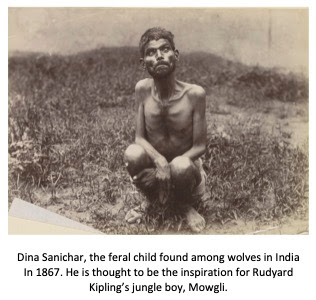
What sort of event could lead to the belief that a human being could be transformed into a wolf when the moon is full? Perhaps the legend has its roots in the tales of feral children found in the forests and jungles of the world long after they were presumed dead. Some of these stories are purely fictional, of course. The wolf-suckled twins Romulus and Remus who, according to legend, founded Rome, are one such example. Rudyard Kipling’s The Jungle Book, which details the rescue of the “man cub” Mowgli by a she-wolf who nursed him and raised him as her own, is another. These tales are all well and good, but is there any proof that such a thing has ever really happened? Surprisingly, the answer is yes.


Throughout history, the discovery of feral children has been extremely rare, but it has happened. The previously mentioned Mowgli was inspired by the strange tale of Dina Sanichar who was raised by wolves in India’s Uttar Pradesh jungle. Found by hunters in a wolf’s den in 1867, Sanichar (named by missionaries who later took him in) walked on all fours, would only accept raw meat as food, gnawed on bones to sharpen his teeth, and could not communicate verbally other than producing decidedly wolf-like grunts, barks, and howls. Eventually, Sanichar did learn to walk upright and dress himself; however, he never did learn language and died at the age of 35. Another real-life example of this phenomenon is “Peter the Wild Boy” who was discovered in the forests of Germany in 1725. Believed to have been abandoned by his parents, the boy was estimated to be 11 years old when found. He was unable to speak and loathed wearing clothes. Within a year of his rescue, Peter was shipped off to London where he became the “human pet” of King George I. The wild boy bounded about the King’s court on all fours, which the courtiers of Kensington Palace initially found quite entertaining. It was widely believed that the boy had been raised by wolves or bears due to his behavior. Eventually, the King tired of Peter and shipped him off to a farm in Herfordshire where he was forced to wear a collar that read: “Peter the Wild Man of Hanover. Whoever will bring him to Mr. Fenn at Berhamsted shall be paid for their trouble.” Peter died in 1785 and was buried in the cemetery of St. Mary’s at Northchurch. There are numerous other examples of feral children that were suspected to have been raised by animals that could be cited here, but I trust the point has been made. What many do not realize is that this very scenario may have once played out in the deserts of west Texas.


A nearly forgotten historical fact is that a group of English people once established a small settlement called Delores on the banks of the Devil’s River (part of the Rio Grande drainage basin) in southwest Texas. The community was short-lived as most of the settlers were killed by Comanches. One white couple (who had a rather colorful history of their own), who lived on the extreme edges of the settlement, survived and carried on. One day in 1835, the settler husband frantically rode up to a homestead owned by Mexican goat ranchers and asked for help as his wife was having a baby and was in great distress. According to legend, a storm was brewing and the Mexican couple wanted to wait it out before mounting up and going to the aid of the mother to be. The settler insisted they leave immediately as his wife’s need was great. The Mexican couple relented and they started toward the settler’s home on the Devil’s River. The party had hardly started out when the settler was struck by lightning and killed. This event gave the rancheros pause and they decided to wait until morning to make the trek. While understandable, the decision of the Mexican couple proved disastrous for the female settler. Her lifeless body was found beneath an open brush arbor the next morning. There were clear signs the woman had died during childbirth, yet no child could be found. The couple hastily searched for the infant but found only lobo tracks in the vicinity. The couple assumed that wolves had come upon the scene and devoured the infant. Why the lobos had left the body of the mother unmolested was puzzling to the pair, but they proceeded with burying the unfortunate woman and then made their way home.


Ten years later, in 1845, a boy living at San Felipe Springs (now called Del Rio) reported that he had witnessed a pack of wolves attacking a herd of goats. With them, he claimed, was a long-haired creature that resembled a naked girl. The boy was chastised greatly, but the story – as good tales are apt to do – spread throughout the region. Roughly a year later, a Mexican woman at San Felipe declared she had watched two big lobos and a naked girl ravenously devouring a freshly killed goat. The woman claimed to have gotten very close to this odd trio before they took notice of her and bolted. The naked girl, at first, ran on all fours but eventually rose up and ran on two feet. The woman reported she was positive as to what she had seen and that the child was definitely keeping company with the two wolves.


Again, the story spread like wildfire, but this time the memory of the unfortunate settler woman who had died during childbirth, but whose baby was never found, was recalled. Could the feral “lobo girl” be the missing child, now 10 years old? Other stories related by local Native Americans – previously dismissed as superstitious drivel by the Anglo settlers - were also recalled. The Indians had claimed more than once to have located barefoot human tracks and handprints on the sandy areas along the river. The human spoor was always found among wolf tracks. Could it be? Was such a thing even possible? It was decided by the settlers that they had to find the wolf or lobo girl and rescue her. The posse managed to pick up the wolf pack’s trail quickly and cornered the girl in a small canyon. With the feral girl was a big lobo that fled when the child wedged herself into a crevice in the canyon wall. The girl at first cowered in fear before her tormentors, but then her countenance grew fierce. She spat, hissed, and growled at the men as they approached and bit and clawed them once they took a hold of her. Once captured, the girl began to produce a “pitiful, frightful, unearthly sound…resembling both the scream of a woman and the howl of a lobo, but being neither.” Distracted by these terrifying sounds, the vaqueros nearly failed to spy a huge he-wolf, likely the pack alpha, creeping up on the group. Fortunately for the posse, one man turned in time to see the wolf as it was preparing to spring and shot it dead with his pistol. At this, the lobo girl fainted.


The men bound the girl securely and stepped back to examine her more closely. According to the men, she was “excessively hairy, but breasts of beautiful curvature and other features showed that she was a normally formed human female. Her hands and arms were muscled in an extraordinary manner but were not ill proportioned.” The party rode to the nearest ranch where the girl was untied and placed in an isolated room for the night. The men attempted to communicate with her, offered her food, coverings for her body, and water but she reacted only with distrust and fear. The terrified girl backed herself into the farthest corner of the room where she cowered pitifully. The men decided, for the time being at least, to leave the poor creature alone. The door was closed and locked and the men nailed a thick board across the room’s only window. Things remained quiet…until darkness fell.


Once the sun set, the wolf girl began to emit screaming howls that were terrible to hear. Soon, her cries were answered by the long deep howls of wolves in the distance. The men’s eyes widened and fear began to creep into their souls as the cries of the lobos – seemingly approaching the ranch house from all sides - grew louder and more menacing. It wasn’t long before they were all howling in unison, “a bass-throated chorus of ferocity” the likes of which the rough and tumble vaqueros had never before heard. To the men, it seemed all of the lobos of the western world were gathering outside of the house. These rancheros, all of whom had lived their entire lives in the region, had never heard anything like it, “either from such a number of wolves now assembling or in the sullen, doom-like quality of the long, deep howling.” Back and forth the calls went. One of the men later recalled, “They (the wolves) would go silent as if waiting from some answer, and the wild girl in the dark room there would answer back with her unearthly, howling scream, a voice neither of woman nor of beast.”


After a while, exactly how long no one could say for sure, the pack made for the corrals and pens, attacking goats, cows, and horses. The screams of the livestock broke the spell the terrified men were under and they sprang into action in an effort to save the animals. Ordinarily, the rancheros did not fear wolves; however, on this night, the men stayed tightly packed together as they sought to run the predators off by shooting and shouting into the darkness. Eventually, the wolves retreated. When the men returned to the ranch house, they discovered that someone, or something, had managed to wrench the plank nailed across the window of the room where the lobo girl had been incarcerated loose. She was gone, presumably reunited with her pack. Not a single howl was heard for the rest of the night and, somewhat curiously, wolf sightings in the general area became exceptionally rare over the following years.


Six years would pass before the wolf girl was seen one final time. The year was 1852; gold had been discovered in California and travel westward had greatly increased necessitating the need for a wagon trail or road that was better watered than the Chihuahua Trail currently used by travelers heading to and/or through El Paso. A group of scouts seeking such a route came upon the lobo girl at a spot on the Rio Grande where it takes a sharp bend far above the mouth of the Devil’s River. At close range, the men caught sight of the hair-covered, naked young woman (some versions of the tale say she was holding or nursing two young wolf pups). Once she caught sight of the men, she sprang away in a flash, “dashing into the breaks at a rate no horse could follow.” The slack-jawed men sat stunned upon their mounts, knowing they had just glimpsed none other than the lobo girl of the Devil’s River.


As far as I can tell, the lobo girl was never seen again…at least not by white or Mexican settlers who would have left some record of the account. It is rumored that some of the handful of Apaches left in the region caught sight of her from time to time, but it cannot be confirmed. As years passed, the memory of the lobo girl faded. What happened to her will likely never be known. Some would later claim the entire story had been fabricated as it was simply not possible; however, the vaquerosrancheros, and scouts who did see her never recanted their stories and stuck to their guns until the day they died.


Texas does have werewolf legends of the more classic shapeshifting type: The Beast of Bear Creek, The Converse Werewolf, and the Cajun Rougarou all come to mind. To me, however, the tale of the lobo girl of the Devil’s River may be the strangest and most unsettling of them all. If scenarios where feral children raised by animals in other parts of the world have proven to be true, why could it not also have happened in the arid deserts and scrubland of frontier west Texas? Was she a true werewolf? No. To the rancheros that encountered the lobo girl and her fiercely protective pack, however, it mattered little. She was wolf enough to them.


West Texas remains sparsely populated to this very day. It is a wild and lonesome country where nature still reigns supreme. It is a region where all manner of strange goings on continue to be reported; a place where it is easier to believe in such things as the lobo girl of the Devil’s River than it might be in other locales. Should you ever find yourself there, alone on the night of a full moon, you might still hear the howl of a wayward wolf or coyote and recall the legend of the lobo girl. On such a night, even though you do not believe in such things, another stanza of the famous werewolf poem might come to mind:


To hear her cry in the dead of night

And strain to see the terrible sight,

Is to know the meaning of dreadful fright.


Sleep well.


Sources: 


Dobie, J. F., & Boatright, M. C. (1966). Straight Texas. Southern Methodist University Press.

Sawyer, B. J. (2017, November 22). The Devils River is an Off-Grid Paradise for Adventurers. Wide Open Country. Retrieved July 21, 2022, from https://www.wideopencountry.com/devils-river-off-grid-rugged-texas-paradise/ 

Lee, A. (2021, August 12). Dina Sanichar – a wild Indian feral child who was raised by wolves. Mysteriesrunsolved. Retrieved July 21, 2022, from https://mysteriesrunsolved.com/2020/04/dina-sanichar-real-mowgli.html 

Lane, M. (2011, August 8). Who was peter the wild boy? BBC News. Retrieved July 21, 2022, from https://www.bbc.com/news/magazine-14215171 

Zimmerman, J. (2014, March 24). Wolf Boys and girls. Jean Zimmerman. Retrieved July 21, 2022, from https://jeanzimmerman.com/bio/savage-girl/wolf-boys-and-girls/ 


Sunday, November 7, 2021

The Legend of the Belled Buzzard

Going on ten years ago, I was out checking on some game cameras here in Central Texas. I had placed my cameras along the Lampasas River below the Stillhouse Hollow Dam. My cameras never captured anything unusual while in this location, but I did experience something a bit odd one day while servicing them. I was changing out batteries on one of the cameras when I thought I heard the tinkling of a bell. It was a sound akin to that made by a small, round “sleigh bell.” I turned to look around, but saw nothing. I started to get on with the task at hand when I heard the bell again. This time, the sound seemed to emanate from somewhere above me. I looked up into the trees but saw only a few black vultures (Coragyps atratus) lingering about. The whole thing was a bit odd, but – and you know this if you have followed the blog for any length of time – I have had much stranger experiences while out in the woods so I just finished the chore of refreshing my trail camera. I did not hear the sound again that day, or on any of my subsequent trips to the location, and thought so little of it I did not mention it in the blog post I made later regarding the photos I had captured on that particular set. I had not thought about that day in years, but a recent discovery brought it all back and made me wonder about what I might have heard that day.


            Recently, I was thumbing through a book called Unexplained! By Jerome Clark at the Temple Public Library. I was flipping through the usual chapters on the UFOs, sasquatches, yetis, and Loch Ness monsters of the world when my eyes fell upon an entry titled “Belled Buzzard.” Never having heard of such a thing, I began reading. Imagine my surprise to find out that many odd stories have been published over the years – most between 1860 and 1950 – about a “belled buzzard.” Reports spanned the continent from the Dakotas to Florida, but a couple of locales popped up more than any others: Indiana and, you guessed it, Texas.


            The origin of the belled buzzard legend is hazy at best. The earliest sightings seem to have occurred in 1869 in Tennessee. These encounters were documented in the Memphis Appeal in the early summer months of that year and the stories were picked up and reprinted by other newspapers across the country. The term belled buzzard is not used in the articles, but related were the tales of two separate accounts where multiple people spotted a buzzard (a colloquial term for a vulture) with a small bell around its neck. The sightings took place on a farm near Burnsville and witnesses described the bird seen as seeming “more than usually wild.” 


Following are snippets of the earliest Texas accounts I could locate:


 Pilot Point, April 25, 1893. “The belled buzzard was seen…by Mrs. Keys and family on their farm near town and as usual it was not accompanied by any of its kind” (Dallas Morning News, April 30)


Erath County, March 18, 1894. “Col. J. L. Hansel…always doubted reports concerning the famous ‘belled buzzard.’ He did not believe until yesterday afternoon that such a buzzard existed. He was out in his yard when above him he heard a bell ringing. Looking up he saw a buzzard with a bell hanging on its neck” (Dallas Morning News, March 20).


Nunn, early June, 1894. “M. K. Ownsly and Will James caught a belled buzzard… The bell was branded ‘J’ and was attached to the buzzard’s neck by a leather collar” (Dallas Morning News, June 15)


Longview, June 27, 1894. “A buzzard wearing a sheep bell was seen by several citizens yesterday morning. The belled buzzard has been seen at numerous places in this state…Mr. O. H. Methvin and his son, over whose corn field he circled several times, thought it was a belled sheep or calf in their corn and tried some time to find it” (Dallas Morning News, June 29).


Chatfield, April 3, 1898. “’The belled buzzard’ has been captured. It was caught…last Sunday. The bell consisted of an oyster can securely tied about the bird’s neck with a ten-penny nail as the bell clapper. It was trapped on the farm of Mr. T. B. Roberts, liberated from the burden, which had cut into the flesh, and the bird turned loose. The can is on exhibition at Shook’s drug store” (Dallas Morning News, April 10, quoting the Corsicana Chronicle, Texas).


Woodbury, October 29, 1900. “J. C. Goldfrey…informed The News correspondent that the celebrated belled buzzard spent the day on his farm yesterday. He saw it several times and distinctly heard the bell which he described as having a tin sound” (Dallas Morning News, October 31).


Falfurrias, early February, 1931. “A belled buzzard may be seen daily in the Flowella section…Mrs. J. F. Dawson and her son, Jimmie, were working in the yard…when suddenly they heard the tinkle of a small bell, seemingly out of the blue sky. After straining their eyes in every direction for a short time, they discovered  his buzzardship lazily floating along, while with each flap of his wings the little bell tinkled” (San Antonio Express, February 15).


Just where did this belled bird or birds - for surely it had to have been more than one vulture responsible for the plethora of sightings - come from? One of the origin stories that seems the most credible came from physician C. A. Tindall of Shelbyville, Indiana. While being interviewed by an International News Service Reporter in March of 1930, the good doctor – after discussing a recent sighting – said, “It calls to mind an incident that occurred about 1879 or 1880 on the old home farm four miles out of Shelbyville.” Dr. Tindall goes on to say that he and his brothers discovered a buzzard’s nest on the family property and were able to catch a hen guarding her eggs. “We put a sheep bell with a leather strap around the body of the buzzard,” he said. “In front of one wing and behind the other. As the buzzard soared away the bell tinkled.”


            The other story of the how the belled buzzard got its start caught my eye as it originates from Belton, Texas. (I teach school in the Belton ISD.) In a 1968 interview with the Belton Journal, eighty-year-old Irma Sanford Eddleman was coerced by her daughter to tell a unique story from her childhood. One day (the specific year is not mentioned), a young Irma and her little brother noticed several vultures circling the carcass of a recently deceased chicken that had been disposed of behind their house. “My little brother and I decided to catch one,” Irma said. “I did. It jerked me almost two feet off the ground, trying to get away, and how it stank. But I held on, and sent my brother into the barn to get a length of wire that had a bell on it. We wrapped the wire around that bird’s neck, and let it go. My father worried for days about a bell ringing up in the air; he could hear it in the early morning up in the sky. My brother and I did not say a word.” Ms. Eddleman went on to express regret for the prank. “I’m not at all proud of that,” she said. “It was the unthinking act of a child, and not a kind one.”


            While the origin story of the belled buzzard may be hazy, what can be said for sure is that for the better part of four decades sightings of the unfortunate vulture were reported in newspapers on a semi-regular basis. After that, newspaper stories regarding the famous belled buzzard became increasingly rare, though they never went away completely.


            As might be expected, the belled buzzard achieved something akin to mythical status among rural Americans living through the heyday of sightings. To some, the appearance of this belled vulture was a harbinger of misfortune or even death. In other places, however, the sighting of the belled buzzard was anything but a bad omen. To some, the appearance of the famous bird over a rural homestead was “regarded as an infallible sign that there was to be an addition to the family. Mothers instead of telling their children of the stork’s visit informed them that the belled buzzard was the bearer of the little one” (Philadelphia Record, 1908). The legend became so well-known that a story, written by Irvin S. Cobb, about it was published in the Saturday Evening Post in 1912.


            Like today, skeptics abounded during the belled buzzard craze. Witnesses were often ridiculed and public questioning regarding their state of mental health and drinking habits were standard. The possible existence of such a bird was deemed too ridiculous to take seriously and, therefore, had to be figments of fevered/drunken imaginations or outright fabrications. Clark writes in his book, “In 1897, when mystery airships (a late nineteenth-century equivalent to modern UFOs) were reported in various parts of the country, witnesses received the same treatment. In fact, mystery airships and belled buzzards were sometimes mentioned in the same humorous or unflattering sentences.”


            As a native Texan, I can tell you that there is no tradition of belling buzzards – nor any other type of bird – here. Neither has it ever been a common practice across the American South or Midwest. I find it plausible – as the previously mentioned origin stories relate - that someone somewhere caught and attached a bell to either a black or turkey vulture at some point as a prank, inadvertently birthing a legend. No doubt, there were some copycats who duplicated the stunt. (It is the only way so many birds could have been seen across such a vast amount of the continent over so many years.) For whatever reason, sightings of belled buzzards are all but non-existent now, but in their day the existence of these mysterious vultures was as hotly debated and controversial as the possible existence of the sasquatch or UFOs are today.


            As I close, my mind once again drifts back to that day along the Lampasas River a decade ago. I heard what I heard and numerous vultures were present. Is it possible the belled buzzard – who may have gotten his start in nearby Belton – had returned home after all these years? Surely, not.


            Right?


Sources: 


Clark, Jerome. Unexplained! Third ed., VISIBLE INK PR., 2012. 

Cobb, Irvin S. “The Belled Buzzard.” The Saturday Evening Post, 28 Sept. 1912. 

“Indiana University Bloomington.” ""Belled Buzzard" from Library", http://webapp1.dlib.indiana.edu/images/item.htm?id=http%3A%2F%2Fpurl.dlib.indiana.edu%2Fiudl%2Flilly%2Fhohenberger%2FHoh006.091.0016. 

Lindaseccaspina, and Lindaseccaspina. “Don't Fear the Cow Bell - the Belled Vulture.” Lindaseccaspina, 31 May 2021, https://lindaseccaspina.wordpress.com/2021/05/31/dont-fear-the-cow-bell-the-belled-vulture/.