Showing posts with label Best of TCH. Show all posts

Thursday, July 21, 2022

The Lobo Girl of the Devil's River

Even a man who is pure of heart

And says his prayers by night,

May become a wolf when the wolfbane blooms 

And the Autumn moon is bright.


The werewolf legend is likely as old as mankind itself. Tales of shape-shifting shamans, skinwalkers, and unfortunate souls who were either cursed or survived an attack by one of these beasts (only to become a monster themselves) appear in nearly every culture to have ever existed on this planet. I am sure that those versed in the science of psychology could share many theories on why this may be so. I, however, tend to believe that there is something more to such stories. Something significant – and very real to those who experienced it – must have taken place at some point; otherwise, the lore of the werewolf would not have survived for these many generations.


What sort of event could lead to the belief that a human being could be transformed into a wolf when the moon is full? Perhaps the legend has its roots in the tales of feral children found in the forests and jungles of the world long after they were presumed dead. Some of these stories are purely fictional, of course. The wolf-suckled twins Romulus and Remus who, according to legend, founded Rome, are one such example. Rudyard Kipling’s The Jungle Book, which details the rescue of the “man cub” Mowgli by a she-wolf who nursed him and raised him as her own, is another. These tales are all well and good, but is there any proof that such a thing has ever really happened? Surprisingly, the answer is yes.
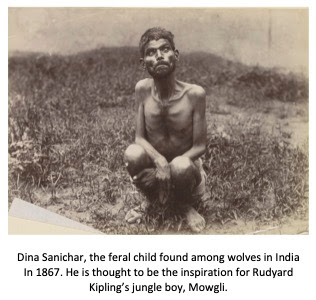


Throughout history, the discovery of feral children has been extremely rare, but it has happened. The previously mentioned Mowgli was inspired by the strange tale of Dina Sanichar who was raised by wolves in India’s Uttar Pradesh jungle. Found by hunters in a wolf’s den in 1867, Sanichar (named by missionaries who later took him in) walked on all fours, would only accept raw meat as food, gnawed on bones to sharpen his teeth, and could not communicate verbally other than producing decidedly wolf-like grunts, barks, and howls. Eventually, Sanichar did learn to walk upright and dress himself; however, he never did learn language and died at the age of 35. Another real-life example of this phenomenon is “Peter the Wild Boy” who was discovered in the forests of Germany in 1725. Believed to have been abandoned by his parents, the boy was estimated to be 11 years old when found. He was unable to speak and loathed wearing clothes. Within a year of his rescue, Peter was shipped off to London where he became the “human pet” of King George I. The wild boy bounded about the King’s court on all fours, which the courtiers of Kensington Palace initially found quite entertaining. It was widely believed that the boy had been raised by wolves or bears due to his behavior. Eventually, the King tired of Peter and shipped him off to a farm in Herfordshire where he was forced to wear a collar that read: “Peter the Wild Man of Hanover. Whoever will bring him to Mr. Fenn at Berhamsted shall be paid for their trouble.” Peter died in 1785 and was buried in the cemetery of St. Mary’s at Northchurch. There are numerous other examples of feral children that were suspected to have been raised by animals that could be cited here, but I trust the point has been made. What many do not realize is that this very scenario may have once played out in the deserts of west Texas.


A nearly forgotten historical fact is that a group of English people once established a small settlement called Delores on the banks of the Devil’s River (part of the Rio Grande drainage basin) in southwest Texas. The community was short-lived as most of the settlers were killed by Comanches. One white couple (who had a rather colorful history of their own), who lived on the extreme edges of the settlement, survived and carried on. One day in 1835, the settler husband frantically rode up to a homestead owned by Mexican goat ranchers and asked for help as his wife was having a baby and was in great distress. According to legend, a storm was brewing and the Mexican couple wanted to wait it out before mounting up and going to the aid of the mother to be. The settler insisted they leave immediately as his wife’s need was great. The Mexican couple relented and they started toward the settler’s home on the Devil’s River. The party had hardly started out when the settler was struck by lightning and killed. This event gave the rancheros pause and they decided to wait until morning to make the trek. While understandable, the decision of the Mexican couple proved disastrous for the female settler. Her lifeless body was found beneath an open brush arbor the next morning. There were clear signs the woman had died during childbirth, yet no child could be found. The couple hastily searched for the infant but found only lobo tracks in the vicinity. The couple assumed that wolves had come upon the scene and devoured the infant. Why the lobos had left the body of the mother unmolested was puzzling to the pair, but they proceeded with burying the unfortunate woman and then made their way home.


Ten years later, in 1845, a boy living at San Felipe Springs (now called Del Rio) reported that he had witnessed a pack of wolves attacking a herd of goats. With them, he claimed, was a long-haired creature that resembled a naked girl. The boy was chastised greatly, but the story – as good tales are apt to do – spread throughout the region. Roughly a year later, a Mexican woman at San Felipe declared she had watched two big lobos and a naked girl ravenously devouring a freshly killed goat. The woman claimed to have gotten very close to this odd trio before they took notice of her and bolted. The naked girl, at first, ran on all fours but eventually rose up and ran on two feet. The woman reported she was positive as to what she had seen and that the child was definitely keeping company with the two wolves.


Again, the story spread like wildfire, but this time the memory of the unfortunate settler woman who had died during childbirth, but whose baby was never found, was recalled. Could the feral “lobo girl” be the missing child, now 10 years old? Other stories related by local Native Americans – previously dismissed as superstitious drivel by the Anglo settlers - were also recalled. The Indians had claimed more than once to have located barefoot human tracks and handprints on the sandy areas along the river. The human spoor was always found among wolf tracks. Could it be? Was such a thing even possible? It was decided by the settlers that they had to find the wolf or lobo girl and rescue her. The posse managed to pick up the wolf pack’s trail quickly and cornered the girl in a small canyon. With the feral girl was a big lobo that fled when the child wedged herself into a crevice in the canyon wall. The girl at first cowered in fear before her tormentors, but then her countenance grew fierce. She spat, hissed, and growled at the men as they approached and bit and clawed them once they took a hold of her. Once captured, the girl began to produce a “pitiful, frightful, unearthly sound…resembling both the scream of a woman and the howl of a lobo, but being neither.” Distracted by these terrifying sounds, the vaqueros nearly failed to spy a huge he-wolf, likely the pack alpha, creeping up on the group. Fortunately for the posse, one man turned in time to see the wolf as it was preparing to spring and shot it dead with his pistol. At this, the lobo girl fainted.


The men bound the girl securely and stepped back to examine her more closely. According to the men, she was “excessively hairy, but breasts of beautiful curvature and other features showed that she was a normally formed human female. Her hands and arms were muscled in an extraordinary manner but were not ill proportioned.” The party rode to the nearest ranch where the girl was untied and placed in an isolated room for the night. The men attempted to communicate with her, offered her food, coverings for her body, and water but she reacted only with distrust and fear. The terrified girl backed herself into the farthest corner of the room where she cowered pitifully. The men decided, for the time being at least, to leave the poor creature alone. The door was closed and locked and the men nailed a thick board across the room’s only window. Things remained quiet…until darkness fell.


Once the sun set, the wolf girl began to emit screaming howls that were terrible to hear. Soon, her cries were answered by the long deep howls of wolves in the distance. The men’s eyes widened and fear began to creep into their souls as the cries of the lobos – seemingly approaching the ranch house from all sides - grew louder and more menacing. It wasn’t long before they were all howling in unison, “a bass-throated chorus of ferocity” the likes of which the rough and tumble vaqueros had never before heard. To the men, it seemed all of the lobos of the western world were gathering outside of the house. These rancheros, all of whom had lived their entire lives in the region, had never heard anything like it, “either from such a number of wolves now assembling or in the sullen, doom-like quality of the long, deep howling.” Back and forth the calls went. One of the men later recalled, “They (the wolves) would go silent as if waiting from some answer, and the wild girl in the dark room there would answer back with her unearthly, howling scream, a voice neither of woman nor of beast.”


After a while, exactly how long no one could say for sure, the pack made for the corrals and pens, attacking goats, cows, and horses. The screams of the livestock broke the spell the terrified men were under and they sprang into action in an effort to save the animals. Ordinarily, the rancheros did not fear wolves; however, on this night, the men stayed tightly packed together as they sought to run the predators off by shooting and shouting into the darkness. Eventually, the wolves retreated. When the men returned to the ranch house, they discovered that someone, or something, had managed to wrench the plank nailed across the window of the room where the lobo girl had been incarcerated loose. She was gone, presumably reunited with her pack. Not a single howl was heard for the rest of the night and, somewhat curiously, wolf sightings in the general area became exceptionally rare over the following years.


Six years would pass before the wolf girl was seen one final time. The year was 1852; gold had been discovered in California and travel westward had greatly increased necessitating the need for a wagon trail or road that was better watered than the Chihuahua Trail currently used by travelers heading to and/or through El Paso. A group of scouts seeking such a route came upon the lobo girl at a spot on the Rio Grande where it takes a sharp bend far above the mouth of the Devil’s River. At close range, the men caught sight of the hair-covered, naked young woman (some versions of the tale say she was holding or nursing two young wolf pups). Once she caught sight of the men, she sprang away in a flash, “dashing into the breaks at a rate no horse could follow.” The slack-jawed men sat stunned upon their mounts, knowing they had just glimpsed none other than the lobo girl of the Devil’s River.


As far as I can tell, the lobo girl was never seen again…at least not by white or Mexican settlers who would have left some record of the account. It is rumored that some of the handful of Apaches left in the region caught sight of her from time to time, but it cannot be confirmed. As years passed, the memory of the lobo girl faded. What happened to her will likely never be known. Some would later claim the entire story had been fabricated as it was simply not possible; however, the vaquerosrancheros, and scouts who did see her never recanted their stories and stuck to their guns until the day they died.


Texas does have werewolf legends of the more classic shapeshifting type: The Beast of Bear Creek, The Converse Werewolf, and the Cajun Rougarou all come to mind. To me, however, the tale of the lobo girl of the Devil’s River may be the strangest and most unsettling of them all. If scenarios where feral children raised by animals in other parts of the world have proven to be true, why could it not also have happened in the arid deserts and scrubland of frontier west Texas? Was she a true werewolf? No. To the rancheros that encountered the lobo girl and her fiercely protective pack, however, it mattered little. She was wolf enough to them.


West Texas remains sparsely populated to this very day. It is a wild and lonesome country where nature still reigns supreme. It is a region where all manner of strange goings on continue to be reported; a place where it is easier to believe in such things as the lobo girl of the Devil’s River than it might be in other locales. Should you ever find yourself there, alone on the night of a full moon, you might still hear the howl of a wayward wolf or coyote and recall the legend of the lobo girl. On such a night, even though you do not believe in such things, another stanza of the famous werewolf poem might come to mind:


To hear her cry in the dead of night

And strain to see the terrible sight,

Is to know the meaning of dreadful fright.


Sleep well.


Sources: 


Dobie, J. F., & Boatright, M. C. (1966). Straight Texas. Southern Methodist University Press.

Sawyer, B. J. (2017, November 22). The Devils River is an Off-Grid Paradise for Adventurers. Wide Open Country. Retrieved July 21, 2022, from https://www.wideopencountry.com/devils-river-off-grid-rugged-texas-paradise/ 

Lee, A. (2021, August 12). Dina Sanichar – a wild Indian feral child who was raised by wolves. Mysteriesrunsolved. Retrieved July 21, 2022, from https://mysteriesrunsolved.com/2020/04/dina-sanichar-real-mowgli.html 

Lane, M. (2011, August 8). Who was peter the wild boy? BBC News. Retrieved July 21, 2022, from https://www.bbc.com/news/magazine-14215171 

Zimmerman, J. (2014, March 24). Wolf Boys and girls. Jean Zimmerman. Retrieved July 21, 2022, from https://jeanzimmerman.com/bio/savage-girl/wolf-boys-and-girls/ 


Sunday, January 9, 2022

Sasquatch Classics: Daniel Boone and the Yahoo

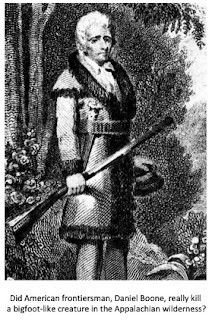
Daniel Boone was born on November 2, 1734 near the present-day town of Reading, Pennsylvania. The sixth of eleven children born to Squire Boone and the former Sarah Morgan, he would go on to earn great fame as a hunter, soldier, politician, statesman, woodsman, and guide. To this day, his is a household name that inspires images of trailblazing adventure and life on a frontier now long gone. Volumes have been written on this legendary figure’s life and of late, I have read through several tomes about this American legend. While doing so, one incident related by the great man himself kept popping up that seems to have been given short-shrift by each his biographers: Boone’s claim that he once shot and killed a ten-foot tall, hair-covered beast, called a “yeahoa” or “yahoo,” in the region that would one day become Kentucky or West Virginia.


     It is easy to see why a biographer of Boone would not know what to think about such a claim. The man did not suffer fools gladly, nor did he tolerate being thought of as one. This is obvious to anyone who reads about how Boone handled being dragged through a humiliating court-martial in 1778. Though he was found not guilty - and was even given a promotion in rank after the court heard his testimony about the matter in question – the frontiersman remained bitter about the entire affair and rarely spoke of it. The grudge against his accusers is one Boone held until the day he died. Yes, Boone was very conscious of his reputation and public image. That being the case, it seems odd he would make a claim as bizarre as having killed a monster.

     Some biographers go into more detail than others about the alleged incident; however, all seem to agree on the basic details of how the story came to light. Late in his life, Boone was holding court with a group of distinguished citizens at a dinner held in his honor at an inn in Missouri. At the conclusion of the meal, a question-and-answer session of sorts seems to have taken place. It was at this time that one of the men in attendance asked for a story. It is unclear if the gentleman asked for the particular yarn he ended up hearing or if Boone decided on the tale to be told. Either way, the story Boone shared was one of having come upon and shooting a ten-foot tall, hair-covered “yahoo” in the Appalachian wilderness many years before. The old frontiersman did not get too deep into the tale before one of the men listening laughed out loud and declared the story “impossible.” Accounts indicate that Boone was deeply offended and refused to continue despite the requests of the others in attendance. The awkwardness of the situation led to the premature end of the get-together and people began making their exits. After most of the others had left, the innkeeper’s son petitioned Boone to finish. 

“I would not have opened my lips had that man remained,” said Boone. 

“Well, we are alone now,” the boy replied. 

The frontiersman is said to have smiled wryly before saying, “You shall have it…” and finishing the story for the lad and the few holdouts who quietly made their way back into the room once it was obvious the story-telling had recommenced.


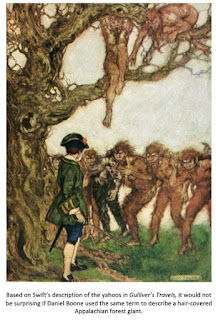
     While Boone never received much in the way of formal schooling – and his spelling was notoriously “creative” – he read well. His early favorites were history books. It is also said Boone took a strong liking to Robinson Crusoe. Later, two books dominated the frontiersman’s reading time: the Bible and Gulliver’s Travels. Written by Irish writer and clergyman, Jonathan Swift, Gulliver’s Travels became an instant hit upon publication in 1726. Most likely think they are familiar with the plot of Gulliver’s Travels in which the main character finds himself shipwrecked on the shores of an island nation called Lilliput and is taken prisoner by a horde of the island’s tiny inhabitants. It is true this is the most well-known part of Swift’s masterpiece; however, the tale of Lemuel Gulliver’s trials and tribulations among the Lilliputians is just part of the overall work. It is actually the story of Gulliver’s fourth voyage that concerns us in regards to the tale told by Daniel Boone.

     In Part 4 of the book, titled “A Voyage to the Country of the Houyhnhnms,” Gulliver – who has tired of his life as a surgeon – returns to the sea as captain of a merchant vessel. After several crew members die, Gulliver hires replacements out of Barbados and the Leeward Islands. Unfortunately, the new hires turn out to be buccaneers and soon mutiny. The pirates strand Gulliver on the first piece of land they come across and sail away in his ship. It is now that the story becomes relevant to the Boone tale as the fictional Gulliver soon encounters some terrifying creatures:


“At last I beheld several animals in a field, and one or two and deformed, which a little discomposed me, so that I lay down behind a thicket to observe them better…their heads and breasts were covered with thick hair, some frizzled and others lank; they had beards like goats, and a long ridge of hair down their backs…they often stood on their hind feet…”


Another passage reads:


“My horror and astonishment are not to be described, when I observed in this abominable animal, a perfect human figure: the face of it indeed was flat and broad, the nose depressed, the lips large, and the mouth wide…the forefeet (arms) of the Yahoo differed from my hands in nothing else but the length of the nails, the coarseness and browness (sic) of the palms, and the hairiness of the backs. There was the same resemblance between our feet, with the same differences…the same in every part of our bodies except as to the hairiness and colour (sic)…I never saw any sensitive being so detestable on all accounts; and the more I came near them the more hateful they grew…”


Daniel Boone was intimately familiar with the yahoos described in Gulliver’s Travels. If he had ever come into contact with a huge, hair-covered, human-like beast in his years of traversing the American wilderness, calling the beast a yahoo – based on the description of the creatures written by Swift – seems natural enough. To this day, the names Yeahoh and Yahoo are used to describe sasquatch-like creatures said to roam the mountains and forests of Appalachia.

Critics say Boone’s tale of shooting a bigfoot-like creature is just a campfire story meant to entertain his rapt followers who hung on his every word. Boone biographer, Robert Morgan, would seem to concur and wrote, “He (Boone) was also known to tell tales about encountering great hairy monsters like the yahoos in Gulliver’s Travels. Most likely it never happened.” It is hard to blame Morgan for having doubts about such a fantastic claim, but he dismisses the tale without any elaboration. While the story might be hard to take at face value, Morgan himself writes about the integrity of Boone and how much he valued his reputation. It would seem proper for the author to explain why the famous woodsman would veer from his character and fabricate a story about having killed a monster, especially when it seems all scholars agree regarding how offended the frontiersman became when his story was challenged.


Boone is said to have related the tale of the yahoo on multiple occasions, most often during the last year of his life. Some have speculated that he might have been losing his faculties during his 85th and final year on this earth. Others correctly point out that the “deathbed confession” is a real phenomenon. People confess all manner of things when they realize the end of life is near. Such confessions are thought to help alleviate feelings of guilt or regret the dying person may have been harboring during their lifetime. Too, the “deathbed declaration” - when a dying person shares some secret knowledge - is not an unusual occurrence. Usually, these declarations have to do with feelings the dying individual has for another person; however, sometimes knowledge is shared which the person has been holding onto for years, decades even. Such dying declarations have sometimes been used in court as evidence; indeed, at times, the final words of a dying man/woman are given more credence in such a scenario, as common sense would seem to indicate that they no longer have anything to lose or gain by sharing what they know.

It is true Boone told the story of the yahoo multiple times over his final year(s), but not on his literal deathbed. Still, Boone’s health was beginning to wane and any man once he reached the age of 85 would realize that there was precious little time ahead of him. Too, men of a certain age often get to a point where they could not care less about what others think of them and no longer concern themselves with how they might be ridiculed. Could the knowledge that his time on earth was short have motivated Boone to relate his incredible tale while he still could? Was it important for him to share the story – one he had kept to himself for years – before leaving this mortal plane? Perhaps.

It is highly doubtful that the truth about whether or not Daniel Boone shot and killed a sasquatch-like creature will ever be known. What is inarguable is that Boone spent more time in the American wilderness than just about any white man who has ever lived. That being the case, if the sasquatch is a real creature, who would have been more likely to eventually come across one than Daniel Boone?


Sources:

Faragher, John Mack. Daniel Boone: The Life and Legend of an American Pioneer. The Easton Press, 1995. 

Morgan, Robert. Boone a Biography. Recorded Books, 2008. 

Mart, T. S. The Legend of Bigfoot: Leaving His Mark on the World. Indiana University Press, 2020. 

Swift, Jonathan, and David Womersley. Gulliver's Travels. Cambridge Univ. Press, 2012. 

“Daniel Boones' Sasquatch.” Daniel Boones' Sasquatch Story, enigmose.com/daniel-boone-sasquatch.html. 

Peacock, Lee. “Did Pioneer Daniel Boone Really Kill a Bigfoot-like Creature Prior to 1820?” Did Pioneer Daniel Boone Really Kill a Bigfoot-like Creature Prior to 1820?, 1 Jan. 1970, leepeacock2010.blogspot.com/2017/05/did-pioneer-daniel-boone-really-kill.html. 


Monday, January 11, 2021

The Missionary, the Former Slave, and the Sasquatch

What do an eighteenth-century Jesuit missionary and a former slave from the state of Arkansas have in common? I hate to disappoint any of you that thought this might be the opening line to a bad joke, it is actually a legitimate question. Read on for the answer.


In my mind, some of the strongest sources of anecdotal evidence regarding the existence of the sasquatch are those that pre-date the coining of the term bigfoot in an article about a catskinner named Jerry Crew - who found massive human-like tracks around his road-building equipment in California’s Six Rivers National Forest in August of 1958 - and the explosion of the Patterson-Gimlin footage on the world stage in October of 1967. Sightings reported before these two seminal events cannot be dismissed as the work of hoaxers seeking to hop on the bigfoot bandwagon. The sasquatch was all but unknown to the Europeans who began flooding the North and South American continents in the 1500s…and to the slaves that they brought with them. Their accounts of bipedal, hair-covered creatures simply cannot be dismissed out of hand.    


I would like to discuss here two such historical sightings. The incidents are not well-known, but they may well be extremely important when attempting to trace just how far back sightings of wood apes might go. The similarity between these two accounts cannot be denied and both lend credibility to the opinion of those who believe the animal commonly referred to as bigfoot was being seen well before the 1950s by people of different cultural backgrounds living many miles apart.


The first incident comes directly from the writings of a Jesuit missionary who worked among the people of the province of Sonora, Mexico – a region that stretched up from northwest Mexico to the Sierra Madre from Cjeme (now Ciudad Obregon), near the California coast, to Tuscon - in the eighteenth-century. Father Ignaz Pfefferkorn (b. 1725), a German Jesuit lived and worked among the Pima Indians from 1756 to 1767. Details of his work and life among these people can be found in his Descripcion de la Provincia de Sonora. The diaries, journals, and logs of missionaries have long been highly valued by anthropologists and historians. Pfefferkorn’s work was no different and he is considered by academics to have been an extremely reliable and credible observer. His writings continue to be cited by historians to this day. Among Pfefferkorn’s writings were descriptions of the local wildlife. Among the descriptions of what would be considered common animals, the good father wrote about the different bears (differentiated by their color) found in the region. He wrote:


“Of the Sonora bears some have black hair, others dark gray, and the smallest number are a reddish color. These last are the most cruel and harmful, according to the statements of herdsmen.”


Only two species of bear are known to have ever lived in the Province of Sonora during the eighteenth-century. The black bear (Ursus americanus) and the grizzly (Ursus arctos horribilis) both made Sonora part of their home range during the time in question. While black bears can be black, blonde, or reddish, it is likely the cinnamon-colored bears that were “the most cruel and harmful” were grizzlies. While these grizzlies were likely the animals most often responsible for the killing of livestock in the region, some of the other activities attributed to them may well have been the work of something else.


Pfefferkorn, while documenting bear activity related to him by the indigenous tribesmen, in some cases may have actually been recording accounts of bigfoot interaction with humans. If so, his accounts are some of the earliest ever written down in North America. One intriguing passage is below:


“Bears are a special menace to stock raising, for they eat many a calf, and, if no smaller prey falls into their clutches, they will attack even horses, cows, and oxen. They delight especially in eating maize as long as it is still tender and soft. Woe to the field if a hungry bear breaks into it at night. He eats as much as he can and makes off with as much as he can grasp and carry in his mighty arms. In so doing he ruins even more of the field by breaking it down and treading upon it. The inhabitants assert that a bear defends himself by throwing stones when one attempts to chase him away and that a stone hurled from his paws comes with much greater force than one thrown from the hand of the strongest man.”


I do not think I have to tell anyone that a bear cannot throw stones; nor is it capable of walking bipedally in order to carry off large amounts of corn in its “mighty arms.” Pfefferkorn was familiar with bears. He had traveled across the region for many years and had seen many bruins. Pfefferkorn even witnessed a grizzly kill his Indian guide on one trip across Sonora (the guide had attempted to kill the bear, succeeded only in wounding it, and paid the ultimate price when the animal turned on its tormentor). This being the case, it is strange that Pfefferkorn would attribute rock-throwing and the ability to carry large amounts of corn away while walking on two legs to grizzlies. I think it is entirely possible that the stone-hurling, corn-stealing, bipedal “bears” of Sonora might have actually been wood apes.


A strikingly similar account comes from another historical source: a former Arkansas slave. Doc Quinn was one of the oldest living residents of Miller County, Arkansas (yes, the same Miller County that would become known as the home of the Fouke Monster of The Legend of Boggy Creek fame) when he was interviewed by Cecil Copeland at his home in Texarkana in the 1930s. Doc recalled when he was first brought to the plantation of one Colonel Ogburn – between Index and Fulton on the Red River - that there was a section of the property dominated by an immense canebrake. This canebrake was a favorite retreat of bears and other wild animals. It was all but impossible to go in after problem bears that would steal out of the thicket at night and take livestock, so the plantation owner had the slaves round up the hogs and animals and place them in pens at the end of the day. Several slaves were charged with standing guard at night over the domesticated animals. The efforts of the slaves helped somewhat, but bears were still seen often and some of their actions “were almost human.” The following is a passage taken from the book Bearing Witness: Memories of Arkansas Slavery Narratives from the 1930s WPA Collection in which Doc Quinn describes to Cecil Copeland the odd behavior of a “bear” he came across in a cornfield one day:


“The bear picked off an ear of corn and put it in his bended arm. He repeated this action until he had an armful, and then waddled over to the fence. Standing by the fence, he carefully threw the corn on the other side, ear by ear. The bear then climbed the fence, much in the same manner of a human being, retrieved the corn, and went on his way.”


Sounds familiar, does it not? The simple truth is that bears cannot stroll around in a bipedal fashion while plucking ears of corn from stalks in the field with one front paw and place them into the crook of their other front “arm.” The description of how Quinn witnessed this animal climb a fence “in the same manner of a human being” is fascinating. The entire incident simply does not describe bear behavior in any form or fashion.


Quinn provides another interesting anecdote in the same interview. I thought long and hard about including it here, not because it is not interesting (it is), but because Doc Quinn’s words are transcribed in such a way that his dialect is evident. Some hot-button words, including the n-word, are used. After wrestling with it for a while, I decided to include the account here with only one minor edit (I decided not to type the n-word out. I fear in today’s climate, I would be accused of approving of it or some such thing). Again, I would remind readers these are not my words. These are the words spoken by former Arkansas slave, Doc Quinn and transcribed by his interviewer, Cecil Copeland. The text comes straight from the book previously mentioned. Try to focus on the story Doc Quinn is telling and not the language and terminology he uses. The account is as follows: 


“Late one ebenin’, me an’ anudder (edit) named Jerry wuz comin’ home frum fishin’. Roundin’ a bend in de trail, whut do we meet almos’ face to face? – A great big ol’ bar! Bein’ young, and blessed wid swif’ feet, I makes fo’ de nearest tree, and hastily scrambles to safety. Not so wid mah fat frien’. Peerin’ outen thru de branches ob de tree, I sees de bar makin’ fo’ Jerry, an’ I says to mahself: ‘ Jerry, yo’ sins has sho’ kotched up wid yo’ dis time.’ But Jerry, allus bein’ a mean (edit), mus’ hab had de debbil by he side. Pullin’ outen his Bowie knife, dat (edit) jumps to one side as de bar kum chargin’ pas’, and’ stab it in de side, near de shoulder. As de bar started toinin’ roun’ to make annuder lunge at de (edit) he notice de blood spurtin’ frum de shoulder. An’ whut do yo’ think happen’? Dat ole bar forgets all about Jerry. Hastily scramblin’ aroun’, he begins to pick up leaves, an trash an’ clamps dem on de wound, tryin’ to keep frum bleedin’ to deaf. Yo’ ax did de bar die? Well, suh, I didn’ wait to see de result. Jerry, he done lef’ dem parts, an’ not wantin’ to stay up in dat tree alnight by mahself, I scrambles down an’ run fo’ mile home in double quick time!”


I ask you, what kind of bear notices it is bleeding, stops in the middle of an altercation, begins gathering leaves, and then packs its own wound? I will tell you the answer. None. No bear behaves in this manner. If Doc Quinn is not spinning a yarn to his interviewer, the creature his fishing partner, Jerry, tangled with was certainly no bear. Was it an aggressive sasquatch? Certainly, the location was right as the aggressive nature of the Fouke Monster would be well documented some years later. There is a real shortage of viable alternatives if the creature in question was not a bear.


The parallels between these two accounts – accounts separated by more than a century and approximately 1,400 miles – are uncanny. Bears cannot and do not gather up corn in their “arms” and walk away with it in a bipedal fashion. Yet, a Jesuit missionary and a former Arkansas slave describe observing this same behavior. Doc Quinn’s account of how his fishing partner, Jerry, tangled with an animal that packed its own wound after being stabbed lends credence to the theory that something other than a bear was roaming about Miller County, Arkansas in his youth. Is it possible that these two men from very different worlds - Father Ignaz Pfefferkorn and former slave Doc Quinn - described the same type of animal? An animal they had no name for? An animal that just might have been a wood ape?


Food for thought.


*Special thanks to NAWAC Chairman Emeritus, Alton Higgins, who authored the article, “A Sonoran Sasquatch,” that I drew heavily from for this post.


Sources:


Brown, D. E. (1996). The Grizzly in the Southwest: Documentary of an Extinction. Norman, OK: University of Oklahoma Press.

Pfefferkorn, I., Treutlein, T. E., & Pfefferkorn, I. (1949). Sonora A Description of the Province. Albuquerque: University of New Mexico Press.

Higgins, A. (2010, November 19). A Sonoran Sasquatch? Retrieved January 11, 2021, from https://www.woodape.org/index.php/sonoransasquatch/

Lankford, G. E. (Ed.). (2006). Bearing Witness Memories of Arkansas Slavery. Fayetteville: University of Arkansas Press. 


Thursday, August 20, 2020

Sasquatch Classics: The Leflore County Bigfoot War

The telling of scary stories around a campfire is a tradition that is likely nearly as old as mankind itself. While tales of ghosts, goblins, and murderous psychopaths can rattle the cage of nearly anyone, what better subject for a campfire story could there be than a cannibalistic and murderous sasquatch? The story of a haunted house might be creepy, but unless you are actually staying in the house in question it is easily and quickly forgotten once the marshmallows, chocolate, and graham crackers appear at the fire. Tales of a creature – a creature many people regard as being real – stalking the very woods in which you have pitched your tent, however, are not always so easy to put aside. One such terrifying tale is the story of a “bigfoot war” that allegedly took place in eastern Oklahoma during the mid 1850s.The story of the LeFlore County bigfoot war is one I have heard bits and pieces of through the years. I finally decided to look into the matter, gather as much information as I could, and make a determination as to whether the tale might have some truth to it or was an outright fabrication. Following is what I was able to find out.

It is said that in or around 1855, a band of Choctaws in what is now LeFlore County and farmers in what is now Arkansas were experiencing some terrifying events. It all began in a rather benign way with the theft of vegetables, a few head of livestock, and other foodstuff by stealthy bandits in the night. The thieves were cagey, quiet, and never seen. They were also smart, as somehow they never ventured into Choctaw encampments on nights when a watchman was in place. Neither did the bandits ever fall into the traps set for them by farmers outside of Indian Territory. Those charged with finding and capturing these marauders began to develop a begrudging respect for the wiliness of their adversaries as time went by and the petty thefts continued. While the thefts were annoying and did cause some hardships, neither the Choctaw or the neighboring Anglo farmers were afraid of the food bandits; however, things changed once women and children began to go missing.


Spurred by reports of these kidnappings, a group of 30 Choctaw cavalrymen was organized to hunt down the abductors. The group was led by Joshua LeFlore, a man of mixed Choctaw and French blood, who was deeply respected by his fellow tribesmen. Also joining the search party was a Choctaw warrior named Hamas Tubbee and his six sons. The Tubbees were huge men – all approaching seven feet in height and weighing in at more than 300 pounds each – and were regarded as fierce warriors and expert horsemen.  The Tubbees were so effective in mounted warfare that despite their massive size, they became known as the “Lighthorsemen.” The contingent of searchers, armed to the teeth, set out into the region known today as the McCurtain County Wilderness Area to search for the kidnappers.


After riding all day, the searchers finally arrived in the area where they believed the bandits to be hiding. LeFlore brought his troops to a halt, stood up in his stirrups, and surveyed the area with a spyglass. It is unclear exactly what LeFlore saw but whatever it was, he ordered his men to charge toward a stand of pines roughly 500 yards distant. LeFlore and the Tubbee men led the attack. As the troops closed the distance between themselves and the stand of pines where the kidnappers were thought to be hiding, they were assaulted by a tremendous stench, the unmistakable odor of decay and decomposition. The horses of most of the men began to buck and rear, tossing their riders. Only the mounts of LeFlore and the Tubbee men were disciplined enough to remain composed, allowing the eight men to continue through the pines. As the men cleared the small wooded patch they came upon a large earthen mound. Scattered across the mound were the bodies of children and women in various stages of decomposition. LeFlore and the Tubbees caught a glimpse of a number of the murderers fleeing into the tree line on the opposite side of the mound. Only three of the killers stood their ground to meet the charge of the “Lighthorsemen.” It was at this time that the cavalrymen realized they were not going up against any human foe; rather, standing before them, snarling and beating their chests, were three huge, hair-covered creatures. Despite what must have been a shocking sight to him, LeFlore drew his pistol and sabre, spurred his mount, and charged. As LeFlore approached the nearest ape, it took a mighty swipe and struck his horse in the head, killing it instantly.  LeFlore managed to roll off the falling horse, quickly jumped to his feet, and fired multiple shots into the chest of the creature. Once his pistol was empty, LeFlore attacked the ape with his sabre, opening up gaping wounds on the animal which roared in rage and pain.


LeFlore’s assault on the creature was so quick, and the shock of seeing hair-covered monsters so great, that the Tubbee men hesitated, completely stupefied, before entering the fray. This delay allowed one of the other two apes to get behind LeFlore, who was intensely focused on the ape he had engaged. The second beast grabbed LeFlore’s head with two huge hands and ripped it from his shoulders. The horrible sight jolted the Tubbee warriors into action and they opened fire on the three sasquatches with 50-caliber Sharp’s buffalo rifles. Two of the beasts were killed instantly, dropping in their tracks. The third creature was wounded but turned and fled before the lethal shot could be fired. Robert Tubbee, only 18 years old but already 6’ 11” and well over 300 pounds, spurred his horse, ran down the injured ape, and dispatched him with his hunting knife.


As the rest of the troop, after gathering their panicked horses, joined them, the “Lighthorsemen” surveyed the area. The bodies of dead women and children, most partially devoured, littered the area. The smell of decay, along with the terrible odor of the beast’s feces, caused many of the men to vomit. After composing themselves, the men gathered the remains of the unfortunate women and children and buried them. They also buried their leader, Joshua LeFlore. As for the three ape-like monsters, their bodies were placed upon a huge bonfire and burned. Their hellish task complete, the Choctaw warriors returned to Tuskahoma, where it is said even the mighty Tubbee men were plagued by terrible nightmares for years afterward.


Some story, is it not? But is any of it true? While I could not find much, it does appear the Tubbees existed. So, too, did a man named Joshua LeFlore. What I could not find was any mention – at least in any official documents – that Leflore died in battle. For that matter, I have been unable to find any information leading me to believe that the LeFlore County bigfoot war took place anywhere outside of the realm of folklore.


Having said that, is it possible that the LeFlore County incident was actually based on a real event that took place in a different location? According to a bigfoot researcher named Jim King, the answer might be yes. King believes the LeFlore County story is based on an event that took place much farther west in Kiowa territory, an event related to him by an Indian elder. According to the story, Kiowa women were placed in a special teepee or tent on the edge of camp when they started their menstrual cycle. The women stayed there, being tended to only by older women, until their cycle was complete. The elder told King that women were considered “unclean” during their cycles and Kiowa warriors were not only forbidden any physical contact with the females during this time, they were not even to look upon them (This seems harsh but it not too different than the way many cultures treated menstruating women in the past.) The elder said that once, long ago, there had been trouble with ape-like creatures who were attracted by the scent and pheromones emanating from the tent where the menstruating women were housed. Since the tent was on the edge of the encampment, it proved to be an easy target for renegade apes who are said to have entered and carried off women on several occasions. To make a long story short, the Kiowa leadership decided this was unacceptable and put together a group of warriors to hunt down the kidnappers. The searchers did manage to track an ape back to its lair and killed not only it, but an entire family unit.


Could the LeFlore County story have its roots in the tale told to Jim King by the Kiowa elder? Is there any truth at all – even the smallest of grains – in either tale? I have heard many put their faith in the LeFlore County version simply due to the name of the unfortunate Joshua LeFlore. “They wouldn’t have named the county after him if it wasn’t true,” and other similar statements abound. I, however, have not been able to find anything saying LeFlore County was named after Joshua LeFlore. According to the Oklahoma Historical Society’s website, “The name honors the prominent LeFlore family of the Choctaw Nation.” Could Joshua LeFlore have been one of the “prominent LeFlore family?” It is certainly possible, but there does not seem to be any documentation singling out Joshua or his actions as the reason for the naming of the county. 


The story of the LeFlore County bigfoot war, even if totally fictional, does seem to point to the fact that enormous, hair-covered, ape-like animals have been thought to reside in the region for a very long time; a time long before the Patterson-Gimlin film brought bigfoot into America’s consciousness. Add this to the beliefs of many other Native American tribes from across the North American continent who have long told stories of these creatures snatching women and children and the anecdotal evidence stack grows taller. Truth be told, the idea of child- or woman-snatching sasquatches continues to thrill, terrify, and enthrall us to this very day. One needs to look no farther than the success of David Paulide’s Missing 411 books to confirm this.


It may very well be the tale of the LeFlore County bigfoot war was inspired by actual, less dramatic events (think the siege of Honobia, the Ape Canyon incident, etc.) Over the years, such a story would be embellished and grow to mythic proportions. It is all but inevitable as a good scary story is irresistible. Do not be too hard on those who might have added to the original facts. After all, we all know the most frightening types of campfire stories will always have one thing in common…


...they could really happen.


Sources:


The LeFlore Horror/Bear [Radio series episode]. (2018, April 18). In World Bigfoot Radio #53.

Swancer, B., & Seaburn, P. (2018, June 06). The Strange Case of the Human-Bigfoot War of 1855. Retrieved August 21, 2020, from https://mysteriousuniverse.org/2018/06/the-strange-case-of-the-human-bigfoot-war-of-1855/

Nashoba, D. T. (2002, January 6). The Legend of Sacred Baby Mountain [Scholarly project]. In Google Groups. Retrieved August 20, 2020, from https://groups.google.com/g/alt.bigfoot.research/c/tD56ttwlfik?pli=1

Le Flore County: The Encyclopedia of Oklahoma History and Culture. (n.d.). Retrieved August 20, 2020, from https://www.okhistory.org/publications/enc/entry.php?entry=LE007


Saturday, July 4, 2020

What Happened to Dennis Martin?

The loss of a child might be the most devastating of all tragedies. It is every parent’s greatest fear, and the burden of protection – perhaps the most important of parental duties - weighs heavy on those of us blessed enough to have children. The loss of a child leaves the bereaved parents not only reeling from grief but from guilt, the guilt that they have failed in their most sacred of duties: protecting their offspring. In most cases, the parent has nothing to feel guilty about. Accidents do happen, no matter how careful we try to be. Children sometimes simply do not listen to or follow the directions of the adult figure in their lives which sometimes leads to their demise. Certainly, no parent should ever blame themselves should their child develop cancer or some other insidious disease. Still, the parents of lost children often feel they have done something wrong or that they could have done something differently. If they had, they reason, their child would still be alive. The pain of loss dulls over time to some degree, but the guilt seems to be there always, just beneath the surface waiting to bubble to the top if given even half a chance. These are the thoughts that passed through my mind as I revisited one of the most puzzling missing persons cases in U.S. history: the disappearance of Dennis Martin.


It was the summer of 1969 when Bill Martin decided to take a Father’s Day weekend camping trip. It would be a trip for the men of the Martin family and a time to get back to nature. Bill loaded up his father, Clyde, his oldest son, Doug (9 yrs.), and Dennis, who was less than a week away from his seventh birthday, and headed for Great Smoky Mountains National Park. The Martin men spent the first night of their trip at the Russell Field shelter. Early on the morning of June 14th, the group hiked west for two miles until they reached their destination: Spence Field. Spence Field was a grassy area running east to west on the main Great Smoky ridge. The Appalachian Trail and the Tennessee/North Carolina border run along the apex (4,800 ft. above sea level) of the field. Streams and creeks on the north side of the ridge drain into the Volunteer State while water courses on the south side of the ridge descend into North Carolina. The area features steep slopes, deep ravines, fast moving creeks, and scores of laurel and rhododendron vines, but the grassy and flat Spence Field seemed benign enough on this sunny and cloudless day. That being the case, the group settled into a shelter cabin on the western end of the campground.
            
After putting their gear away, Bill and his father sat contentedly and watched the boys, who had found two play mates from another family camping nearby (coincidentally, this other family also had the last name of Martin). The men watched as the group of young boys came together in the tall grass and whispered to each other. Then, almost like a football team breaking a huddle, they sprinted off in two different directions: Doug and his two new friends ran to the wood line to the south, Dennis, alone, ran into the woods to the northwest. The boys had planned a prank on their father and grandfather. They decided to run into the woods, sneak up behind the men, and then jump out and startle them. Why one of the three other boys did not go with Dennis has never been clear. What is clear is that after Dennis ran into the woods that afternoon, he would never be seen again. 

Doug and his two friends carried out their plan and sprang from the woods to “scare” Bill and Clyde. Dennis did not. The men and the boys waited between three and five minutes – thinking Dennis might have misunderstood the timing of the prank – before becoming concerned. Bill, Clyde, and the other boys set off to look for Dennis but found no sign of the young boy. Calls went unanswered, the only noise was the wind whistling through the forest canopy as a storm approached. After searching on their own for over an hour, Bill Martin managed to report his missing son to park authorities. The reaction was swift with several park Rangers responding but their efforts were stopped short when a ferocious thunderstorm rolled into the area. Spence Field received between 2.5” and 3” of rain over the next several hours. Hail fell from the heavens in some spots. The streams and creeks in the area rose quickly and were described as “high and turbulent” in the official incident report. No sign of young Dennis was found. Bill, Clyde, and Doug had to sit and wait out the storm knowing Dennis was out there somewhere alone.

The initial search the following day consisted of upwards of 50 people ranging from Park Rangers to maintenance personnel. Also joining the effort were members of the Sevier County Rescue Squad, the Blount County Rescue Squat, and the Smoky Mountain Hiking Club. The searchers began combing drainages in the area. Rain continued to fall intermittently, washing away potential tracks and sign, winds kicked up and the temperature dropped into the 50s, increasing the chance of the boy becoming hypothermic. The searchers beat the bushes until well past dark. There was no sign of Dennis. 


As word of the missing boy got out, more and more people made the trek to Spence Field to help. The number of searchers would swell to 1,500 before the operation was called off. It would become the largest search in National Parks history with the volunteers investigating at least 50 square miles. No one found any sign of the boy. Some believe the search party became too large and unwieldy. Clay Jordan, Deputy Park Superintendent, in a 2019 interview with USA Today said, “Today, we would not have anywhere near that number (searching).” The hearts of the people who showed up to help were in the right place but looking back, far too many well-meaning but inexperienced volunteers were allowed to participate. It is quite possible that some sign left by the boy was trampled by people who did not know what to look for. In addition to the mistake of allowing too many novice searchers to participate, officials decided, due to the prolific rainfall, not to call in dogs to search for Dennis’s scent. The officials were likely correct in that Dennis’s scent near Spence Field was likely washed out, but he was still out there somewhere and should have been creating new scent trails search dogs might have been able to lock on to (These and other miscues have been used as teaching tools ever since for search and rescue teams in training). Even so, the fact that absolutely no sign of the boy was found was shocking. “Something should have been found,” said Dwight McCarter, a veteran tracker and retired Smokies Ranger struck by the complete lack of sign.

By the second day of searching, Bill’s wife and Dennis’s mother, Violet Martin, had arrived on the scene. She was devastated by the developments but hopeful. “I have a feeling we’re going to find him,” she said. “Maybe God sent this ordeal to us so we could appreciate things more.” Others, however, were beginning to lose hope. Some searchers were told surreptitiously to start closely examining any bear, coyote, or bobcat scat. Others were dispatched to areas where vultures were spotted circling. The hours and the days dragged on, still no Dennis.

The first of several self-proclaimed psychics chimed in on Wednesday, June 18th. The Martins, and to some degree Park authorities, did not dismiss the visions of these seers outright. The areas recommended by the clairvoyants were all dutifully searched. “I believe some people have the ability to see or predict things,” said Bill Martin at the time. Whether the Knoxville-based architect had given any thought to such matters prior to the disappearance of his son remains unknown but desperation had set in and all involved wanted to leave no stone unturned in the hunt for Dennis. One such example came from a Mrs. Schwaller of Linden, Michigan who contacted authorities to say Dennis would be found in a spot “near a stream by a small waterfall with white pine trees in the area.” Unfortunately, like other visions reported by the various psychics who contacted authorities, this description was so vague that it could have been applied to hundreds of spots in the region. Still, the parents grabbed on to each of these visions as if they were life rings and the searchers did their best to check them all out. 

Excitement was briefly aroused on the fourth day of searching when volunteers located a set of faint child-sized tracks about a mile from Spence Field. After examination, authorities dismissed them as having been made by members of a Boy Scouts troop that was searching the area. Potentially, this was yet another missed lead. Tracker Dwight McCarter, still aggravated about the way the tracks were dismissed, would tell USA Today 50 years later, “They didn’t find tracks from a bunch of kids. They found tracks from one kid.” It will never be known with any certainty who made those faint impressions or what they might have led searchers to discover. Later, Dennis’s seventh birthday would come and go (June 20th) without any trace of him having been found.

On June 23rd, the Spartanburg, South Carolina Police Department provided a “police dog” to help in the search. According to the official report, “The search met with negative results.” The description of the canine as a “police” dog and not a "search" dog could be simply a semantic error or it could be significant as not all police dogs are trained for search and rescue. Other dogs were called in – far later than they should have been - but they fared no better. Rumors began circulating from the beginning that the dogs were not attempting to find Dennis’s scent and failing; rather, they were refusing to track at all. The canines, so the story goes, simply sat down and whined, refusing to work. This is one of the big factors that has set off the “high strangeness” radar of so many, however, I simply cannot say whether it is true or not. I found references to dogs not being successful, but never found any source that stated the dogs refused to track.

Fate can be cruel and she turned especially so on June 24th. Searchers came across a young man wearing a red t-shirt and green shorts (the same color of shirt and shorts Dennis had been wearing when he vanished) walking the perimeter road of the Cades Cove campground. It turned out the boy’s name was Michael Devlin and he was camping in the area with his parents. The parents agreed to change the boy’s shirt so as to avoid any future confusion. On the 26th, a man called in to Carson Brewer of the Knoxville News-Sentinel and told him to inform the searchers to “Look in the trees and treetops. Stop looking on the ground.” Did this caller have some kind of inside knowledge of the case? Was he another alleged psychic? We will likely never know. This cryptic phone call is another of the strange details surrounding the case that just does not sit right with many.


The official search would end on June 29th. Unofficial efforts would continue into September. The Martin family, refusing to believe their son was dead – in their defense, no body, blood, or any other spoor that might lead to that conclusion was ever found – put up a $5,000 reward for information leading to the return of their son. Authorities never bought in to the Martin’s kidnapping theory, but could not dismiss it outright either. In any case, the reward remained unclaimed.

The scope of the search for Dennis Martin has given pause to some. Never before had such a large force of government resources been used in a missing persons case. Between the National Parks Service employees, various county rescue squads, and military personnel involved, nearly 30,000 man-hours were invested in the search. This total does not include private citizens who volunteered their time. It is the involvement of those military personnel that has raised suspicion among many that something unusual, something other than the disappearance of a small boy, had occurred at Spence Field that June day in 1969. While it is not unusual for the National Guard to help in such matters, I have been told it is highly unusual for a regular military outfit to do so, much less a Special Forces unit like the Green Berets. The story was they were in the area on a training exercise and were instructed to come help in the search. As a non-military person, this did not seem like anything unusual to me but I have since been told by friends in the military that this simply does not happen. A bit of research revealed that the Green Berets are considered a Special Operations Force of the U.S. Army and exist to deploy and execute “nine doctrinal missions,” none of which include search and rescue operations. Digging a bit deeper, secondary missions sometimes taken on by U.S. Special Forces include, among others, combat search and rescue, hostage rescue, and manhunts. This being the case, perhaps the involvement of the Green Berets is not as strange as it at first seems. Other details, however, do lend an air of mystery to their presence. Many witnesses claim the “special ops guys” were standoff-ish, unfriendly, and “did their own thing,” which intimates a lack of communication and coordination with the other searchers. In addition, multiple reports state that these military units were armed with rifles while conducting their searches. This does sound unusual to me but I have been unable to absolutely confirm this assertion. I have seen photos of military personnel arriving at Spence Field but have not seen any weapons.

One thing that cannot be denied is that the government and the military were heavily involved in the search for Dennis Martin, much more so than any other missing persons case I can recall. A fixed wing plane, multiple helicopters, a dozen jeeps, multiple National Guard Units, and Special Forces were called in. Several military command posts were established that seemed to be working independently of the National Parks Service and FBI. In the official case report on the incident it states that President Nixon was monitoring the situation and wanted to be kept up to speed. The sheer scope of the government and military involvement regarding this event was unprecedented. The question many ask is why? It is true that Tennessee Congressman James "Jimmy" Quillen requested assistance from the government but the sheer scale of the effort would have required much more than a call for help from a Representative. In any case, the military commitment was extraordinary. You can look up all the numbers here but here are some statistics from the case report to chew on: 

-       The Army flew 938 sorties into Spence Field 
-       The Air Force flew 78 sorties into Spence Field
-       The military moved between 1,800 and 2,000 personnel in and out of the area via jeep over the course of the search
-       Involved branches/military resources included:
o   Tennessee Air National Guard
o   Tennessee Army National Guard
o   United States Special Forces
o   The U.S. Marine Reserve, Knoxville, TN.
o   U.S. Army troops from Fort Benning, GA.
o   Air Force personnel from McGhee-Tyson AFB, TN.
o   Air Force personnel from Robbins AFB, FL.
o   Personnel from the U.S. Coast Guard Auxiliary, TN.
o   Agents from the Federal Bureau of Investigation
o   Two Huey helicopters
o   Two HH-53 (Jolly Green Giant) helicopters
o   One U-10 fixed wing airplane
o   Two CH-53 helicopters
o   Two Air Force communications trucks
o   Two Chinook helicopters


I must admit to being quite taken aback regarding the investment of time, money, and resources the federal government committed to the search for a civilian missing person. I do not think it a stretch to state that it was highly unusual. George W. Fry, at the time Superintendent of Great Smoky Mountains National Park, echoed a similar opinion in a letter to Tennessee Representative James H. Quillen sent on June 26, 1969 – three days before the official search for Dennis Martin concluded. He wrote, “In my entire experience with the National Park Service I have never heard of or participated in a search the extent of which this has built up to.” It may be the cynic in me but I simply do not believe that the government was acting out of the goodness of its heart in this matter. Neither do I believe a personal relationship with someone in Congress could yield such a deep level of involvement. Military personnel were flown in from as far away as Florida. It is very strange.

The final piece of weirdness is quite likely the most well-known piece of the entire strange puzzle that is the Dennis Martin case. It seems a family (Keys was their last name) hiking between 3-6 miles (I’ve found documentation supporting both these numbers) from the spot where Dennis vanished reported hearing a young boy scream in the woods. One of the family members spotted movement in a brushy area and thought it must be a bear. Instead, it turned out to be a man walking in the woods with something red slung over his shoulder (remember, Dennis was wearing a red t-shirt when he disappeared). The details of this report have morphed together and now you will find that the Keys saw a “bear man” walking upright through the woods. This birthed the theory that young Dennis had been snatched by a wood ape or sasquatch. Other reports describe the figure as an “unkempt man.” Largely ignored, another version of the Keys visual is that they saw only a “suspicious” man in dark gray work clothes that drove away after being seen. Either way, the FBI gave the Key report no credence and failed to share the information with Bill Martin, something that angered him greatly as he believed in his heart his son had been kidnapped.


It has been 51 years since little Dennis Martin disappeared. Bill Martin died in 2014, never knowing what had become of his youngest boy. The rest of the Martin family has been silent and has not discussed the case publicly since the search was called off all those years ago. There have been a few “false alarms” over the years when it seemed the remains of Dennis Martin might have been discovered. The most recent occurred in 1985 when a ginseng hunter reached out to tracker and retired Smokies Ranger, Dwight McCarter and told him he had come across a child-sized skeleton below Spence Field near an uprooted tree. A search of the area, however, yielded nothing. Most have come to the same conclusion as Clay Jordan, Deputy Park Superintendent, who said, “I think it is virtually impossible that we will ever know what happened to Dennis Martin…It’s become one of the enduring mysteries of the Smokies.” 

Spence Field looks quite different than it did a half-century ago. Trees now cover what was once open ground. Leaf litter and other forest debris cover the earth where meadow grasses once grew. “For every year, nature layers up about an inch,” Dwight McCarter said. “And it’s been a lot of years.”

As a parent, most of us sympathize greatly with the torment Bill Martin must have endured after his son disappeared practically before his very eyes. Such pain is something to which we believe we can relate, but can we? Can we really?

I, for one, pray I never find out. 


Sources:

Lakin, Matt. “Missing in the Smokies.” USA Today, 12 June 2019, pp. 1A–3A.

Lakin, Matt. “'An Enduring Mystery': Why Dennis Martin's Disappearance Fascinates Us, 50 Years Later.” KNOX News, 6 June 2019, www.knoxnews.com/story/news/local/2019/06/06/dennis-martin-missing-smoky-mountains-disappearance/1338089001/.

Balloch, Jim. “From the Archives: Search in Smokies for Lost Boy, Dennis Martin, Produces Lessons for Future Searches.” Knoxville News Sentinel, 2 Oct. 2018, www.knoxnews.com/story/news/2018/10/02/massive-1969-search-dennis-martin-produces-lessons-future-searches-smokies-archives/1496635002/.

Striepe, Becky. “10 Mysterious Disappearances in National Parks.” HowStuffWorks, HowStuffWorks, 10 July 2015, adventure.howstuffworks.com/survival/wilderness/10-mysterious-disappearances-in-national-parks6.htm.

StrangeOutdoors. “Dennis Martin - Strange Disappearances from US National Parks.” StrangeOutdoors.com, StrangeOutdoors.com, 27 Oct. 2017, www.strangeoutdoors.com/mysterious-stories-blog/2017/10/22/dennis-martin-strange-disappearances-from-us-national-parks.

Swancer, Brent, and Paul Seaburn. “Some Very Strange Information on the Bizarre Vanishing of Dennis Martin.” Mysterious Universe, 9 June 2017, mysteriousuniverse.org/2017/06/some-very-strange-information-on-the-bizarre-vanishing-of-dennis-martin/.

“United States Army Special Forces.” Wikipedia, Wikimedia Foundation, 30 June 2020, en.wikipedia.org/wiki/United_States_Army_Special_Forces.

https://www.nps.gov/aboutus/foia/upload/1969_GRSM_DennisMartin_dissapearance_REDACTED.pdf