Showing posts with label Sasquatch Classics Series. Show all posts

Thursday, February 2, 2023

The Kindly Phantom of Wilson Creek

As most of you know, I am a native Texan. To be more specific, I am from East Texas. The reason I make this distinction is due to the difference in terrain and geography from east to west.  The East is home to the Piney Woods and the legendary - and jungle-like - Big Thicket. Copious amounts of rain falls on this part of the state, birthing numerous rivers and countless creeks.  The dark woods and deep thickets offer cover and food for many animal species. This is also the region of the state from whence most of the sightings of large, hairy, ape-like creatures originate. The tale that follows concerns at least one such creature and is one I was not familiar with until recently. Some of the details reported will be familiar to followers and researchers of the sasquatch phenomenon; however, other accounts are unlike anything I have ever come across. Do the various stories over the years describe different beings/creatures or are all the accounts related? I suppose that is for you to decide, dear reader. Now, on with the story.


“It looked like a monster,” a 1934 article from the May 20th Sunday edition of the Beaumont Enterprise begins. “It’s (sic) body…seemed to be covered with long black hair. Some described the Thing as bearing every earmark of a great ape.” The creature in question was squatty and powerfully built. He (we make an assumption on gender here) wore no clothing and never uttered a word. More often than not, the phantom – as he came to be known – appeared to locals at the height of raging storms and/or when said folks were in some sort of trouble and in dire need of help.


This particular “haint” wandered the woods and along the banks of creeks in Tyler County, Texas in the 1840s and 1850s. While the settlers of this region had many encounters with the benevolent beast – for that is how he was thought of by the locals – it is the stories of brothers John and Robert Rotan which I will focus on here. The following tales were related to reporter Dean Tevis by Young John Rotan for the previously referenced 1934 article. The stories were told to him by both his uncle, Old John, and father, Robert Rotan.


 Old John left the community of Peach Tree one night to visit the nearby Burch settlement, which sat about a mile from the spot where the town of Chester exists today. The exact nature of the trip is not stated, but it was most likely a business trip (Old John dealt in cattle). Whether John Rotan closed his deal is not disclosed; what is known is that a terrible storm set in on the area as he was making his way home. The night was pitch black and rain was falling in buckets. Old John had to depend on the vision of his horse to keep to the trail, as he could see little to nothing in the deluge. It was not long before he rode up on a creek called Wilson Branch. The usually benign stream was running fast and deep due to the heavy rains. His horse – an unusually trustworthy animal, according to John – hesitated and balked at crossing the torrent. Old John tried everything to get his mount to proceed. He coaxed, prodded, and spurred the beast but to no avail. The horse would not budge. Suddenly, an event occurred that caused Old John to question whether it had really been the raging waters that his horse had shied away from. “Seemingly from the creek itself, then well out of its banks, grew an unnatural figure.” His horse reared in fright, pawing at the air in the direction of the advancing shadow, forcing John to hold on for dear life. “It wasn’t very tall,” he is quoted as saying. “But it was thick set, ape-like, and seemed hairy. It seemed to wear no clothes. In a way, you may have said it was rather shapeless.”


John was chilled to the bone by the sight of the apparition but made no move to retrieve the loaded pistols he carried in his saddlebags. Whether John froze in fear, or, as he later claimed, concluded that it would not have been to his advantage to fire a bullet into the Thing, can only be speculated upon now. What is known is that while Old John pondered on what action to take, the phantom walked up to a position even with his saddle horn. Miraculously, the frightened horse quieted and stood stock still as the creature reached out and touched the animal’s neck. Wide-eyed, Old John Rotan watched as “The wild figure put its hand on the horse for an instant, and then, without adoo (sic) took hold of the bridle” and began leading the steed down the slope and across the angry creek branch safely. “It was all over in a few seconds,” John said, “then the figure disappeared into the darkness it came from…”. Old John never saw the phantom again but often speculated on what his fate might have been had the creature never appeared. The tale of the kindly phantom of Wilson Creek might have faded into oblivion soon after, had not dozens of other settlers seen and had experiences with what most feel was the same being. One such notable account was given by Old John Rotan’s own brother, Robert.


Robert Rotan’s story took place in the springtime as he awaited the arrival of his first-born, a season that brings violent thunderstorms to much of the Lone Star State. As many can attest, babies care little for what atmospheric conditions are present at the time of their arrival on this mortal plane, nor do they seem concerned whether or not medical help is available. Such were the circumstances the night of little Sally Rotan’s birth.  Mother and father had hoped and prayed that the child’s arrival would come after the raging storm outside had broken, but it soon became obvious that would not be the case. Help was needed and it was needed fast. Robert saddled up and tore off through the storm towards the homestead of a local woman known to locals as “Grandma Pullen.” Ms. Pullen was often called upon by the residents of Tyler County to assist in the birthing process. Robert needed to fetch her fast, as his wife was in distress. The problem was that Ms. Pullen lived 8-10 miles away in an area that was in the thick woods and nearly impenetrable under the best of circumstances. Robert was attempting to find the Pullen cabin on a moonless and stormy night.


Situated between Robert Rotan’s home and that of Grandma Pullen was Caney Creek. According to theEnterprise article, “Caney is famed for its tangled wilderness. Its banks, and the country on both sides of them for a good distance, are thick in palmettos, tear blankets, and saw vines, bearing mean sharp briars which cling tenaciously to the clothing, and rip the hide of a horse sent through them. By daylight a horseman could ride round the worst of the patches which overgrew the narrow roadways, but at night he was almost helpless against them. It was often said that a man could hide all his life in this country and never be found…”. This is what Robert Rotan was up against as he fought the elements in an effort to locate the Pullen cabin.


Robert successfully, though painfully, negotiated the tear-blanket vines and made it to the bank of Caney Creek. Once there, he found the creek dangerously high and fast-moving, due to the raging storm. While searching for a safe spot to cross the creek, Robert and his mount became hopelessly lost. Being nighttime – a dark, stormy, and moonless night at that – there were no landmarks visible to guide him, and after riding in circles for what seemed like an eternity, Robert stopped his horse and hunkered down, hoping that the weather would soon break and he would be able to find his way out of the thicket. 


Exactly how long Robert and his horse had been motionless in the deep thicket is not known. All that is known is that Robert, after having been still for a while, saw a figure rise up mere yards in front of his mount, “seemingly from the ground.” The apparition did not hesitate, but stepped forward and took the reins of the horse and proceeded to lead him through the bottoms, across the creek, and up into the hills, where Robert was able to again locate the trail. Robert, who had had ample time to observe the creature, described a being “covered with black hair,” and having a “somewhat short, stubby body, and looked like…an ape.” The phantom said nothing, nor did it ever even look at Robert, and melted back into the gloom of the forest once its mission had been accomplished. 


Robert Rotan did make it to Grandma Pullen’s cabin that night and she was, indeed, able to help deliver baby Sally. Years later, Robert’s son, Young John, would say, “As you can believe, my father was desperate that night. Perhaps it was a dream he had. Perhaps it was something else. As far as I’m concerned, I’m of the opinion that what he saw was the same figure my Uncle John saw that night he crossed Wilson Branch.”


There are other stories from the Peach Tree Village area that are more typical (if that term can ever be used) descriptions of sasquatch encounters. Settlers during this same time period were hounded by a mischievous “pebble thrower.” One homestead in particular, dubbed the Hallmark Home, was the favorite target of the hurler and was showered with rocks, pebbles, gravel, and other forest debris on a regular basis for 75 years. Often, the pebble thrower was accompanied by what the pioneers called the “wild woman of Caney Creek.” The wild woman was never seen, but her “wild, untamed screams were heard in the tangled bottoms of the creek on many occasions over a period of half a century.” Were the pebble thrower, the wild woman of Caney Creek, and the kindly phantom of Wilson Creek all different entities, or was the same being responsible for all of the strange occurrences in Tyler County during the late 19th century? Young John Rotan, son of Robert and nephew of Old John, pondered the same question. “I often wonder if the kindly phantom was kin to the wild woman, if she was a ghost, too, and whether they both were related to the strange pebble thrower of the Hallmark House. Sometimes I think they’re different, and then sometimes I think, well, maybe they’re one and the same thing – just acting different at different times and for different purposes.”


I admit that the actions of the kindly phantom described in these old stories are unlike anything I have ever heard regarding sasquatch behavior. Whether the events took place exactly as described, I obviously cannot say. What I do know is that in a world where wood apes are often seen as creatures to fear and are subtly blamed for the disappearances of what seems like every missing hiker or hunter across the nation, it was nice to come across a story where the sasquatch-like figure was seen in a positive light and not feared by the locals (though the pioneers of Tyler County did fear the pebble thrower and wild woman of Caney Creek). 


I will wrap this post up with the words of Young John Rotan who said, “You know there are some things in this world, now as well as back there, that neither you nor I, or anyone else, can explain. And just because we can’t explain them, why, that’s no reason to say they didn’t happen. I don’t look at things like that, do you?”


Well, do you? 


P.S. – I would like to send a special “thank you” to Susan Shine Kilcrease and her crack research staff at the Ice House Museum in Silsbee, Texas for finding and forwarding the Beaumont Enterprise article sourced for this post. 


Source:

Tevis, Dean. “The Kindly Phantom of Wilson Creek.” Beaumont Enterprise, 25 May 1934, pp. 10–10. 

Sunday, January 9, 2022

Sasquatch Classics: Daniel Boone and the Yahoo

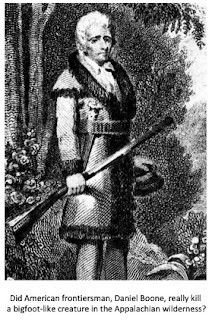
Daniel Boone was born on November 2, 1734 near the present-day town of Reading, Pennsylvania. The sixth of eleven children born to Squire Boone and the former Sarah Morgan, he would go on to earn great fame as a hunter, soldier, politician, statesman, woodsman, and guide. To this day, his is a household name that inspires images of trailblazing adventure and life on a frontier now long gone. Volumes have been written on this legendary figure’s life and of late, I have read through several tomes about this American legend. While doing so, one incident related by the great man himself kept popping up that seems to have been given short-shrift by each his biographers: Boone’s claim that he once shot and killed a ten-foot tall, hair-covered beast, called a “yeahoa” or “yahoo,” in the region that would one day become Kentucky or West Virginia.


     It is easy to see why a biographer of Boone would not know what to think about such a claim. The man did not suffer fools gladly, nor did he tolerate being thought of as one. This is obvious to anyone who reads about how Boone handled being dragged through a humiliating court-martial in 1778. Though he was found not guilty - and was even given a promotion in rank after the court heard his testimony about the matter in question – the frontiersman remained bitter about the entire affair and rarely spoke of it. The grudge against his accusers is one Boone held until the day he died. Yes, Boone was very conscious of his reputation and public image. That being the case, it seems odd he would make a claim as bizarre as having killed a monster.

     Some biographers go into more detail than others about the alleged incident; however, all seem to agree on the basic details of how the story came to light. Late in his life, Boone was holding court with a group of distinguished citizens at a dinner held in his honor at an inn in Missouri. At the conclusion of the meal, a question-and-answer session of sorts seems to have taken place. It was at this time that one of the men in attendance asked for a story. It is unclear if the gentleman asked for the particular yarn he ended up hearing or if Boone decided on the tale to be told. Either way, the story Boone shared was one of having come upon and shooting a ten-foot tall, hair-covered “yahoo” in the Appalachian wilderness many years before. The old frontiersman did not get too deep into the tale before one of the men listening laughed out loud and declared the story “impossible.” Accounts indicate that Boone was deeply offended and refused to continue despite the requests of the others in attendance. The awkwardness of the situation led to the premature end of the get-together and people began making their exits. After most of the others had left, the innkeeper’s son petitioned Boone to finish. 

“I would not have opened my lips had that man remained,” said Boone. 

“Well, we are alone now,” the boy replied. 

The frontiersman is said to have smiled wryly before saying, “You shall have it…” and finishing the story for the lad and the few holdouts who quietly made their way back into the room once it was obvious the story-telling had recommenced.


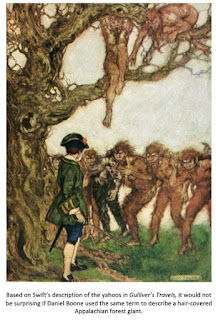
     While Boone never received much in the way of formal schooling – and his spelling was notoriously “creative” – he read well. His early favorites were history books. It is also said Boone took a strong liking to Robinson Crusoe. Later, two books dominated the frontiersman’s reading time: the Bible and Gulliver’s Travels. Written by Irish writer and clergyman, Jonathan Swift, Gulliver’s Travels became an instant hit upon publication in 1726. Most likely think they are familiar with the plot of Gulliver’s Travels in which the main character finds himself shipwrecked on the shores of an island nation called Lilliput and is taken prisoner by a horde of the island’s tiny inhabitants. It is true this is the most well-known part of Swift’s masterpiece; however, the tale of Lemuel Gulliver’s trials and tribulations among the Lilliputians is just part of the overall work. It is actually the story of Gulliver’s fourth voyage that concerns us in regards to the tale told by Daniel Boone.

     In Part 4 of the book, titled “A Voyage to the Country of the Houyhnhnms,” Gulliver – who has tired of his life as a surgeon – returns to the sea as captain of a merchant vessel. After several crew members die, Gulliver hires replacements out of Barbados and the Leeward Islands. Unfortunately, the new hires turn out to be buccaneers and soon mutiny. The pirates strand Gulliver on the first piece of land they come across and sail away in his ship. It is now that the story becomes relevant to the Boone tale as the fictional Gulliver soon encounters some terrifying creatures:


“At last I beheld several animals in a field, and one or two and deformed, which a little discomposed me, so that I lay down behind a thicket to observe them better…their heads and breasts were covered with thick hair, some frizzled and others lank; they had beards like goats, and a long ridge of hair down their backs…they often stood on their hind feet…”


Another passage reads:


“My horror and astonishment are not to be described, when I observed in this abominable animal, a perfect human figure: the face of it indeed was flat and broad, the nose depressed, the lips large, and the mouth wide…the forefeet (arms) of the Yahoo differed from my hands in nothing else but the length of the nails, the coarseness and browness (sic) of the palms, and the hairiness of the backs. There was the same resemblance between our feet, with the same differences…the same in every part of our bodies except as to the hairiness and colour (sic)…I never saw any sensitive being so detestable on all accounts; and the more I came near them the more hateful they grew…”


Daniel Boone was intimately familiar with the yahoos described in Gulliver’s Travels. If he had ever come into contact with a huge, hair-covered, human-like beast in his years of traversing the American wilderness, calling the beast a yahoo – based on the description of the creatures written by Swift – seems natural enough. To this day, the names Yeahoh and Yahoo are used to describe sasquatch-like creatures said to roam the mountains and forests of Appalachia.

Critics say Boone’s tale of shooting a bigfoot-like creature is just a campfire story meant to entertain his rapt followers who hung on his every word. Boone biographer, Robert Morgan, would seem to concur and wrote, “He (Boone) was also known to tell tales about encountering great hairy monsters like the yahoos in Gulliver’s Travels. Most likely it never happened.” It is hard to blame Morgan for having doubts about such a fantastic claim, but he dismisses the tale without any elaboration. While the story might be hard to take at face value, Morgan himself writes about the integrity of Boone and how much he valued his reputation. It would seem proper for the author to explain why the famous woodsman would veer from his character and fabricate a story about having killed a monster, especially when it seems all scholars agree regarding how offended the frontiersman became when his story was challenged.


Boone is said to have related the tale of the yahoo on multiple occasions, most often during the last year of his life. Some have speculated that he might have been losing his faculties during his 85th and final year on this earth. Others correctly point out that the “deathbed confession” is a real phenomenon. People confess all manner of things when they realize the end of life is near. Such confessions are thought to help alleviate feelings of guilt or regret the dying person may have been harboring during their lifetime. Too, the “deathbed declaration” - when a dying person shares some secret knowledge - is not an unusual occurrence. Usually, these declarations have to do with feelings the dying individual has for another person; however, sometimes knowledge is shared which the person has been holding onto for years, decades even. Such dying declarations have sometimes been used in court as evidence; indeed, at times, the final words of a dying man/woman are given more credence in such a scenario, as common sense would seem to indicate that they no longer have anything to lose or gain by sharing what they know.

It is true Boone told the story of the yahoo multiple times over his final year(s), but not on his literal deathbed. Still, Boone’s health was beginning to wane and any man once he reached the age of 85 would realize that there was precious little time ahead of him. Too, men of a certain age often get to a point where they could not care less about what others think of them and no longer concern themselves with how they might be ridiculed. Could the knowledge that his time on earth was short have motivated Boone to relate his incredible tale while he still could? Was it important for him to share the story – one he had kept to himself for years – before leaving this mortal plane? Perhaps.

It is highly doubtful that the truth about whether or not Daniel Boone shot and killed a sasquatch-like creature will ever be known. What is inarguable is that Boone spent more time in the American wilderness than just about any white man who has ever lived. That being the case, if the sasquatch is a real creature, who would have been more likely to eventually come across one than Daniel Boone?


Sources:

Faragher, John Mack. Daniel Boone: The Life and Legend of an American Pioneer. The Easton Press, 1995. 

Morgan, Robert. Boone a Biography. Recorded Books, 2008. 

Mart, T. S. The Legend of Bigfoot: Leaving His Mark on the World. Indiana University Press, 2020. 

Swift, Jonathan, and David Womersley. Gulliver's Travels. Cambridge Univ. Press, 2012. 

“Daniel Boones' Sasquatch.” Daniel Boones' Sasquatch Story, enigmose.com/daniel-boone-sasquatch.html. 

Peacock, Lee. “Did Pioneer Daniel Boone Really Kill a Bigfoot-like Creature Prior to 1820?” Did Pioneer Daniel Boone Really Kill a Bigfoot-like Creature Prior to 1820?, 1 Jan. 1970, leepeacock2010.blogspot.com/2017/05/did-pioneer-daniel-boone-really-kill.html. 


Thursday, August 20, 2020

Sasquatch Classics: The Leflore County Bigfoot War

The telling of scary stories around a campfire is a tradition that is likely nearly as old as mankind itself. While tales of ghosts, goblins, and murderous psychopaths can rattle the cage of nearly anyone, what better subject for a campfire story could there be than a cannibalistic and murderous sasquatch? The story of a haunted house might be creepy, but unless you are actually staying in the house in question it is easily and quickly forgotten once the marshmallows, chocolate, and graham crackers appear at the fire. Tales of a creature – a creature many people regard as being real – stalking the very woods in which you have pitched your tent, however, are not always so easy to put aside. One such terrifying tale is the story of a “bigfoot war” that allegedly took place in eastern Oklahoma during the mid 1850s.The story of the LeFlore County bigfoot war is one I have heard bits and pieces of through the years. I finally decided to look into the matter, gather as much information as I could, and make a determination as to whether the tale might have some truth to it or was an outright fabrication. Following is what I was able to find out.

It is said that in or around 1855, a band of Choctaws in what is now LeFlore County and farmers in what is now Arkansas were experiencing some terrifying events. It all began in a rather benign way with the theft of vegetables, a few head of livestock, and other foodstuff by stealthy bandits in the night. The thieves were cagey, quiet, and never seen. They were also smart, as somehow they never ventured into Choctaw encampments on nights when a watchman was in place. Neither did the bandits ever fall into the traps set for them by farmers outside of Indian Territory. Those charged with finding and capturing these marauders began to develop a begrudging respect for the wiliness of their adversaries as time went by and the petty thefts continued. While the thefts were annoying and did cause some hardships, neither the Choctaw or the neighboring Anglo farmers were afraid of the food bandits; however, things changed once women and children began to go missing.


Spurred by reports of these kidnappings, a group of 30 Choctaw cavalrymen was organized to hunt down the abductors. The group was led by Joshua LeFlore, a man of mixed Choctaw and French blood, who was deeply respected by his fellow tribesmen. Also joining the search party was a Choctaw warrior named Hamas Tubbee and his six sons. The Tubbees were huge men – all approaching seven feet in height and weighing in at more than 300 pounds each – and were regarded as fierce warriors and expert horsemen.  The Tubbees were so effective in mounted warfare that despite their massive size, they became known as the “Lighthorsemen.” The contingent of searchers, armed to the teeth, set out into the region known today as the McCurtain County Wilderness Area to search for the kidnappers.


After riding all day, the searchers finally arrived in the area where they believed the bandits to be hiding. LeFlore brought his troops to a halt, stood up in his stirrups, and surveyed the area with a spyglass. It is unclear exactly what LeFlore saw but whatever it was, he ordered his men to charge toward a stand of pines roughly 500 yards distant. LeFlore and the Tubbee men led the attack. As the troops closed the distance between themselves and the stand of pines where the kidnappers were thought to be hiding, they were assaulted by a tremendous stench, the unmistakable odor of decay and decomposition. The horses of most of the men began to buck and rear, tossing their riders. Only the mounts of LeFlore and the Tubbee men were disciplined enough to remain composed, allowing the eight men to continue through the pines. As the men cleared the small wooded patch they came upon a large earthen mound. Scattered across the mound were the bodies of children and women in various stages of decomposition. LeFlore and the Tubbees caught a glimpse of a number of the murderers fleeing into the tree line on the opposite side of the mound. Only three of the killers stood their ground to meet the charge of the “Lighthorsemen.” It was at this time that the cavalrymen realized they were not going up against any human foe; rather, standing before them, snarling and beating their chests, were three huge, hair-covered creatures. Despite what must have been a shocking sight to him, LeFlore drew his pistol and sabre, spurred his mount, and charged. As LeFlore approached the nearest ape, it took a mighty swipe and struck his horse in the head, killing it instantly.  LeFlore managed to roll off the falling horse, quickly jumped to his feet, and fired multiple shots into the chest of the creature. Once his pistol was empty, LeFlore attacked the ape with his sabre, opening up gaping wounds on the animal which roared in rage and pain.


LeFlore’s assault on the creature was so quick, and the shock of seeing hair-covered monsters so great, that the Tubbee men hesitated, completely stupefied, before entering the fray. This delay allowed one of the other two apes to get behind LeFlore, who was intensely focused on the ape he had engaged. The second beast grabbed LeFlore’s head with two huge hands and ripped it from his shoulders. The horrible sight jolted the Tubbee warriors into action and they opened fire on the three sasquatches with 50-caliber Sharp’s buffalo rifles. Two of the beasts were killed instantly, dropping in their tracks. The third creature was wounded but turned and fled before the lethal shot could be fired. Robert Tubbee, only 18 years old but already 6’ 11” and well over 300 pounds, spurred his horse, ran down the injured ape, and dispatched him with his hunting knife.


As the rest of the troop, after gathering their panicked horses, joined them, the “Lighthorsemen” surveyed the area. The bodies of dead women and children, most partially devoured, littered the area. The smell of decay, along with the terrible odor of the beast’s feces, caused many of the men to vomit. After composing themselves, the men gathered the remains of the unfortunate women and children and buried them. They also buried their leader, Joshua LeFlore. As for the three ape-like monsters, their bodies were placed upon a huge bonfire and burned. Their hellish task complete, the Choctaw warriors returned to Tuskahoma, where it is said even the mighty Tubbee men were plagued by terrible nightmares for years afterward.


Some story, is it not? But is any of it true? While I could not find much, it does appear the Tubbees existed. So, too, did a man named Joshua LeFlore. What I could not find was any mention – at least in any official documents – that Leflore died in battle. For that matter, I have been unable to find any information leading me to believe that the LeFlore County bigfoot war took place anywhere outside of the realm of folklore.


Having said that, is it possible that the LeFlore County incident was actually based on a real event that took place in a different location? According to a bigfoot researcher named Jim King, the answer might be yes. King believes the LeFlore County story is based on an event that took place much farther west in Kiowa territory, an event related to him by an Indian elder. According to the story, Kiowa women were placed in a special teepee or tent on the edge of camp when they started their menstrual cycle. The women stayed there, being tended to only by older women, until their cycle was complete. The elder told King that women were considered “unclean” during their cycles and Kiowa warriors were not only forbidden any physical contact with the females during this time, they were not even to look upon them (This seems harsh but it not too different than the way many cultures treated menstruating women in the past.) The elder said that once, long ago, there had been trouble with ape-like creatures who were attracted by the scent and pheromones emanating from the tent where the menstruating women were housed. Since the tent was on the edge of the encampment, it proved to be an easy target for renegade apes who are said to have entered and carried off women on several occasions. To make a long story short, the Kiowa leadership decided this was unacceptable and put together a group of warriors to hunt down the kidnappers. The searchers did manage to track an ape back to its lair and killed not only it, but an entire family unit.


Could the LeFlore County story have its roots in the tale told to Jim King by the Kiowa elder? Is there any truth at all – even the smallest of grains – in either tale? I have heard many put their faith in the LeFlore County version simply due to the name of the unfortunate Joshua LeFlore. “They wouldn’t have named the county after him if it wasn’t true,” and other similar statements abound. I, however, have not been able to find anything saying LeFlore County was named after Joshua LeFlore. According to the Oklahoma Historical Society’s website, “The name honors the prominent LeFlore family of the Choctaw Nation.” Could Joshua LeFlore have been one of the “prominent LeFlore family?” It is certainly possible, but there does not seem to be any documentation singling out Joshua or his actions as the reason for the naming of the county. 


The story of the LeFlore County bigfoot war, even if totally fictional, does seem to point to the fact that enormous, hair-covered, ape-like animals have been thought to reside in the region for a very long time; a time long before the Patterson-Gimlin film brought bigfoot into America’s consciousness. Add this to the beliefs of many other Native American tribes from across the North American continent who have long told stories of these creatures snatching women and children and the anecdotal evidence stack grows taller. Truth be told, the idea of child- or woman-snatching sasquatches continues to thrill, terrify, and enthrall us to this very day. One needs to look no farther than the success of David Paulide’s Missing 411 books to confirm this.


It may very well be the tale of the LeFlore County bigfoot war was inspired by actual, less dramatic events (think the siege of Honobia, the Ape Canyon incident, etc.) Over the years, such a story would be embellished and grow to mythic proportions. It is all but inevitable as a good scary story is irresistible. Do not be too hard on those who might have added to the original facts. After all, we all know the most frightening types of campfire stories will always have one thing in common…


...they could really happen.


Sources:


The LeFlore Horror/Bear [Radio series episode]. (2018, April 18). In World Bigfoot Radio #53.

Swancer, B., & Seaburn, P. (2018, June 06). The Strange Case of the Human-Bigfoot War of 1855. Retrieved August 21, 2020, from https://mysteriousuniverse.org/2018/06/the-strange-case-of-the-human-bigfoot-war-of-1855/

Nashoba, D. T. (2002, January 6). The Legend of Sacred Baby Mountain [Scholarly project]. In Google Groups. Retrieved August 20, 2020, from https://groups.google.com/g/alt.bigfoot.research/c/tD56ttwlfik?pli=1

Le Flore County: The Encyclopedia of Oklahoma History and Culture. (n.d.). Retrieved August 20, 2020, from https://www.okhistory.org/publications/enc/entry.php?entry=LE007


Monday, August 6, 2018

Sasquatch Classics: The "Caddo Critter" and the "Hawley Him"

Not many think of Texas when the subject of bigfoot is mentioned. Places like Oregon, northern California, or Washington are far more likely to come up in any discussion of where wood apes might be located. Few realize that the Lone Star State actually has a rich and long history of encounters with large, bipedal, ape-like creatures. The few who are aware of this fact are drawn to the eastern half of the state; places like the Big Thicket National Preserve or the Piney Woods region that spills over into western Louisiana and southwestern Arkansas are most often the areas of interest for would-be monster hunters, and rightfully so. The woods, river bottoms, and swamps of this part of Texas have long been associated with “boogers,” “wild men,” and “bush apes.” Not many, however, bother to consider visiting west Texas to look for these creatures; after all, bigfoot – if it exists at all – lives in heavily wooded areas and not the arid scrublands of the west. However, if history is any indication, this assumption might be completely wrong.

Caddo, Texas is all but a ghost town these days. It is an unincorporated community in Stephens County that, as of the 2000 census, is only home to 40 residents. The entire county is sparsely populated with only 9,630 people calling it home. More than half of these souls – 5,780 of them - live within the city limits of the county seat of Breckenridge. The remaining 3,850 people are spread throughout the county’s 921 square miles. This quiet west Texas community briefly became the epicenter of all things bigfoot in the summer of 1964 when an unidentified animal, soon dubbed the “Caddo Critter” by the local media, made several appearances in the area. The animal was first seen by a Caddo resident named Charlie Gantt about 11:30 on two consecutive nights in July. Gantt “unloaded his gun at the critter, but apparently missed,” according to an article in the July 20 edition of the Abilene Reporter-News. The animal was seen subsequently by other Caddo area residents and a full-scale furor erupted. Jo Roberts, a correspondent for the Abilene paper who was covering the story said, “Everyone has said the same thing; it is about seven-feet-tall, four-feet-wide, and covered with hair.” After the first incident, Stephens County Sheriff Chase Booth and the Texas Highway Patrol (DPS), along with a dozen or so area residents searched for the animal with no luck.

It would come to light after the Gantt encounter that residents of the area around Caddo had been seeing the creature for at least two weeks prior. The media that covered the story were convinced the people had seen something and were “genuinely concerned, if not scared.” Roberts wrote that every yard was lit up by outside lights and that the populace was armed. “They were sitting up last night to shoot whatever it was,” she said in the July 21 edition of the Abilene Reporter-News. “If it’s a prank, it’s a highly dangerous one; someone could get killed.” Deputy Sheriff Edgar Martin, too, did not doubt that the people of Caddo had seen something real. “No doubt they’ve seen something, but we don’t know what it is,” he said. As the days went by, more Caddoans claimed to have seen the “critter.” 9-year-old Gene Couch said he saw the creature only 200 yards from his house as he was walking to a fishing spot. His mother could not confirm her son’s account, but did add, “Something has been fighting the dogs at night.” Another mother and son claimed to have seen the beast while walking near a stock pond. According to an article in the July 23 edition of the Amarillo Globe-Times, the boy saw the creature first and pointed it out to his mother. The animal turned around to face them, growled, and then began throwing rocks at them. After a minute or so, it fled. “My boy turned white as a sheet,” the mother said.

The sightings soon stopped and many locals and members of the media began to question the veracity of the dozen or so people who steadfastly insisted they had seen the creature. Some expressed their doubts to local newspapers. One John Luttrell is quoted in the Abilene Reporter-News as saying, “Mr. Gantt probably saw a buck deer.” The 72-year-old Gantt – a lifelong Caddo resident – was understandably insulted and annoyed by such talk. Having lived in the area his entire life, Gantt certainly knew what a deer looked like and was adamant that what he saw, and fired upon, “looked like a gorilla.” Soon, others chimed in on what Caddo residents had likely seen. Everything from black bears to wayward yaks were bandied about as suspects, but no resolution was ever reached. 

While most soon put the whole “critter craze” behind them, residents of Haskell, about 70 miles to the northwest, began to suspect that the creature terrorizing Caddo residents might be the same animal that had been seen many times in and around their small town. While the “Haskell Rascal” was rumored to be much larger than the “Caddo Critter,” the parallels did not go unnoticed. The Haskell County Sheriff at the time – last name of Garrett – said, “If the critter was an even four-foot taller, it just could be our varmint walking on his hind legs.” According to locals, the “rascal” had been spotted, off and on, for the previous 80 years. Rascal mania had hit a high-water mark just the summer before (1963) when a series of livestock attacks were blamed on the creature. Residents swore the “rascal” did its dirty work within a 60-mile radius, which could put it very close to the community of Caddo. Noted bigfoot researcher, John Green, wrote in his classic Sasquatch: The Apes Among Us, “The residents here (Haskell) claim that the ‘Haskell Rascal’ and the ‘Caddo Critter’ are one and the same. Although the Haskell creature has been reported for 80 years, I have had difficulty finding descriptions of it. Residents claim that it spends summers in the Kiowa Peak area, west of Haskell, and that it prowls in the lowlands during the winter, killing and feeding on livestock." While official documentation of encounters with the “Haskell Rascal” were hard to come by, it would not be too very long before the similar experiences of the residents of another small town in the region would be very well chronicled.


Roughly 82 miles west of Caddo and 42 miles south of Haskell, tucked in the southeastern corner of Jones County, sits the small town of Hawley. Even smaller than Haskell – as of the 2010 census there were only 634 people living in the town – Hawley seems a most unlikely place for a flap of ape-man sightings, yet that is exactly what took place in the summer of 1977. It all started in early July when two boys – Larry Suggs (15) and Tom Roberts (14) – were clearing brush from the property of the Abilene Boys Ranch where they lived at the behest of ranch owner Bob Scott. At approximately 10:00 a.m. the two boys sat down to take a break. They were soon startled by the sounds of branches breaking and a rain of rocks, seemingly hurled in their direction from the brush. Suggs was hit in the leg by one of the flying rocks. The boys then got a glimpse of their attacker. “Whatever it was, he looked like kind of an ape, but still a man,” said Suggs. “He had huge arms. They hung down to his knees. You’d have to see him to believe it.” Seeing their attacker was enough to convince the boys to flee to the nearby home of Mr. Ed McFarland. The McFarland’s daughter, Renee (15), grabbed a deer rifle and headed back out to the sighting location with the boys (news articles are not clear on whether or not Renee’s parents were home at the time). The trio of teens investigated the area where the sighting had taken place and soon encountered the creature again. The sight of the beast rattled Renee who handed the rifle to Suggs and said, “You shoot it.” Suggs took aim and fired at the ape-like animal from a distance of only about 40 yards. The teen missed and the recoil of the gun knocked him to the ground. Fortunately for the frightened youths, the shot was enough to send the animal running. It crashed through brush that would have been impenetrable to a normal man and made its escape. Footprints were later found at the spot where the teens watched “Him” dive into the brush. When interviewed by the media, Bob Scott said that he had never seen anything like the animal described by the three youngsters, but recently lost 21 goats from a pen. The goats had disappeared without a trace. No blood, no broken fence, no nothing. A few goat carcasses were later found in the brush, not too far from the sighting location, but the rest were just gone. Jones County Sheriff’s officers felt that coyotes had likely killed the goats found in the brush but could offer no explanation for the 18, or so, others that had vanished.

The incident hit Texas newspapers on July 7 and it wasn’t long before monster hunters descended upon Bob Scott’s ranch. One such hunter was Ed Nash, who along with his step-son, David Woods, and a reporter armed with a 35mm camera, decided to hunt for “Him” in a tangle of stunted oak trees dubbed the “chinry” by locals. The chinry forms the  dense jungle of entangled brush that runs through most of southern Jones County and often rises to heights of five-feet or more. Traveling through the chinry is all but impossible on foot except on established game trails. Nash expressed optimism that the rain that had fallen over the previous two days would make it more likely that the creature they sought would leave tracks. He would be disappointed, however, to find that he and his step-son were far from the first hunters to search the area. Nash cursed the carelessness of previous monster hunters, and himself for not getting to the ranch sooner, as he found mostly boot prints on the game trails. Finally, while searching an overgrown and long abandoned dirt road deep in the chinry, Woods discovered fresh footprints left by a creature with toes. An article in the July 11 edition of the Abilene Reporter-News said, “The prints clearly showed the impression of four toes and the ball of a foot as if whatever made the tracks walked upright on its toes. The prints were approximately five-inches wide and from their distance from each other looked as if their creator had a four-foot stride.” Frustratingly, no photographs of these prints were included with the article. After examining the prints, Nash said, “There is something out there and he is running around barefoot. Whether it is a monster or a man in a bigfoot disguise I can’t say.” When asked about the likelihood of the tracks being made by a human, Nash added that anyone running around in the thorn-infested chinry barefoot would have to be “kind of a lunatic.”


It was not long before the skeptics came out of the woodwork. Some people simply said the teenagers had made the entire incident up; others believed that they had been frightened by something, but certainly it was no monster. Papers began printing insulting hack pieces that insinuated the whole thing had been one big hoax. One piece that appeared in the July 15 edition of the Abilene Reporter-News in the “Page One” column of writer Katharyn Duff is a good example. In the piece, Duff had little to say about the “Him.” Instead she harkened back to a flap of sightings of a creature back in the 1960s she called the “Haskell Thang,” which was likely just another term for the aforementioned “Haskell Rascal.” In the column, Duff recognizes that encounters with 7-foot tall ape-like creatures had been reported in the Haskell/Hawley area for at least the last 15-20 years; however, she quickly threw cold water on the entire phenomenon by propagating the theory of a Texas Tech geologist named Dr. Frank Conselman who felt the “Thang” had been nothing but an ocelot. Dr. Conselman’s response when asked how people could mistake a huge, hair-covered biped for a small, spotted wild cat? “Why not an ocelot?” he said. The absurdity of this position is so apparent no more time need be spent on it; however, many similar explanations from various skeptics – none quite as insulting as that of Dr. Conselman – continued to roll in from all corners of the country.

The “Hawley Him” remained on the minds of local residents despite the tongue-in-cheek explanations offered by skeptics. Some even attempted to capitalize on “Him” mania. One notable example was when the Hawley First Baptist Church provided a space on their VBS invitations - mailed out to local children - to draw and color their idea of what the “Hawley Him” looked like. The “Him” gimmick proved effective as a then record 109 children attended VBS at the church that summer.


Some outsiders did take the “Him” sightings more seriously. Oil man Jack Grimm – who was sort of a poor man’s Tom Slick – offered a $5,000 reward for the capture of “Him.” The stipulations were simple: the creature had to be captured unharmed and had to be a previously unidentified species. “I don’t want to pay a reward for a bear or a gorilla that escaped from the zoo,” Grimm said. Interestingly, Grimm had the same reward posted for the capture of a “red-eyed monster” said to be roaming southeast Oklahoma. Alas, no one was able to claim the bounty and sightings of the “Him” became fewer and farther between.

There has not been a rash of monster sightings from this area of west Texas that can approach the mania caused by the “Caddo Critter,” “Hawley Him,” or “Haskell Rascal” back in the 1960s through the late 1970s. To say that there have been no sightings, however, would not be accurate. A quick search of the databases of three bigfoot research groups active in Texas revealed a handful of interesting accounts from the nine-county region (see graphic below for the counties). The North American Wood Ape Conservancy (NAWAC) has one report in its database from Callahan County. The sighting took place only 41 miles southwest of Caddo in 2005. The Bigfoot Field Researchers Organization (BFRO) has two sightings from the region: a 1977 sighting that took place outside of Ranger in Eastland County only 19 miles south of Caddo and a 1988 sighting that occurred near Throckmorton, in the county of the same name, just 32 miles east of Haskell. Finally, the database of the Gulf Coast Bigfoot Researchers Organization (GCBRO) includes one 2001 Jones County sighting that took place near historic Fort Phantom Hill, a mere 11 miles from Hawley. Certainly, this handful of sightings – spread out over a 28-year period, with none more recent than 2005 – do not grab the attention or the imagination like the flap of sightings in in the 1960s and 1970s. They should, however, make us wonder if, at least occasionally, wood apes do not wander up the riparian areas paralleling the Leon, Colorado, and Brazos Rivers into west Texas. Texas still contains thousands of acres of uninhabited, lonesome country, especially west of the I-35 corridor. Though most of it is privately owned these days, few humans lay eyes on vast tracts of property for weeks or months at a time. It is the domain of domesticated cattle, the coyote, rattlesnake, and red-tailed hawk. There remains, even now, plenty of room for a large animal to, if not live permanently, pass through the region with very little risk of detection by human beings.


 I believe that the rich deciduous forests of the eastern half of the Lone Star State are a more ideal environment for a large ape; however, the more I study primates, the more I learn just how amazingly resilient and adaptable they really are. That being the case, maybe having the perfect forest habitat is not the most important aspect for their survival. Maybe the most important factor as to whether or not wood apes can survive in Texas is isolation. If there is one thing west Texas has, it is vast tracts of lonesome country where humans do not spend much time.

I find the stories of the “Hawley Him” and the “Caddo Critter” more credible than I thought I would when I started researching for this post (there is very little documentation on the “Haskell Rascal,” but it fits the narrative of what was going on in the area during the 1960s and 1970s). Rumors persist of sightings in the area, but nobody seems to want to talk about it. Perhaps they learned their lesson about media attention back in the 1960s-70s. I personally heard a couple of old-timers discussing some kind of large creature that was harassing their livestock near Cross Plains in Callahan County just a couple of years ago. I am a bit embarrassed to say I was eavesdropping on their private conversation while I was in line at a convenience store/gas station in Cross Plains. I think they noticed me listening in as they clammed up and gave me the stink-eye pretty good until I left the store; chastened. I have also heard tales of some very intriguing incidents at the cemetery near the old ghost town of Belle Plain in Callahan County (I actually did a post on these events in 2015; you can access that post here). Visitors to the old cemetery have reported hulking, hair-covered creatures “twice the size of an athletic man” roaming the back portion of the property. More common than visuals are the reports of long, powerful howls, deep growls, and “mumbling” made by something that remains in the shadows and just out of sight. 

It all begs the question, could the “Hawley Him” or “Caddo Critter” still haunt the region? I am afraid I cannot give you the answer. The residents of the nine county area discussed in this post probably know, you might be thinking. That is likely true, but trust must be earned before west Texans open up, especially when it comes to something as strange as monsters roaming the countryside. Earning such trust takes time. Maybe one day a reader of this site or others like it will decide to share what they know. For now, though, nobody is talking.

Sources:

“Gorilla-Type Animal Hunted In Caddo Area.” Abilene Reporter-News, 20 July 1964, p. 14.

“Caddo Residents Take Up Arms, Watch For 'Critter'.” Abilene Reporter-News, 21 July 1964, p. 48.


Bruce, Bob. “Caddo's 'Critter Jitters' Aren't Total.” Abilene Reporter-News, 22 July 1964, p. 1.


Bruce, Bob. “'Critter Talk' Takes Heat Off Caddo Conversations.” Abilene Reporter-News, 22 July 1964, p. 51.


“Yak Suspected Of 'Crittering'.” Abilene Reporter-News, 24 July 1964, p. 16.


“Opinion Divided in Caddo On Existence of Critter.” Amarillo Globe-Times, 23 July 1964, p. 41.


“'That' Yak Still Free.” Abilene Reporter-News, 12 Aug. 1964, p. 8.


“Blue Planet Project - 03.” Cattle Mutilations, www.bibliotecapleyades.net/vida_alien/blueplanetproject/blueplanetproject03.htm.


Green, John. Sasquatch: the Apes among Us. Hancock House, 2006. Page 184


“'The Hawley WHAT?' Asks Jones Sheriff.” Abilene Reporter-News, 7 July 1977.


“'Hawley Him' on the Loose.” Corsicana Daily Sun, 7 July 1977, p. 13.


Downing, Roger. “Abilenians Go to Hawley to Hunt 'Him'.” Abilene Reporter-News, 11 July 1977.


Duff, Katharyn. “Page One.” Abilene Reporter-News, 15 July 1977, p. 1.


“Incident Report Locator.” North American Wood Ape Conservancy, woodape.org/reports/report/state?state=TX#allRegions=screen.


“Reports for Texas.” Bigfoot Field Researchers Organization, bfro.net/GDB/state_listing.asp?state=tx.


Hamilton, Bobby. “Sightings Encounters Texas.” Gulf Coast Bigfoot Research Organization, gcbro.com/txdb1.htm.

Tuesday, May 29, 2018

Sasquatch Classics: The Davy Crockett Incident

Few men are as revered in my home state of Texas as those who held off the mighty Mexican Army – led by the self-proclaimed “Napoleon of the West,” dictator Antonio Lopez de Santa Anna - for 13 long days in the spring of 1836. The blood sacrifice of men like William Barrett Travis, James Bowie, James Bonham, and David Crockett bought precious time for General Sam Houston to train and prepare his ragtag troops for a final confrontation with what might have been the mightiest army in the Western Hemisphere. The tale of the defenders of the Alamo is as interesting as it is tragic, but that is not the story I want to share with you today. Instead, I want to share a little-known tale about arguably the most well-known of the Alamo freedom fighters: David Crockett. It is a story with which most Texans are not familiar, much less anyone outside the Lone Star State. As a matter of fact, it is a tale I had never heard until very recently. It is incredibly strange, but undeniably fascinating. 


By the spring of 1835, lured by empresarios like Stephen F. Austin and Green DeWitt, more than 20,000 American settlers had migrated to Texas in search of cheap land and the promise of prosperity. Around this same time, David Crockett, who had served as both a Tennessee State Representative (1821-1823) and a U.S. Congressman (1827-1835) had declared himself done with politics and was pondering what to do with the next phase of his life. The allure of Texas proved too much for him to resist. On November 1, 1835, Crockett, his brother-in-law Abner Burgin, William Patton, and Lindsey K. Tinkle set out for Texas. It was at a stop along their trip – in Memphis, Tennessee – that Crockett uttered his famous line, “Since you have chosen to elect a man with a timber toe to succeed me, you may all go to hell and I will go to Texas.”

The group traveled west and eventually made their way into the Mexican province of Texas. Upon arriving in the San Augustine/Nacogdoches area the group was told that each individual would be required to sign an “Oath of Allegiance” to the government of Mexico. Two in the group, including Crockett’s brother-in-law Abner Burgin, refused to sign the oath and decided to return to their homes in the U.S. Crockett and Patton, after some negotiation regarding the wording of the oath (men took their oaths more seriously then, it seems), signed and were allowed to continue their journey. It was at some point soon after this that things got strange for Crockett. In a letter addressed to his brother-in-law, Burgin, Crockett detailed the following experience:

“William and I were pushing through some thicket, clearing the way, when I sat down to mop my brow. I sat for a spell, watching as William made his good and fine progress. I removed my boots and sat with my rations, thinking the afternoon a fine time to lunch. As the birds whistled and chirped, and I ate my small and meager ration, I tapped my axe upon the opposite end of the felled tree I rested upon.

“Whether it was the axe’s disturbance or possibly the heat of the sun which caused an apparition to slowly form in front of my eyes, I know not. As a Christian man, I swear to you, Abe, that what spirit came upon me was the shape and shade of a large ape man, the likes we might expect among the more bellicose and hostile Indian tribes in the Territories. The shade formed into the most deformed and ugly countenance. Covered in wild hair, with small and needling eyes, large broken rows of teeth, and the height of three foundlings, I spit upon the ground the bread I was eating.

“The monster then addressed a warning to me. Abner, it told me to return from Texas, to flee this Fort and to abandon this lost cause. When I began to question this, the creature spread upon the wind like the morning steam swirls off a frog pond. I swear to you, Abner, that whatever meat or sausage disagreed with me that afternoon, I swore off all beef and hog for a day or so afterward.”


Less than six months after the writing of this letter, Crockett was killed at the Alamo along with approximately 190 others who dared stand in Santa Anna’s way as he and his Mexican Army swept north and east in an attempt to snuff out the Texas Revolution. That being the case, no clarification on the information in the Burgin letter was ever given. Most historians feel that the account in the letter was just an attempt by Crockett to entertain his brother-in-law. Some, however, feel differently. Many point to the fact that Crockett “swore” his account was true not once, but twice in the letter. They also point to how Crockett had insisted on changing the wording of the “Oath of Allegiance” as evidence that he took his honor seriously (The wording changed in the oath included the addition of the word Republican before the word government. That way Crockett would not have been obliged to defend a rogue government run by a non-elected dictator. It is this very change in the agreement that allowed Crockett to fight against Santa Anna with a clear conscience). Would Crockett have sworn the tale was true in writing if it did not occur? 

The entire matter of the creature/apparition appearing and verbalizing a warning to Crockett is about as bizarre an incident as I have ever come across. Certainly, the description of the creature given by Crockett matches the classic description of a wood ape or sasquatch. The "ugly countenance, covering of wild hair, and the small and needling eyes" described all sound familiar. So does the estimated height of "three foundlings" (while there is no exact height of a foundling - a small abandoned child - most agree a safe estimate for this description would be somewhere between 7 and 8 feet). That is where the similarities between Crockett's creature and credible modern bigfoot accounts end. The claim of Crockett that the creature spoke to him and actually warned him to leave Texas is utterly unprecedented. I simply do not know what to say about it. Crockett's description of how the apparition slowly formed and later disappeared, "like the morning steam off a frog pond" makes the entire incident seem more likely to have been a lucid dream or hallucination of some kind. Again, it is all very strange.

What did David Crockett see in the woods near Nacogdoches in 1836? The likelihood is that we will never know. Something telling, however, is how few people have heard of this account. So many of Crockett’s feats and experiences have been trumpeted and blown up to mythic proportions through the years that it seems strange that this tale has fallen between the cracks and remains largely untold today. On second thought, maybe it isn’t so strange after all. Americans like their heroes, especially those in the distant past, to be without blemish; perfect images chiseled in marble. These heroes, men like David Crockett, are revered to this very day and held up as icons. The legacy of such a man might be tarnished if such a story leaked out and became well known. Better to dismiss the tale as nothing more than a bit of “yarn-spinning” on the part of good old Davy than to attempt to come to grips with the possibility that something genuinely strange happened in the deep woods of east Texas in 1836…something very strange, indeed.

Sources:

Xerxes, R. John. “1836, Nacogdoches, Texas: Davy Crockett and the Bigfoot's Prophesy.” Bigfoot History, Wordpress, 15 May 2012, bigfoothistory.wordpress.com/2012/05/15/1836-nacogdoches-texas-davy-crockett-and-the-bigfoots-prophecy/ .

“The Burgin-Crockett Connection.” The Burgin Family, theburginfamily.org/crockett.html.

Stewart, Jeff. “Bigfoot in Texas? Read This.” Fish and Game, May 2017, fishgame.com/2018/05/bigfoot-in-texas-read-this/.