
"To accomplish great things, we must not only act, but also dream; not only plan, but also believe."
- Anatole France
Monday, February 4, 2013

Saturday, February 2, 2013
The Swamp Monsters of Cajun Louisiana
The term swamp monster conjures up different images in different people. Thoughts would range from the skunk apes said to roam the Florida Everglades to the reptilian lizard man that allegedly haunts the swamps of Lee County, South Carolina. Still others would, without a doubt, think of the terrifying images of the sasquatch-like creature, dubbed the Fouke monster, that terrified so many back in the 1970’s when The Legend of Boggy Creek made its debut on the big screen.
For me, the first thing that comes to mind is the fictional paramafait that was featured in an episode of the 1970’s series Kolchak: The Nightstalker. The paramafait was, according to the episode entitled The Spanish Moss Murders, a legendary swamp monster that was humanoid in shape but much larger and more powerful than any person. It was covered in Spanish moss and decaying vegetation. Paramafait squeezed the very life out of its victims by enveloping them in a bear hug that crushed their chest cavities. The show portrayed the paramafait as part of Cajun lore; a legendary creature that parents frightened their children with when they failed to behave. The creature was all but invulnerable and could only be killed by a spear fashioned from the wood of a gum tree. The climactic battle between Kolchak, played brilliantly by Darren McGavin, and the swamp monster in the sewers below Chicago made quite an impression on a then 8 year-old future cryptid hunter.
I wondered, years after viewing this episode, if paramafait was based on an actual Cajun legend. Having grown up in SE Texas in the Port Arthur area (Port Arthur is often jokingly referred to as the capital of Louisiana) I became well acquainted with Cajun culture. I have heard a lot of interesting tales from some old Cajuns. One has to be careful as these old timers are notorious yarn spinners and don’t mind “polishing up” a good story just a bit if it helps achieve the desired effect. Even so, I never heard anyone mention paramafait. I’ve looked often but have never found anything on this monster that connects it to anything but the old television show. It appears that paramafait was purely the creation of the Kolchak: The Nightstalker writing team. Having said that, it is entirely possible that the writers took some well-known Cajun folk tales and weaved elements of them together to yield the ultimate swamp monster that was paramafait. It is those tales I would like to examine now.
One of the most prominent figures in Cajun folklore is that of the rougarou. The term is, no doubt, derived from the original French term loup-garou. Both of these terms are used interchangeably in French Louisiana. Where I grew up, I heard the term loup-garou more often but noticed, even as a young boy, that when the old-timers told tales of the beast, they used rougarou. The rougarou legend has been around for generations and likely migrated south with the French Canadians two hundred years ago.

The rougarou is, for all intents and purposes, a werewolf. It was described in the past as a beast with the body of a man and the head of a wolf; however, the monster is described most often these days as a shape-shifting human that can transform into a massive wolf-like creature during the full moon. The rougarou is said to inhabit the swamps, marshes, and bayous of Louisiana and mindlessly slaughters any living thing unfortunate enough to cross its path. The tale, as is the case with almost all “boogeyman” stories, is most often told around campfires and/or to “encourage” obedience in children. One interesting twist on the rougarou legend is that the beast will actually hunt down Catholics who fail to observe the rules of Lent. Some versions of the legend actually claim that one way a person can be cursed and become a rougarou is by breaking the rules of Lent for seven consecutive years.
Most would consider the rougarou/loup-garou just another legend, a myth and nothing more. After all, there is no physical evidence to support the existence of such a fantastic creature.
Or is there?
Back in 1996 The DeQuincy News printed a rather unusual story. It tells the story of a woman named Barbara Mullins who stumbled across something very unusual on the side of a rural Louisiana state highway. Mullins was driving down Louisiana State Hwy. 12 when she noticed what appeared to be the road-killed carcass of a large animal at the edge of the road’s paved surface. She decided to stop and have a look. What she saw amazed her.

She described the animal as being roughly equivalent in size to an adult St. Bernard. The beast was covered with a thick, matted coat of reddish-brown hair. What really stood out to Mullins was the overall simian appearance of the animal. This didn’t look like any sort of dog she had ever seen. The snout was more like what one would see on a baboon than a dog. The ears of the animal were small and pointy: not dog-like at all. The feature that stood out more than any, however, was the very un-paw-like feet of the creature. They were long and elongated and looked much more like the feet of an ape than those of any canine. Mullins, unlike so many people who have had strange encounters, had a camera in the car and took several intriguing photos.
I have to admit that the photos of the “Deridder Road Kill,” as the carcass has become known, are very interesting to me. The Louisiana Department of Wildlife and Fisheries wasted little time before stating the animal was nothing more than a Pomeranian dog. Others felt, due to the simian-like features present, that the animal was some sort of primate. Some ventured this was physical evidence proving the existence of none other than the legendary rougarou/loup-garou.

Whatever the animal might have been will likely never be known. Even the photos themselves, intriguing as they are, are frustrating in that there is nothing in them to provide scale and, thus, verify the claim that the animal was the size of a St. Bernard. Was it just a Pomeranian dog that had gone feral or something more? Is this the real creature behind the tales about the rougarou/loup-garou?
Of all the swamp monster legends, that of the Honey Island swamp monster might be the most intriguing. The Honey Island Swamp is a tract of bottomland lying between the East Pearl and West Pearl Rivers in SE Louisiana. The swamp covers about 250 square miles. Of that, approximately 70,000 acres have been set aside as a protected wildlife area by the Nature Conservancy. The swamp teems with life. Alligators, cougars, coyotes, waterfowl of all kinds, bald eagles, and even the endangered red wolf have all been spotted here. Some claim something else has been seen as well.
The first heavily publicized sighting of what would become known as the Honey Island Swamp monster took place in 1963 when a retired air traffic controller named Harlan Ford claimed to have spotted the creature while fishing the black waters of the Pearl. Ford and a friend named Bill Mills later brought a casting back of a very unusual footprint. The footprint was very large and featured three webbed and clawed toes. I believe strongly this print is nothing more than that of a very large bull gator but it isn’t this casting that makes me pause and consider the possibility that a monster might actually roam the Honey Island Swamp. Rather, it is the words of Harlan Ford and another local named Ted Williams (not the baseball player), spoken during several interviews, and a piece of film that make me think there might be something to the legend. Williams told the television crew of the famous In Search Of series the following:
“First time I ever saw it, it was standing plum still like a stump. I stopped and realized it wasn't a stump and it wasn't supposed to be there. When I stopped it ran. It was dark gray, about seven foot high, it jumped a bayou, that was the first time I saw it. The next time I seen him was swimming the river [Pearl River], two of them, one was bigger than the other and faster than the other and they swam just like a human with them long overhead strokes. I tried to get one of them to look at me and the other one ran off and the other one wouldn't look at me. I could've shot it but I wouldn't on account it wouldn't look at me. It looked too much like a human too me, broad shoulders, arms hanging down below its knees, hands looked almost like a humans."

One of the things Williams says during his interview that catches my attention is his description of how the creature stood dead still, “like a stump,” until it realized it had been seen. Once it realized it had been spotted, the animal fled. This scenario has been described many times by alleged sasquatch witnesses (The creature in question is clearly a sasquatch-like animal). Another intriguing aspect of his second account is of the creatures swimming. There have been a handful of sasquatch sightings where the witnesses claimed to have seen these animals swimming. These reports were often dismissed at the time since it was believed no apes could swim. This has now been proven wrong (see my Great Ape Parallel Series). The claim of seeing a wood ape swim would have been deemed too outlandish to be believed back in the early 1970's even by those who believed in the existence of such creatures. Why would Ford and Williams say something they knew even monster hunters wouldn't believe? Ford is also among the first to mention the possibility that the creature might climb trees to escape detection. I have a copy of the Honey Island Swamp Monster DVD, a documentary produced by Harlan’s daughter, in which another man recounted a sighting to Ford. In a nutshell, the man said he saw the beast and then it just “disappeared.” The man could not believe the animal could have gotten very far in the time it took him to get to the spot where it was first seen. Ford asked him, “Did you look up? Never forget to look up.” It is little tidbits like these that lend credence to the stories of Harlan Ford.
After Harlan Ford died in 1980, a reel of Super 8 film was found among his belongings. A segment of the film featured an upright creature walking right to left just inside a tree line somewhere in the swamp. You can see a snippet of the video above. His footage is one of only three pieces of video that I’ve seen that I believe may very well be authentic (I have another post in the works comparing and contrasting these three pieces of footage). Some dismiss the video as a hoax. I don't. I have reasons for feeling the way I do. I'll delve into those in a future post but, in the meantime, consider something. Wouldn't Harlan Ford, assuming he was a hoaxer after fame, money, or attention, have promoted his 8mm film for all it was worth? Wouldn't he have "gotten it out there" to television producers, newspaper and magazine editors, or even the local news stations? Why would he hold onto the footage and show no one? It doesn't make sense. Some might think Ford did have plans for the footage and that he died before he could realize his plans. I don't buy it though. I have no idea why Ford never shared the footage. Maybe he had simply achieved his goal of proving the monster was real. Maybe that was enough for him.
As stated above, the creature described by Ford and others in the Honey Island Swamp is clearly a sasquatch-like animal. It is almost universally said to be close to 7-feet tall, covered in hair, and bipedal. The colors described range from a grayish hue to the more typical reddish-brown. To bring this thing full circle, could the legends of the loup-garou/rougarou be based on sightings of sasquatches? The descriptions of the beasts are similar in many ways: large, upright, covered in hair/fur, etc. Maybe the old Acadians that first settled these bottomlands were projecting their previous knowledge of the French werewolf to the unknown animal they were seeing in the woods near their new homes in the deep south. It is an intriguing theory.
Tales of hair-covered, screaming, shambling bipedal swamp monsters aren’t going anywhere. Popular culture revels in these sorts of things. Bigfoot is used to sell everything from beef jerky to cosmetics. The Swamp Thing (DC Comics) and Man-Thing (Marvel Comics) both play off the swamp monster mythos to sell comic books. None other than Survivorman Les Stroud alluded to swamp monsters when he did an episode of his show from the Okefenokee Swamp of southern Georgia several years back. The movie industry will, no doubt, continue to churn out B-grade films featuring beasts that emerge from the creepy bayous and swamps to terrorize those who dare venture into their territory (usually scantily clad co-eds, it seems).
Quietly, however, among all the noise about these monsters made by popular culture, compelling reports continue to trickle in from normal people who encounter something strange while hunting, camping, fishing, and/or hiking in the bottomlands of the south. The paramafait of Nightstalker fame may have been a figment of some writer’s imagination but real-life swamp monsters might not be.
Think about that next time you venture into the bottomlands and realize there are more strange things under heaven and on the earth than we can possibly imagine.
For me, the first thing that comes to mind is the fictional paramafait that was featured in an episode of the 1970’s series Kolchak: The Nightstalker. The paramafait was, according to the episode entitled The Spanish Moss Murders, a legendary swamp monster that was humanoid in shape but much larger and more powerful than any person. It was covered in Spanish moss and decaying vegetation. Paramafait squeezed the very life out of its victims by enveloping them in a bear hug that crushed their chest cavities. The show portrayed the paramafait as part of Cajun lore; a legendary creature that parents frightened their children with when they failed to behave. The creature was all but invulnerable and could only be killed by a spear fashioned from the wood of a gum tree. The climactic battle between Kolchak, played brilliantly by Darren McGavin, and the swamp monster in the sewers below Chicago made quite an impression on a then 8 year-old future cryptid hunter.
I wondered, years after viewing this episode, if paramafait was based on an actual Cajun legend. Having grown up in SE Texas in the Port Arthur area (Port Arthur is often jokingly referred to as the capital of Louisiana) I became well acquainted with Cajun culture. I have heard a lot of interesting tales from some old Cajuns. One has to be careful as these old timers are notorious yarn spinners and don’t mind “polishing up” a good story just a bit if it helps achieve the desired effect. Even so, I never heard anyone mention paramafait. I’ve looked often but have never found anything on this monster that connects it to anything but the old television show. It appears that paramafait was purely the creation of the Kolchak: The Nightstalker writing team. Having said that, it is entirely possible that the writers took some well-known Cajun folk tales and weaved elements of them together to yield the ultimate swamp monster that was paramafait. It is those tales I would like to examine now.
One of the most prominent figures in Cajun folklore is that of the rougarou. The term is, no doubt, derived from the original French term loup-garou. Both of these terms are used interchangeably in French Louisiana. Where I grew up, I heard the term loup-garou more often but noticed, even as a young boy, that when the old-timers told tales of the beast, they used rougarou. The rougarou legend has been around for generations and likely migrated south with the French Canadians two hundred years ago.

The rougarou is, for all intents and purposes, a werewolf. It was described in the past as a beast with the body of a man and the head of a wolf; however, the monster is described most often these days as a shape-shifting human that can transform into a massive wolf-like creature during the full moon. The rougarou is said to inhabit the swamps, marshes, and bayous of Louisiana and mindlessly slaughters any living thing unfortunate enough to cross its path. The tale, as is the case with almost all “boogeyman” stories, is most often told around campfires and/or to “encourage” obedience in children. One interesting twist on the rougarou legend is that the beast will actually hunt down Catholics who fail to observe the rules of Lent. Some versions of the legend actually claim that one way a person can be cursed and become a rougarou is by breaking the rules of Lent for seven consecutive years.
Most would consider the rougarou/loup-garou just another legend, a myth and nothing more. After all, there is no physical evidence to support the existence of such a fantastic creature.
Or is there?
Back in 1996 The DeQuincy News printed a rather unusual story. It tells the story of a woman named Barbara Mullins who stumbled across something very unusual on the side of a rural Louisiana state highway. Mullins was driving down Louisiana State Hwy. 12 when she noticed what appeared to be the road-killed carcass of a large animal at the edge of the road’s paved surface. She decided to stop and have a look. What she saw amazed her.

She described the animal as being roughly equivalent in size to an adult St. Bernard. The beast was covered with a thick, matted coat of reddish-brown hair. What really stood out to Mullins was the overall simian appearance of the animal. This didn’t look like any sort of dog she had ever seen. The snout was more like what one would see on a baboon than a dog. The ears of the animal were small and pointy: not dog-like at all. The feature that stood out more than any, however, was the very un-paw-like feet of the creature. They were long and elongated and looked much more like the feet of an ape than those of any canine. Mullins, unlike so many people who have had strange encounters, had a camera in the car and took several intriguing photos.
I have to admit that the photos of the “Deridder Road Kill,” as the carcass has become known, are very interesting to me. The Louisiana Department of Wildlife and Fisheries wasted little time before stating the animal was nothing more than a Pomeranian dog. Others felt, due to the simian-like features present, that the animal was some sort of primate. Some ventured this was physical evidence proving the existence of none other than the legendary rougarou/loup-garou.

Whatever the animal might have been will likely never be known. Even the photos themselves, intriguing as they are, are frustrating in that there is nothing in them to provide scale and, thus, verify the claim that the animal was the size of a St. Bernard. Was it just a Pomeranian dog that had gone feral or something more? Is this the real creature behind the tales about the rougarou/loup-garou?
Of all the swamp monster legends, that of the Honey Island swamp monster might be the most intriguing. The Honey Island Swamp is a tract of bottomland lying between the East Pearl and West Pearl Rivers in SE Louisiana. The swamp covers about 250 square miles. Of that, approximately 70,000 acres have been set aside as a protected wildlife area by the Nature Conservancy. The swamp teems with life. Alligators, cougars, coyotes, waterfowl of all kinds, bald eagles, and even the endangered red wolf have all been spotted here. Some claim something else has been seen as well.
The first heavily publicized sighting of what would become known as the Honey Island Swamp monster took place in 1963 when a retired air traffic controller named Harlan Ford claimed to have spotted the creature while fishing the black waters of the Pearl. Ford and a friend named Bill Mills later brought a casting back of a very unusual footprint. The footprint was very large and featured three webbed and clawed toes. I believe strongly this print is nothing more than that of a very large bull gator but it isn’t this casting that makes me pause and consider the possibility that a monster might actually roam the Honey Island Swamp. Rather, it is the words of Harlan Ford and another local named Ted Williams (not the baseball player), spoken during several interviews, and a piece of film that make me think there might be something to the legend. Williams told the television crew of the famous In Search Of series the following:
“First time I ever saw it, it was standing plum still like a stump. I stopped and realized it wasn't a stump and it wasn't supposed to be there. When I stopped it ran. It was dark gray, about seven foot high, it jumped a bayou, that was the first time I saw it. The next time I seen him was swimming the river [Pearl River], two of them, one was bigger than the other and faster than the other and they swam just like a human with them long overhead strokes. I tried to get one of them to look at me and the other one ran off and the other one wouldn't look at me. I could've shot it but I wouldn't on account it wouldn't look at me. It looked too much like a human too me, broad shoulders, arms hanging down below its knees, hands looked almost like a humans."

One of the things Williams says during his interview that catches my attention is his description of how the creature stood dead still, “like a stump,” until it realized it had been seen. Once it realized it had been spotted, the animal fled. This scenario has been described many times by alleged sasquatch witnesses (The creature in question is clearly a sasquatch-like animal). Another intriguing aspect of his second account is of the creatures swimming. There have been a handful of sasquatch sightings where the witnesses claimed to have seen these animals swimming. These reports were often dismissed at the time since it was believed no apes could swim. This has now been proven wrong (see my Great Ape Parallel Series). The claim of seeing a wood ape swim would have been deemed too outlandish to be believed back in the early 1970's even by those who believed in the existence of such creatures. Why would Ford and Williams say something they knew even monster hunters wouldn't believe? Ford is also among the first to mention the possibility that the creature might climb trees to escape detection. I have a copy of the Honey Island Swamp Monster DVD, a documentary produced by Harlan’s daughter, in which another man recounted a sighting to Ford. In a nutshell, the man said he saw the beast and then it just “disappeared.” The man could not believe the animal could have gotten very far in the time it took him to get to the spot where it was first seen. Ford asked him, “Did you look up? Never forget to look up.” It is little tidbits like these that lend credence to the stories of Harlan Ford.
After Harlan Ford died in 1980, a reel of Super 8 film was found among his belongings. A segment of the film featured an upright creature walking right to left just inside a tree line somewhere in the swamp. You can see a snippet of the video above. His footage is one of only three pieces of video that I’ve seen that I believe may very well be authentic (I have another post in the works comparing and contrasting these three pieces of footage). Some dismiss the video as a hoax. I don't. I have reasons for feeling the way I do. I'll delve into those in a future post but, in the meantime, consider something. Wouldn't Harlan Ford, assuming he was a hoaxer after fame, money, or attention, have promoted his 8mm film for all it was worth? Wouldn't he have "gotten it out there" to television producers, newspaper and magazine editors, or even the local news stations? Why would he hold onto the footage and show no one? It doesn't make sense. Some might think Ford did have plans for the footage and that he died before he could realize his plans. I don't buy it though. I have no idea why Ford never shared the footage. Maybe he had simply achieved his goal of proving the monster was real. Maybe that was enough for him.
As stated above, the creature described by Ford and others in the Honey Island Swamp is clearly a sasquatch-like animal. It is almost universally said to be close to 7-feet tall, covered in hair, and bipedal. The colors described range from a grayish hue to the more typical reddish-brown. To bring this thing full circle, could the legends of the loup-garou/rougarou be based on sightings of sasquatches? The descriptions of the beasts are similar in many ways: large, upright, covered in hair/fur, etc. Maybe the old Acadians that first settled these bottomlands were projecting their previous knowledge of the French werewolf to the unknown animal they were seeing in the woods near their new homes in the deep south. It is an intriguing theory.
Tales of hair-covered, screaming, shambling bipedal swamp monsters aren’t going anywhere. Popular culture revels in these sorts of things. Bigfoot is used to sell everything from beef jerky to cosmetics. The Swamp Thing (DC Comics) and Man-Thing (Marvel Comics) both play off the swamp monster mythos to sell comic books. None other than Survivorman Les Stroud alluded to swamp monsters when he did an episode of his show from the Okefenokee Swamp of southern Georgia several years back. The movie industry will, no doubt, continue to churn out B-grade films featuring beasts that emerge from the creepy bayous and swamps to terrorize those who dare venture into their territory (usually scantily clad co-eds, it seems).
Quietly, however, among all the noise about these monsters made by popular culture, compelling reports continue to trickle in from normal people who encounter something strange while hunting, camping, fishing, and/or hiking in the bottomlands of the south. The paramafait of Nightstalker fame may have been a figment of some writer’s imagination but real-life swamp monsters might not be.
Think about that next time you venture into the bottomlands and realize there are more strange things under heaven and on the earth than we can possibly imagine.
Friday, February 1, 2013
Black Panther Struck By Car: A Call To Arms
I received a report yesterday from a reader who hit what he describes as a very large black cat two nights ago on Hwy 90 just south of Madisonville, TX. His description of the incident is as follows:
"Last night I was traveling back from Houston to Dallas on the back roads to avoid traffic. Around 9pm I was on HWY 90 south of Madisonville and hit a large black cat with my car. The animal was by my estimation about 80lbs and bigger than my English Springer Spaniel. I was traveling about 70mph with high beams on, it was clear, and I could see fine. But suddenly from the left side of the road it appeared and stopped just in front of the car, and turned to look at me.
There appeared to be embankments on each side of the road and I discounted swerving or going in to the ditch to avoid it, So I hit the brakes hard. As I did the animal turned to face me and I saw clearly two blue eyes reflected back at me by my lights, and a clear feline face and large body. I think by the time I hit it the car had slowed to about 30-35 mph. There was a thud on impact, but I didn’t “run over it”, I think it went under the car. I pulled over about 50 yards farther and paused to take a look at the damage on my car. The front quarter panel was torn up and there was some fluids leaking and I noted some vapor clouds that smelled of radiator coolant. I determined that I needed to get in to town ASAP before the car was no longer drivable.
When in town I assessed the damage and had to tie up parts and put extra fluid in the car and was eventually able to “nurse” it back to Dallas where I live.
When I got home my wife and I did some research and I am convinced I saw and hit a black panther. I grew up in the Huntsville Area and as a teen heard stories of people seeing them in the area.
This morning just before the care was towed away I inspected it again and found a collection of long semi-soft black hairs that had become stuck in the plastic, I have these and put them in a baggie. I am writing this to you to ask for any insight or ideas on how I can determine if in deed this was a black panther or if my eyes deceived me and it was perhaps a wild hog, or possibly a coyote. I am so sure that the face and head was that of a large feline, and I am mad now that I didn’t try to go look in the ditch for it, but I feared my car was failing and didn’t want to tangle with a large wounded animal should I find it.
Ideas?"
I replied with the reader and asked if he could provide a more specific location of the incident. His reply is below:
"The location was on Hwy 90, south of Madisonville, and just north of the County Road 106 cut off. As best I can recall, I know I had just crossed some small bridge and it the road side was dropping off sharp, or appeared when I saw the animal which , and looking at the maps on Google, I think the incident happened somewhere between the two little bridges you can see on Google maps."
Here is where I'm in need of some help. I am unable to get out to this area for at least the next week. If there are any readers in this vicinity or any who would be willing to drive out to this area to check for possible roadkill I would be most grateful. The carcass won't last long on the shoulder of the road or on the edge of the wood line. If you are willing to get out there and take a look let me know. Pack a camera, some gloves, and a garbage bag or tarp just in case you find the carcass. Who knows? This could be the break we've all been waiting for when it comes to the black panther enigma.
In the meantime, the reader has agreed to send me the hairs he collected from the front of his vehicle for analysis. These may yet yield some valuable information even if a body cannot be located.
"Last night I was traveling back from Houston to Dallas on the back roads to avoid traffic. Around 9pm I was on HWY 90 south of Madisonville and hit a large black cat with my car. The animal was by my estimation about 80lbs and bigger than my English Springer Spaniel. I was traveling about 70mph with high beams on, it was clear, and I could see fine. But suddenly from the left side of the road it appeared and stopped just in front of the car, and turned to look at me.
There appeared to be embankments on each side of the road and I discounted swerving or going in to the ditch to avoid it, So I hit the brakes hard. As I did the animal turned to face me and I saw clearly two blue eyes reflected back at me by my lights, and a clear feline face and large body. I think by the time I hit it the car had slowed to about 30-35 mph. There was a thud on impact, but I didn’t “run over it”, I think it went under the car. I pulled over about 50 yards farther and paused to take a look at the damage on my car. The front quarter panel was torn up and there was some fluids leaking and I noted some vapor clouds that smelled of radiator coolant. I determined that I needed to get in to town ASAP before the car was no longer drivable.
When in town I assessed the damage and had to tie up parts and put extra fluid in the car and was eventually able to “nurse” it back to Dallas where I live.
When I got home my wife and I did some research and I am convinced I saw and hit a black panther. I grew up in the Huntsville Area and as a teen heard stories of people seeing them in the area.
This morning just before the care was towed away I inspected it again and found a collection of long semi-soft black hairs that had become stuck in the plastic, I have these and put them in a baggie. I am writing this to you to ask for any insight or ideas on how I can determine if in deed this was a black panther or if my eyes deceived me and it was perhaps a wild hog, or possibly a coyote. I am so sure that the face and head was that of a large feline, and I am mad now that I didn’t try to go look in the ditch for it, but I feared my car was failing and didn’t want to tangle with a large wounded animal should I find it.
Ideas?"
I replied with the reader and asked if he could provide a more specific location of the incident. His reply is below:
"The location was on Hwy 90, south of Madisonville, and just north of the County Road 106 cut off. As best I can recall, I know I had just crossed some small bridge and it the road side was dropping off sharp, or appeared when I saw the animal which , and looking at the maps on Google, I think the incident happened somewhere between the two little bridges you can see on Google maps."
Here is where I'm in need of some help. I am unable to get out to this area for at least the next week. If there are any readers in this vicinity or any who would be willing to drive out to this area to check for possible roadkill I would be most grateful. The carcass won't last long on the shoulder of the road or on the edge of the wood line. If you are willing to get out there and take a look let me know. Pack a camera, some gloves, and a garbage bag or tarp just in case you find the carcass. Who knows? This could be the break we've all been waiting for when it comes to the black panther enigma.
In the meantime, the reader has agreed to send me the hairs he collected from the front of his vehicle for analysis. These may yet yield some valuable information even if a body cannot be located.
Sunday, January 20, 2013
Giant Insect Spotted in Texas Hill Country
As you might imagine, I get all manner of emails. To say these messages cover a wide range of topics would be an understatement. Earlier this month, I received an email from a reader that touched on something I’ve never discussed on the site before. This reader recounted his encounter of a giant and unusual insect of some sort in the Texas Hill Country. Following is the reader’s email to me:
“Hello, I hope this e-mail finds you well. I'm a XXXX resident, and a follower of your blog for the past two years or so. During that time I’ve thought of contacting you once or twice to get some input on something that happened about six years ago while I was living in Fredericksburg, out in the hill country. I don't know why, but today is the day I'm finally writing that e-mail. I’m sure you're besieged with stuff like this on a weekly basis, so I'll try to keep it brief.
Back in Fredericksburg, i was working the night shift at a pizza hut on Main Street (or 290, as it's known to the rest of the state) and was out in the back area behind the restaurant smoking a cigarette. Earlier that evening one of the waitresses had come in from break a little shaken up saying that she'd seen some kind of large insect while taking out the trash - being a lifelong Texas native in a relatively rural part of the state, I didn't think much of it - after all, we've got some big bugs here in Texas. Sure enough though, about halfway through my cigarette, I caught sight of something I, to this day, cannot explain. Hanging out on the wall of the building just under a security light was a gigantic insect of some sort.
It was very awkward in shape, something I've attributed in hindsight to the possibility that it might have actually been two insects mating - but even dividing the size of what I saw in half, each one of these things would have to be at least 6 inches - and that's probably a conservative estimate. It had exposed wings which were folded back, the backs of the wings were a molted brown and black pattern much like a moths, but had a very pronounced membrainage like a cicada. It's body was hidden under the wings, but the glimpse I caught of it as it took flight was slender - like a lacewing - but huge. The most prominent feature, and the one that keeps me coming back to the memory time and time again, was a pair of pretty sizable pincher like mandibles - very reminiscent of the kind you see on large tropical beetles. Of course, Fredericksburg, being as small and uneventful as it is, my first response was to grab everyone I could from inside and show them. Shortly afterwards, amid a chorus of 'gross' and 'eww' the whatever-it-was flew off.

No, it's not a very exciting story at all but it's one that's stuck with me over the years. Me and my roommates at the time, both of whom were also there to see it, tried a few times to identify it via the internet but never came up with anything that looked similar. I know it's probably a shot in the dark, but I was wondering if you'd ever come across reports of similar sightings from the Fredericksburg area, or anywhere else for that matter - or if you might know of a species that fits the description. I watch a lot of David Attenburough, but I'm admittedly no entomologist or wildlife expert, so this could be a pretty common species. I just figured that if there was anyone to ask it'd be you. “
I very much appreciated this reader’s faith in me but I’m no entomologist either, I’m afraid. So, what to do? I was intrigued by the description of this large insect as it sounded nothing like anything I was familiar with but didn’t really know where to start. I have all manner of books on mammalian and reptilian species but nothing on insects. I decided that, before I started blindly searching through Google for Texas insects, I would pick the brain of some of my friends and contacts who know a whole lot more about just about everything than I do. They did not let me down.
It was suggested that the insect in question might have been a dobsonfly. There are over 200 species of Dobsonfly and they are found all over the world. Both male and females can reach lengths in excess of five inches. The wingspans of these large insects are often twice the length of their bodies and are lined with intersecting veins. These insects also have very long segmented antennae, which make them appear even larger.
Of all the unique features, it is the sharp mandibles these insects possess that seem to catch the attention of any who spot them and rightfully so. The mandibles of the male are quite menacing looking and can be in excess of one inch in length. While large and scary looking, these mandibles are quite harmless to humans. Males can’t generate much leverage with them and use them only to clasp onto females when mating. These mandibles do add to the frighteningly prehistoric appearance of the creature to be sure. While the male dobsonfly can’t deliver much of a bite, the female, which retains the short and powerful mandibles of their larval stage, certainly can. The female dobsonfly would be more than capable of delivering a painful bite to a human. Both sexes will put on an intimidation display when threatened. They will raise their heads and spread their jaws in a menacing fashion. This display is mostly a bluff. Their last real line of defense is an irritating and foul-smelling liquid they spray from their anal region.

If you’ve never heard of a dobsonfly you aren’t alone. You may be more familiar with what they are called during their larval stage: hellgrammites. Hellgrammites live in rivers, lakes, and creeks. They prefer to linger under rocks and feed on the larvae of other insects. Both males and females possess short and sharp pincers at this stage. Hellgrammites typically reach lengths of two to three inches and remain in this stage of development for 2-3 years before crawling up onto shore to pupate. Typically, the hellgrammite will remain in its cocoon over the winter months and emerge as a fully formed dobsonfly in the spring.
Adult dobsonflies don’t usually venture far from the body of water from whence they emerged. The species is mainly nocturnal and is attracted to bright lights (The reader mentions the insect was positioned under a security light. I would be curious to know if there was a creek or stream in the immediate vicinity as well). Once out of its cocoon, the dobsonfly has only seven days to mate and deposit its eggs near a water source before dying. The fact that they spend most of their lives under water in the larval stage as hellgrammites, don’t venture too far from water sources (which often feature heavily wooded shorelines), and live only seven days once they reach adulthood prevent them from being well-known to most people.

I can’t say for sure the reader who emailed in saw a dobsonfly. I sent a reply email to the reader with a photo of this insect attached but have not yet heard anything back. I do feel the dobsonfly is a good candidate for what this reader witnessed in the Hill Country.
While I am familiar with hellgrammites, I have never seen an adult dobsonfly. After looking into the matter a bit, I can see why running into one would be a bit startling. They are truly intimidating, prehistoric-looking creatures. I was stunned to know insects of this size and appearance make Texas their home.
It is good to know there are still surprises out there in the Lone Star State... even for an old dog like me.
“Hello, I hope this e-mail finds you well. I'm a XXXX resident, and a follower of your blog for the past two years or so. During that time I’ve thought of contacting you once or twice to get some input on something that happened about six years ago while I was living in Fredericksburg, out in the hill country. I don't know why, but today is the day I'm finally writing that e-mail. I’m sure you're besieged with stuff like this on a weekly basis, so I'll try to keep it brief.
Back in Fredericksburg, i was working the night shift at a pizza hut on Main Street (or 290, as it's known to the rest of the state) and was out in the back area behind the restaurant smoking a cigarette. Earlier that evening one of the waitresses had come in from break a little shaken up saying that she'd seen some kind of large insect while taking out the trash - being a lifelong Texas native in a relatively rural part of the state, I didn't think much of it - after all, we've got some big bugs here in Texas. Sure enough though, about halfway through my cigarette, I caught sight of something I, to this day, cannot explain. Hanging out on the wall of the building just under a security light was a gigantic insect of some sort.
It was very awkward in shape, something I've attributed in hindsight to the possibility that it might have actually been two insects mating - but even dividing the size of what I saw in half, each one of these things would have to be at least 6 inches - and that's probably a conservative estimate. It had exposed wings which were folded back, the backs of the wings were a molted brown and black pattern much like a moths, but had a very pronounced membrainage like a cicada. It's body was hidden under the wings, but the glimpse I caught of it as it took flight was slender - like a lacewing - but huge. The most prominent feature, and the one that keeps me coming back to the memory time and time again, was a pair of pretty sizable pincher like mandibles - very reminiscent of the kind you see on large tropical beetles. Of course, Fredericksburg, being as small and uneventful as it is, my first response was to grab everyone I could from inside and show them. Shortly afterwards, amid a chorus of 'gross' and 'eww' the whatever-it-was flew off.

No, it's not a very exciting story at all but it's one that's stuck with me over the years. Me and my roommates at the time, both of whom were also there to see it, tried a few times to identify it via the internet but never came up with anything that looked similar. I know it's probably a shot in the dark, but I was wondering if you'd ever come across reports of similar sightings from the Fredericksburg area, or anywhere else for that matter - or if you might know of a species that fits the description. I watch a lot of David Attenburough, but I'm admittedly no entomologist or wildlife expert, so this could be a pretty common species. I just figured that if there was anyone to ask it'd be you. “
I very much appreciated this reader’s faith in me but I’m no entomologist either, I’m afraid. So, what to do? I was intrigued by the description of this large insect as it sounded nothing like anything I was familiar with but didn’t really know where to start. I have all manner of books on mammalian and reptilian species but nothing on insects. I decided that, before I started blindly searching through Google for Texas insects, I would pick the brain of some of my friends and contacts who know a whole lot more about just about everything than I do. They did not let me down.
It was suggested that the insect in question might have been a dobsonfly. There are over 200 species of Dobsonfly and they are found all over the world. Both male and females can reach lengths in excess of five inches. The wingspans of these large insects are often twice the length of their bodies and are lined with intersecting veins. These insects also have very long segmented antennae, which make them appear even larger.
Of all the unique features, it is the sharp mandibles these insects possess that seem to catch the attention of any who spot them and rightfully so. The mandibles of the male are quite menacing looking and can be in excess of one inch in length. While large and scary looking, these mandibles are quite harmless to humans. Males can’t generate much leverage with them and use them only to clasp onto females when mating. These mandibles do add to the frighteningly prehistoric appearance of the creature to be sure. While the male dobsonfly can’t deliver much of a bite, the female, which retains the short and powerful mandibles of their larval stage, certainly can. The female dobsonfly would be more than capable of delivering a painful bite to a human. Both sexes will put on an intimidation display when threatened. They will raise their heads and spread their jaws in a menacing fashion. This display is mostly a bluff. Their last real line of defense is an irritating and foul-smelling liquid they spray from their anal region.
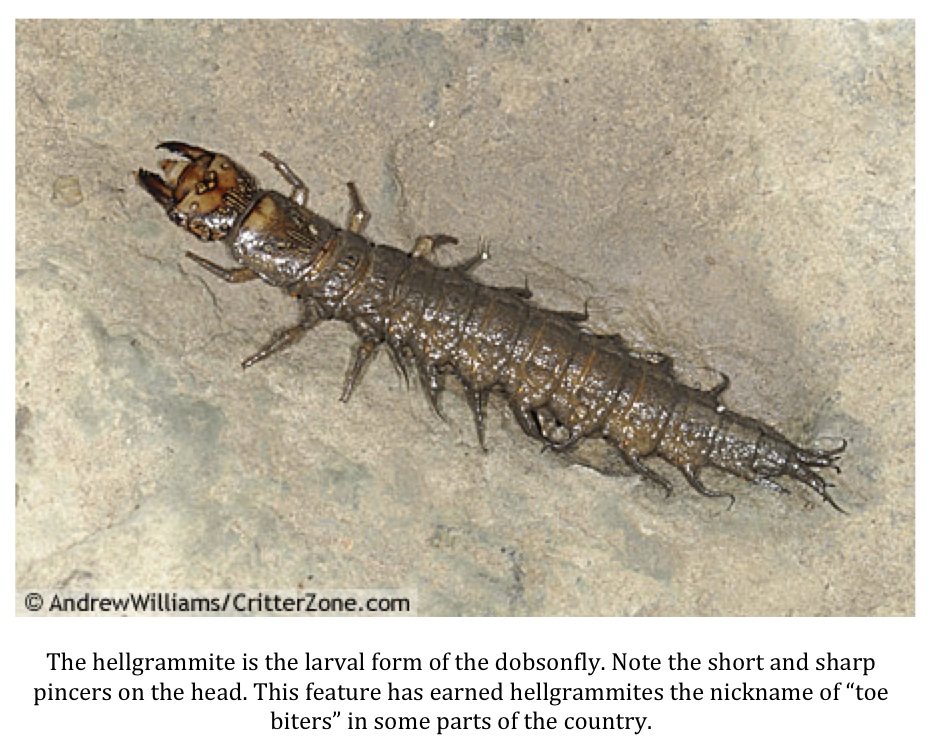
If you’ve never heard of a dobsonfly you aren’t alone. You may be more familiar with what they are called during their larval stage: hellgrammites. Hellgrammites live in rivers, lakes, and creeks. They prefer to linger under rocks and feed on the larvae of other insects. Both males and females possess short and sharp pincers at this stage. Hellgrammites typically reach lengths of two to three inches and remain in this stage of development for 2-3 years before crawling up onto shore to pupate. Typically, the hellgrammite will remain in its cocoon over the winter months and emerge as a fully formed dobsonfly in the spring.
Adult dobsonflies don’t usually venture far from the body of water from whence they emerged. The species is mainly nocturnal and is attracted to bright lights (The reader mentions the insect was positioned under a security light. I would be curious to know if there was a creek or stream in the immediate vicinity as well). Once out of its cocoon, the dobsonfly has only seven days to mate and deposit its eggs near a water source before dying. The fact that they spend most of their lives under water in the larval stage as hellgrammites, don’t venture too far from water sources (which often feature heavily wooded shorelines), and live only seven days once they reach adulthood prevent them from being well-known to most people.

I can’t say for sure the reader who emailed in saw a dobsonfly. I sent a reply email to the reader with a photo of this insect attached but have not yet heard anything back. I do feel the dobsonfly is a good candidate for what this reader witnessed in the Hill Country.
While I am familiar with hellgrammites, I have never seen an adult dobsonfly. After looking into the matter a bit, I can see why running into one would be a bit startling. They are truly intimidating, prehistoric-looking creatures. I was stunned to know insects of this size and appearance make Texas their home.
It is good to know there are still surprises out there in the Lone Star State... even for an old dog like me.
Tuesday, January 15, 2013
Eugene Wilson on Curiosity and the Resolute
"Only the curious will learn and only the resolute overcome the obstacles of learning."
- Eugene S. Wilson
- Eugene S. Wilson
Friday, January 11, 2013
Texas Bigfoot Conference Dates Announced
The TBRC has issued the following press release announcing the dates for their annual conference. Check it out.

Texas Bigfoot Research Conservancy
A 501(c)(3) non-profit organization
PO Box 866621, Plano, TX 75086-6621
www.texasbigfoot.com
Media Contacts: Brian Brown, 612-819-3515, bipto67@gmail.com; or Alton Higgins, 405-625-2158, ahiggins@macu.edu; or Ken Stewart, 214-316-7288, stewartflyer@yahoo.com.
2013 Texas Bigfoot Conference
For Immediate Release January 12, 2013
The Texas Bigfoot Research Conservancy (TBRC) is pleased to announce that the annual Texas Bigfoot Conference will be held at the Fort Worth Convention Center, 1201 Houston Street, Fort Worth, Texas, Saturday, March 16, 2013, from 8:00 AM to 6:00 PM (CDT).
March 16, 2013. This is the 12th year for the conference, previously held in Jefferson and Tyler. The Texas Bigfoot Research Conservancy, a nonprofit 501(c)(3) scientific research organization, sponsors the event.
The conference will feature the Host and Co-Executive Producer of SyFy's Destination Truth, Josh Gates, as well as Dr. Jeff Meldrum, Associate Professor of Anatomy and Anthropology for Idaho State University, and author of “Sasquatch: Legend Meets Science.”
Other speakers include Bill Munns, Veteran Hollywood FX artist and author of "The Munns Report," a detailed analysis of the Patterson-Gimlin Film; Kathy Strain, Anthropologist and author of "Giants, Cannibals & Monsters: Bigfoot in Native Culture"; and Brian Brown, producer of The Bigfoot Information Project Podcast and The Bigfoot Show podcast, and member of the Texas Bigfoot Research Conservancy's Board of Directors. In addition, the TBRC will present a recap of last year's seminal observational and quantitative field study, Operation Persistence.
General admission is $35, with various upgrade packages available. Discounts are available for students, educators and active military with proper ID.
The TBRC is comprised of volunteer investigators, scientists and naturalists, actively engaged in activities designed to test the hypothesis that a very rare form of unknown primate—commonly referred to as the wood ape, bigfoot, or the sasquatch—resides in very remote areas where there is abundant rainfall, dense forestation, and low human population densities. Even Henry Gee—senior editor for Nature magazine—concedes the plausibility of the wood ape’s existence given the incredible rate at which large secretive mammalian species continue to be documented even into the twenty-first century (http://is.gd/g36zW).
The TBRC is funded by membership dues, fundraisers, and the annual Texas Bigfoot Conference, in addition to donations and grants. The TBRC desires to enhance the credibility of wood ape research and facilitate a greater degree of acceptance by the scientific community and other segments of society of the likelihood of a biological basis behind the wood ape mystery.
For more information on the Texas Bigfoot Research Conservancy go to www.texasbigfoot.com.
Tickets for the event can be purchased online here.
I plan on attending and hope to see you there.

Texas Bigfoot Research Conservancy
A 501(c)(3) non-profit organization
PO Box 866621, Plano, TX 75086-6621
www.texasbigfoot.com
Media Contacts: Brian Brown, 612-819-3515, bipto67@gmail.com; or Alton Higgins, 405-625-2158, ahiggins@macu.edu; or Ken Stewart, 214-316-7288, stewartflyer@yahoo.com.
2013 Texas Bigfoot Conference
For Immediate Release January 12, 2013
The Texas Bigfoot Research Conservancy (TBRC) is pleased to announce that the annual Texas Bigfoot Conference will be held at the Fort Worth Convention Center, 1201 Houston Street, Fort Worth, Texas, Saturday, March 16, 2013, from 8:00 AM to 6:00 PM (CDT).
March 16, 2013. This is the 12th year for the conference, previously held in Jefferson and Tyler. The Texas Bigfoot Research Conservancy, a nonprofit 501(c)(3) scientific research organization, sponsors the event.
The conference will feature the Host and Co-Executive Producer of SyFy's Destination Truth, Josh Gates, as well as Dr. Jeff Meldrum, Associate Professor of Anatomy and Anthropology for Idaho State University, and author of “Sasquatch: Legend Meets Science.”
Other speakers include Bill Munns, Veteran Hollywood FX artist and author of "The Munns Report," a detailed analysis of the Patterson-Gimlin Film; Kathy Strain, Anthropologist and author of "Giants, Cannibals & Monsters: Bigfoot in Native Culture"; and Brian Brown, producer of The Bigfoot Information Project Podcast and The Bigfoot Show podcast, and member of the Texas Bigfoot Research Conservancy's Board of Directors. In addition, the TBRC will present a recap of last year's seminal observational and quantitative field study, Operation Persistence.
General admission is $35, with various upgrade packages available. Discounts are available for students, educators and active military with proper ID.
The TBRC is comprised of volunteer investigators, scientists and naturalists, actively engaged in activities designed to test the hypothesis that a very rare form of unknown primate—commonly referred to as the wood ape, bigfoot, or the sasquatch—resides in very remote areas where there is abundant rainfall, dense forestation, and low human population densities. Even Henry Gee—senior editor for Nature magazine—concedes the plausibility of the wood ape’s existence given the incredible rate at which large secretive mammalian species continue to be documented even into the twenty-first century (http://is.gd/g36zW).
The TBRC is funded by membership dues, fundraisers, and the annual Texas Bigfoot Conference, in addition to donations and grants. The TBRC desires to enhance the credibility of wood ape research and facilitate a greater degree of acceptance by the scientific community and other segments of society of the likelihood of a biological basis behind the wood ape mystery.
For more information on the Texas Bigfoot Research Conservancy go to www.texasbigfoot.com.
Tickets for the event can be purchased online here.
I plan on attending and hope to see you there.
Thursday, December 27, 2012
The "Leaping Yeti" Video: A Closer Look
As posted here a week or so ago, there is an interesting video clip making the rounds on the internet that seems to have captured the imagination of not just cryptozoology enthusiasts but the public at large. The video, allegedly shot somewhere in the Ural Mountains of Russia, shows what appears to be a large hair-covered creature bounding through the woods away from the camera bearing witnesses. Many have been quick to dismiss the video outright; as much for the fact that it was first posted to YouTube as because of anything related to its content. I actually find the video more intriguing than any other clip or photo I’ve seen in quite some time. I think it is worth taking a closer look.
I find the “leaping yeti” video, as it has been dubbed, intriguing for many of the very reasons some people are attacking it. The subject is moving and bounding in an odd manner. Why would a yeti or sasquatch be bouncing around like that? I’ll be the first to say that I have no idea. It could have something to do with the terrain it was negotiating though that is speculation. If so, it could be that the creature decided this mode of locomotion was the quickest way to escape. What I do know is that I’ve seen video of young chimps and gorillas at play that bounded and jumped about in very similar ways. In addition, this odd leaping behavior has been observed by alleged sasquatch witnesses before. A very good friend of mine, and fellow TBRC member, had a sighting near the Trinity River in southeast Texas back in May of 2004. The report can be read here. Following is a snippet from his account describing a leaping wood ape:
“It leapt across the trail much like a long jumper, landed on the right side of the trail and leapt again into the woods…”
My friend has been asked many times why he thought the creature he saw would jump in such a manner rather than just run. His answer has varied little over the years. He simply says that he has no idea and only knows that is what he saw.

Another thing that I see in the video that makes me want to give it a second look is the presence of what appears to be a gluteal cleft. To put in laymen’s terms, and more crudely, there seems to be a butt crack present. Costumes, especially the cheaper ones which normal folks might be able to rent or buy, do not feature gluteal clefts. Even high-end suits used in big budget movies do not correctly portray this anatomical feature. Take, for example, 2001: A Space Odyssey. The creatures shown look like they are wearing furry pants when seen from the rear. This movie featured state of the art special effects and they got it wrong. 2001: A Space Odyssey was released in 1968. What about more recent films featuring ape costumes? Did any of them get it right? King Kong (1976)? Nope. Greystoke: The Legend of Tarzan (1984)? Nope. I’ve yet to see a movie or television show featuring a man in a suit that incorporated this feature. Recent high-end movies, like the 2005 remake of King Kong and Rise of the Planet of the Apes, have shown at least a hint of a gluteal cleft on their apes. The key here is that these special effects are generated completely through computer animation using real apes as their models. There is no costume involved. I do not believe a truly convincing ape suit, featuring a gluteal cleft, exists; at least not one that is available and that would be affordable to the general public.
Another thing about the subject in the video is the length and width of the arms. They clearly appear in the best still frame to be proportionately much longer and more muscular than the arms of a human in a costume would be. In addition, the arms appear to be at least as long, and longer to my eye, than the legs of the subject. This is a very ape-like characteristic. Many descriptions of the Asian yeti seem to point to it being more ape-like in appearance than the North American sasquatch. This video could be evidence of that.

The coloration of the subject in the video also caused me to raise my eyebrows a bit. The Asian yeti is almost always described as being reddish-colored, almost orangutan-like. The subject in this video is colored very much like a silverback gorilla. In addition, the hair/fur, assuming it is hair/fur, appears to be somewhat short, as you would see on a gorilla, and not long and shaggy as has often been reported by people claiming to have seen a yeti. Granted, the distance and lack of definition in the video could be playing into what I am seeing when it comes to the length of the hair/fur but there is no arguing the coloration. A hoaxer would likely, in my opinion, give the public what it expects to see. In the case of a yeti that would be a reddish-colored suit.
The thing that gives me the greatest pause in regard to the possible legitimacy of the video is the conversation and tone of the two witnesses. Below is the video, this time, complete with subtitles. The narrator has more or less put his two cents in on the video but try to look past the spin he's putting on the whole thing and make up your own mind based on the translation provided. I mentioned in a previous post that I have a friend who was a Russian linguist/translator in the Air Force. He has verified that the translated subtitles provided are pretty much spot on.
The fact that the pair is already discussing posting the video on YouTube turns some folks off and has led many to assume this is a hoax. Why aren’t they more rattled by what they are seeing? Why aren’t they more agitated? I do not have answers to these questions. It is possible cultural differences play into the seeming lack of agitation expressed by the witnesses. I admit the reference to YouTube bothers me. I do think it is important to remember, though, that this is a different world than the one in which many of us grew up. YouTube is a daily part of younger people’s lives worldwide. Maybe it is only natural that this is the first thought the pair had. What else would someone, who is not concerned with scientific documentation, do with what they think is just a cool video?
Obviously, I can’t say for sure whether the video is genuine or not. It very well could be a hoax. I can only say that there are some things in this video that warrant a closer look. It is definitely a step beyond the typical YouTube fodder out there. In the end, I’m afraid this video sums up the problem with all photographic evidence. It isn’t good enough to be definitive. I truly don’t feel any video or photograph ever will be enough to document something as controversial as the sasquatch or yeti. You can bet even video of a higher quality would be dissected seven ways to Sunday and, given the technology available to the general public in the form of Photoshop and other programs, declared a hoax. That being the case, as unpalatable as it is to many people, I believe only a type specimen will definitively prove the existence of these creatures.
I would like to be wrong about that but I don’t think that I am.
I find the “leaping yeti” video, as it has been dubbed, intriguing for many of the very reasons some people are attacking it. The subject is moving and bounding in an odd manner. Why would a yeti or sasquatch be bouncing around like that? I’ll be the first to say that I have no idea. It could have something to do with the terrain it was negotiating though that is speculation. If so, it could be that the creature decided this mode of locomotion was the quickest way to escape. What I do know is that I’ve seen video of young chimps and gorillas at play that bounded and jumped about in very similar ways. In addition, this odd leaping behavior has been observed by alleged sasquatch witnesses before. A very good friend of mine, and fellow TBRC member, had a sighting near the Trinity River in southeast Texas back in May of 2004. The report can be read here. Following is a snippet from his account describing a leaping wood ape:
“It leapt across the trail much like a long jumper, landed on the right side of the trail and leapt again into the woods…”
My friend has been asked many times why he thought the creature he saw would jump in such a manner rather than just run. His answer has varied little over the years. He simply says that he has no idea and only knows that is what he saw.

Another thing that I see in the video that makes me want to give it a second look is the presence of what appears to be a gluteal cleft. To put in laymen’s terms, and more crudely, there seems to be a butt crack present. Costumes, especially the cheaper ones which normal folks might be able to rent or buy, do not feature gluteal clefts. Even high-end suits used in big budget movies do not correctly portray this anatomical feature. Take, for example, 2001: A Space Odyssey. The creatures shown look like they are wearing furry pants when seen from the rear. This movie featured state of the art special effects and they got it wrong. 2001: A Space Odyssey was released in 1968. What about more recent films featuring ape costumes? Did any of them get it right? King Kong (1976)? Nope. Greystoke: The Legend of Tarzan (1984)? Nope. I’ve yet to see a movie or television show featuring a man in a suit that incorporated this feature. Recent high-end movies, like the 2005 remake of King Kong and Rise of the Planet of the Apes, have shown at least a hint of a gluteal cleft on their apes. The key here is that these special effects are generated completely through computer animation using real apes as their models. There is no costume involved. I do not believe a truly convincing ape suit, featuring a gluteal cleft, exists; at least not one that is available and that would be affordable to the general public.
Another thing about the subject in the video is the length and width of the arms. They clearly appear in the best still frame to be proportionately much longer and more muscular than the arms of a human in a costume would be. In addition, the arms appear to be at least as long, and longer to my eye, than the legs of the subject. This is a very ape-like characteristic. Many descriptions of the Asian yeti seem to point to it being more ape-like in appearance than the North American sasquatch. This video could be evidence of that.

The coloration of the subject in the video also caused me to raise my eyebrows a bit. The Asian yeti is almost always described as being reddish-colored, almost orangutan-like. The subject in this video is colored very much like a silverback gorilla. In addition, the hair/fur, assuming it is hair/fur, appears to be somewhat short, as you would see on a gorilla, and not long and shaggy as has often been reported by people claiming to have seen a yeti. Granted, the distance and lack of definition in the video could be playing into what I am seeing when it comes to the length of the hair/fur but there is no arguing the coloration. A hoaxer would likely, in my opinion, give the public what it expects to see. In the case of a yeti that would be a reddish-colored suit.
The thing that gives me the greatest pause in regard to the possible legitimacy of the video is the conversation and tone of the two witnesses. Below is the video, this time, complete with subtitles. The narrator has more or less put his two cents in on the video but try to look past the spin he's putting on the whole thing and make up your own mind based on the translation provided. I mentioned in a previous post that I have a friend who was a Russian linguist/translator in the Air Force. He has verified that the translated subtitles provided are pretty much spot on.
The fact that the pair is already discussing posting the video on YouTube turns some folks off and has led many to assume this is a hoax. Why aren’t they more rattled by what they are seeing? Why aren’t they more agitated? I do not have answers to these questions. It is possible cultural differences play into the seeming lack of agitation expressed by the witnesses. I admit the reference to YouTube bothers me. I do think it is important to remember, though, that this is a different world than the one in which many of us grew up. YouTube is a daily part of younger people’s lives worldwide. Maybe it is only natural that this is the first thought the pair had. What else would someone, who is not concerned with scientific documentation, do with what they think is just a cool video?
Obviously, I can’t say for sure whether the video is genuine or not. It very well could be a hoax. I can only say that there are some things in this video that warrant a closer look. It is definitely a step beyond the typical YouTube fodder out there. In the end, I’m afraid this video sums up the problem with all photographic evidence. It isn’t good enough to be definitive. I truly don’t feel any video or photograph ever will be enough to document something as controversial as the sasquatch or yeti. You can bet even video of a higher quality would be dissected seven ways to Sunday and, given the technology available to the general public in the form of Photoshop and other programs, declared a hoax. That being the case, as unpalatable as it is to many people, I believe only a type specimen will definitively prove the existence of these creatures.
I would like to be wrong about that but I don’t think that I am.
Subscribe to:
Posts (Atom)


 Posts
Posts

